
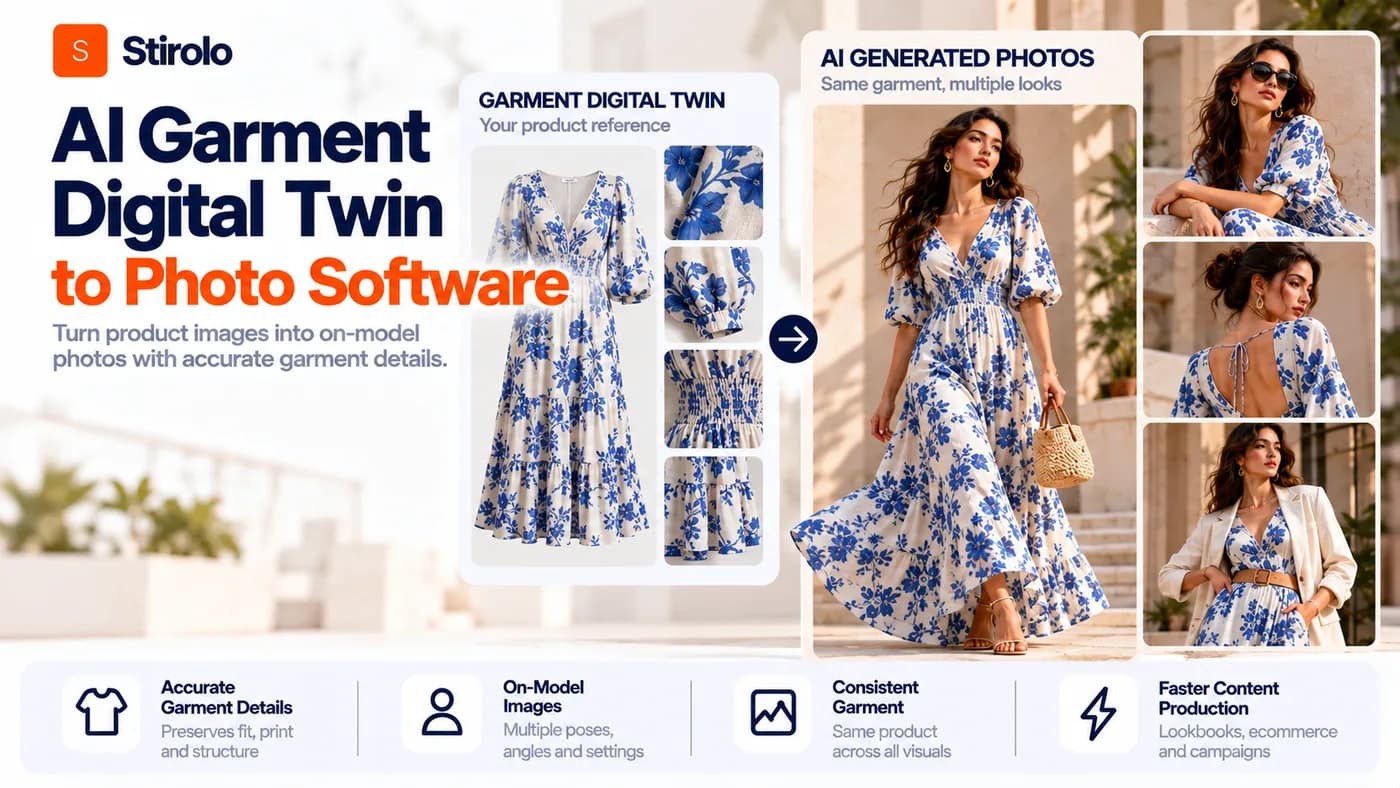
AI garment digital twin to photo software converts clothing images into reusable digital representations that can support ecommerce imagery, virtual try-on, digital wardrobes, styling, product development, or 3D visualization. The important distinction is that a photorealistic copy of a garment is not automatically a production-grade digital twin.
A useful digital twin must preserve the information required for its intended job. A fashion retailer may need accurate color, silhouette, graphics, and product details. A technical team may also need pattern geometry, measurements, fabric properties, grading, construction information, and validated fit. The same source photo can therefore produce assets with very different levels of reliability.
What Is AI Garment Digital Twin to Photo Software?
AI garment digital twin to photo software analyzes one or more clothing images and creates a digital asset that represents the garment. Depending on the platform, that asset may be a cleaned product cutout, an on-model image, a structured wardrobe item, a 3D reconstruction, a virtual try-on input, or a technical starting point for product development.
The phrase “digital twin” is used broadly in fashion technology. Production-focused 3D systems use it for a garment model tied to pattern, material, fit, and technical data. Image-generation tools may use similar language for a visually faithful replica that can be placed on different models or backgrounds. Both can be useful, but they should not be treated as interchangeable.
That difference changes how you evaluate software. If the goal is a product page, visual fidelity may be the priority. If the goal is factory communication, a plausible image is not enough.
Is Every AI Garment Replica a True Digital Twin?
No. A generated garment image can look identical at first glance while lacking the hidden information needed to behave like the physical product.
A visual replica mainly represents what the camera can see: color, visible shape, print, surface texture, closures, and styling details. A production-grade digital garment can additionally represent pattern pieces, seam relationships, fabric properties, measurements, grading, and simulated drape. Browzwear, for example, describes its digital twins as true-to-life 3D garments built with accurate fabrics, trims, fit, and production information. Academic work on clothing reconstruction also treats a clothing twin as a 3D reconstruction problem rather than a single generated photograph.
The safest rule is simple: judge the twin by the data it preserves, not by how impressive the render looks.
How Does AI Turn a Garment Photo Into a Digital Asset?
To turn a garment photo into a digital asset, the software first identifies the clothing item, separates it from the background or mannequin, and estimates visible garment structure. Generative or reconstruction models can then create new views, place the item on a person, infer missing regions, or map the garment into a 3D or structured representation.
Image extraction isolates the product
The first stage usually removes visual noise. A clean front-facing photo gives the system clearer evidence about silhouette, neckline, sleeve shape, hem, print placement, and visible construction. Mannequin removal can also create a cleaner garment reference for later generation.
AI infers what the camera cannot see
A single image does not show the back, inside construction, exact measurements, fabric weight, or hidden seams. Software must either leave those details unknown, request more inputs, or infer them. That is where a convincing result can become inaccurate.
The asset is adapted to the final task
The same garment reference can feed different outputs. One workflow may generate consistent model photography. Another may create a wardrobe item for outfit planning. A 3D apparel workflow may rebuild the garment around patterns and fabric data so teams can inspect fit and drape.
What Can AI Reliably Learn From One Garment Photo?
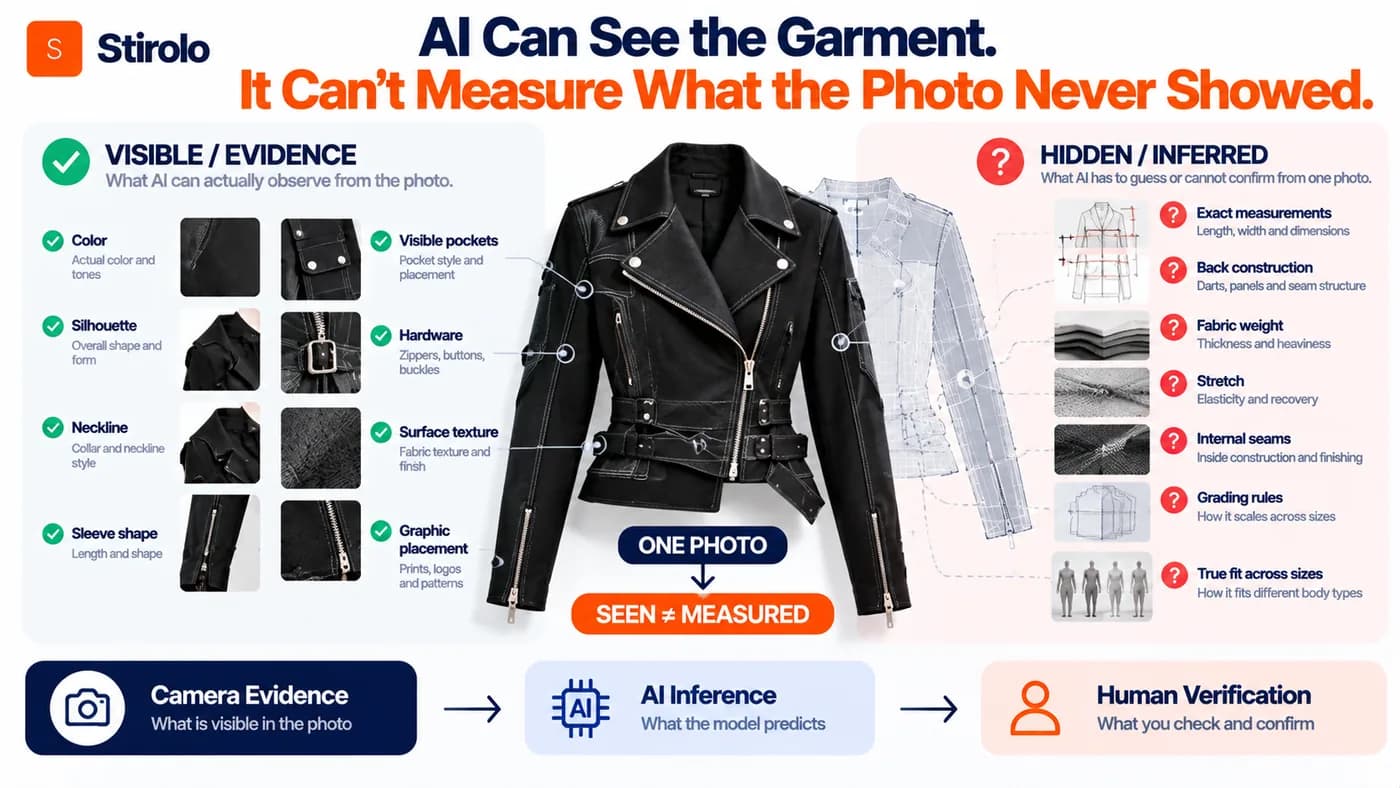
AI can usually extract visible attributes more confidently than hidden technical properties. The clearer and more standardized the source image, the less the system needs to invent.
Useful visible information can include garment category, dominant color, approximate silhouette, neckline, sleeve type, visible pockets, buttons, graphics, surface texture, and some styling attributes. Those signals are valuable for catalog organization, search, wardrobe digitization, styling, and image generation.
One photograph cannot prove exact garment measurements, fabric composition, stretch, weight, internal construction, grading rules, or true fit across body sizes. Even front-to-back geometry can be uncertain when the back is never shown. Software that generates those fields from a single image is making an inference unless additional verified data is supplied.
This is why editable outputs matter. A useful system should let a human correct uncertain details instead of presenting every inferred field as measured fact.
How Accurate Does a Garment Digital Twin Need to Be?
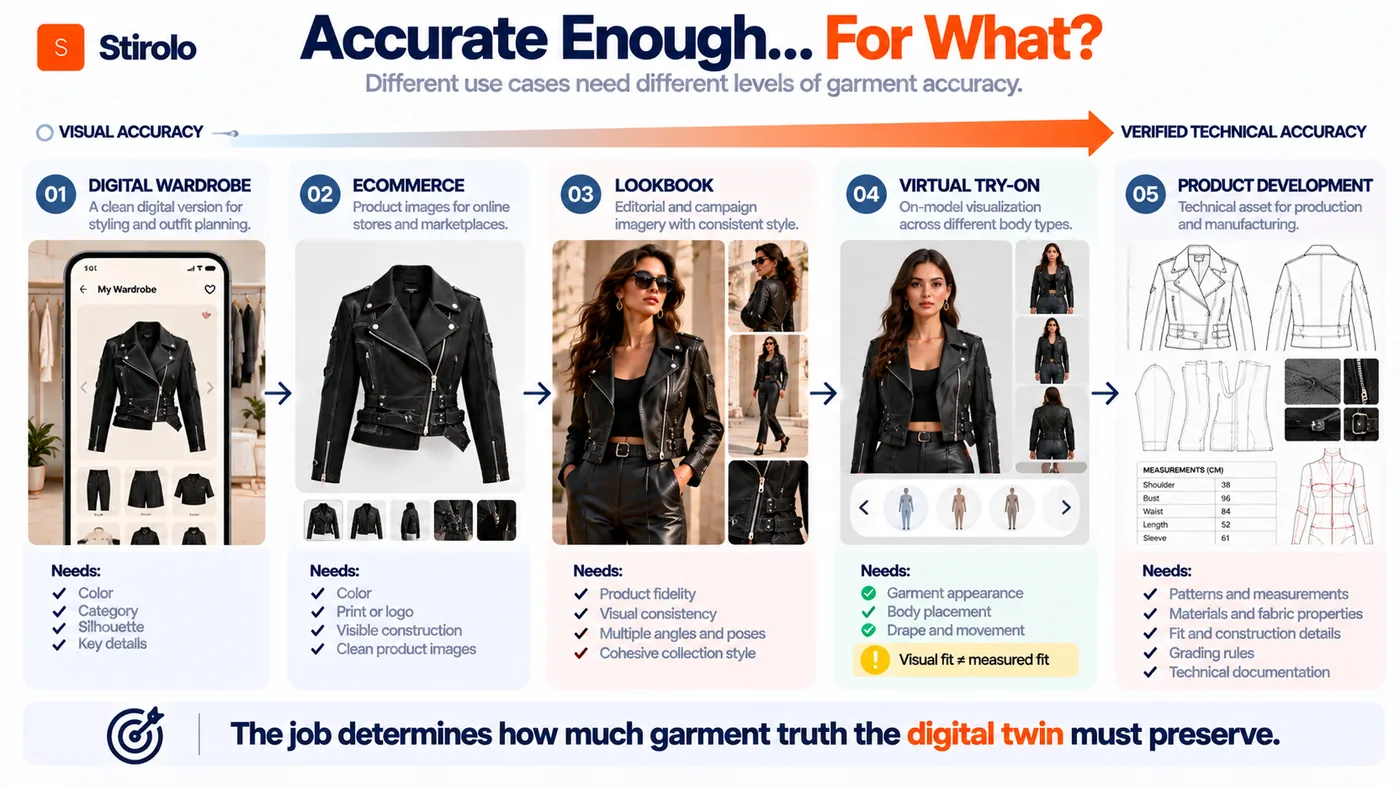
The required accuracy depends on what you plan to do with the asset. A digital twin does not need factory-level information to be useful for every fashion workflow.
| Use case | What must stay accurate | What may remain approximate |
|---|---|---|
| Ecommerce imagery | Color, logo, print, silhouette, visible construction | Hidden structure and exact physics |
| Digital wardrobe | Category, color, shape, key details | Production measurements |
| Virtual try-on | Garment appearance plus body placement | Exact fit unless validated by sizing data |
| Lookbook generation | Product fidelity and visual consistency | Factory construction data |
| Product development | Patterns, measurements, materials, fit, construction | Very little can be guessed |
For customer-facing images, the strongest test is whether the digital output could misrepresent the item being sold. For production, the threshold is much higher because errors can affect samples, costing, construction, and fit.
How Can Brands Use Photo-Based Garment Digital Twins?
Photo-based garment assets are most useful when brands need to reuse the same product identity across multiple digital experiences without photographing every combination from scratch.
A retailer can start with a clean garment image and generate on-model product shots, campaign variations, backgrounds, or collection imagery. The value comes from preserving the product while changing the presentation. A system that quietly changes buttons, seams, graphics, or proportions defeats that purpose.
The same digitized garment can support wardrobe and styling experiences. Stirolo shows how a clothing item can become part of a broader digital wardrobe rather than remaining an isolated product photo. Its wardrobe and styling features connect clothing data with outfit recommendations and wardrobe organization, which is a different objective from factory-grade garment simulation.
Brands can also use digital assets for internal assortment reviews, early merchandising, wholesale presentations, and pre-sample visualization. The closer a workflow moves toward manufacturing decisions, however, the more important verified patterns, measurements, materials, and construction data become.
How Is a Digital Twin Different From Virtual Try-On?
A garment digital twin represents the clothing item. Virtual try-on combines a garment representation with a person, avatar, or body image to visualize the clothing in context.
The distinction matters because a realistic try-on image does not necessarily prove accurate fit. Generative systems can create plausible body placement from a garment image and a user photo, while physics-based 3D workflows may use garment geometry and body measurements to simulate fit more explicitly. The output can look similar even though the underlying evidence is different.
For personal styling, the objective may simply be to understand whether an outfit combination looks coherent. Readers who want to see how wardrobe context, preferences, and styling decisions can work together can explore how Stirolo works. That use case does not require the digital garment to double as a manufacturing file.
What Should You Check Before Choosing Garment Digital Twin Software?
Choose software by matching its evidence and controls to your intended use, not by selecting the tool with the most photorealistic demo.
Start with garment fidelity. Test a difficult item with a logo, patterned fabric, unusual neckline, pockets, hardware, or asymmetric construction. Compare the source against every generated view. Look for invented seams, moved graphics, missing closures, changed hem lengths, altered sleeve shapes, or color drift.
Then test consistency. Generate several outputs from the same garment. A useful system should preserve the item across models, poses, backgrounds, and batches. For a lookbook or ecommerce catalog, consistency matters almost as much as individual image quality.
Check what the system stores. Does it create only images, or does the asset contain editable attributes, 3D geometry, measurements, materials, patterns, or technical fields? Ask which values come from your input and which values are inferred by AI.
Finally, review export formats, commercial usage terms, data handling, human-editing controls, API or catalog integrations, batch processing, and the cost of regenerating failed assets. A fast generator can become slow in practice if every SKU needs repeated manual correction.
How to Create a Useful Garment Digital Twin From Photos
To create a useful garment digital twin from photos, define the final use first, capture the garment with enough visual evidence, generate the asset, and validate every detail that matters to that use.
1. Define the accuracy target
Decide whether you need ecommerce imagery, a wardrobe item, virtual try-on, a 3D sample, or production information. This prevents you from expecting technical certainty from a workflow designed for visual content.
2. Capture clean source images
Use even lighting, a neutral background, high resolution, and an unobstructed garment. Add front, back, side, close-up, and detail images when the software accepts them. Multiple views reduce the amount of missing information the model must infer.
3. Add verified product data
Supply known color names, material composition, measurements, size, product identifiers, and construction notes when the platform supports structured fields. Verified data should override guesses.
4. Generate and compare
Create several outputs, then compare them against the physical garment or approved product photography. Inspect high-risk details at full size rather than approving the image from a thumbnail.
5. Correct the asset before reuse
Fix errors once at the source-asset level when possible. A corrected reusable asset is more valuable than retouching the same mistake across every generated image.
6. Test the downstream workflow
Place the garment into the real environment where it will be used. That may mean a product page, lookbook, try-on experience, styling tool, or 3D review. A technically impressive asset has little value if it fails in the final workflow.
What Are the Limits of Photo-to-Digital Garment AI?
Photo-to-digital garment AI is limited by missing evidence. A camera records appearance from a viewpoint; it does not automatically capture every physical and construction property of the garment.
Occlusion is a major problem. Folded fabric can hide seams. Hair or accessories can cover necklines. A mannequin can distort shape. A flat lay may show construction clearly but reveal little about drape. Dark fabrics can hide surface details, while reflective materials can confuse color and texture estimation.
Fabric behavior is another limit. Two black dresses can look similar in a still image while using materials with very different stretch, weight, stiffness, and movement. Production-focused 3D systems therefore rely on material data and simulation rather than appearance alone.
AI inference can still be valuable. It can create a strong first draft, reduce repetitive extraction work, or generate useful visual content. The risk begins when inferred information is treated as measured information without review.
FAQs About AI Garment Digital Twin Software
Can AI create a garment digital twin from one photo?
Yes, for some visual use cases. AI can create a reusable visual garment asset from one clear photo, but hidden construction, exact measurements, back details, fabric physics, and production data may need more images or verified inputs.
Can a garment photo be turned into a 3D model?
Yes. Reconstruction tools can estimate 3D clothing from images, but accuracy varies. A production-ready 3D garment usually needs stronger geometry, pattern, material, and fit information than a visual reconstruction.
Can AI turn mannequin photos into model photos?
Yes. Photo-based fashion AI can remove a mannequin and generate on-model imagery. Check the output carefully for changed seams, graphics, closures, proportions, and fabric details before using it on a product page.
Is a digital garment twin the same as a digital wardrobe item?
No. A digital wardrobe item can be a structured visual record used for outfit planning and styling. A production-grade garment twin can contain technical geometry, material, construction, and fit data required for apparel development.
Can digital twins help with personal styling?
Yes. Digitized clothing makes it easier for styling software to reason about what you already own, combine garments, and plan outfits. For more consumer-focused wardrobe ideas, Stirolo also provides practical style guidance for applying digital styling concepts to everyday clothing decisions.
Build the Digital Asset Around the Real Garment
The best AI garment digital twin is not the one that produces the most dramatic image. It is the one that preserves the garment information required for the next decision. For ecommerce, that means customers should see the product they can actually buy. For a digital wardrobe, the asset should retain enough identity for useful styling. For virtual try-on, the garment and body representation must be appropriate to the claim being made. For manufacturing, patterns, measurements, materials, construction, and fit need verified technical accuracy.
Photo-based AI makes garment digitization much more accessible, especially for brands that already have product images but lack 3D assets. Use it as a way to reduce repetitive work and create reusable digital clothing records, while keeping a clear boundary between what the camera showed, what the software inferred, and what a human has verified. That boundary is what turns an impressive AI image into a dependable fashion workflow.