
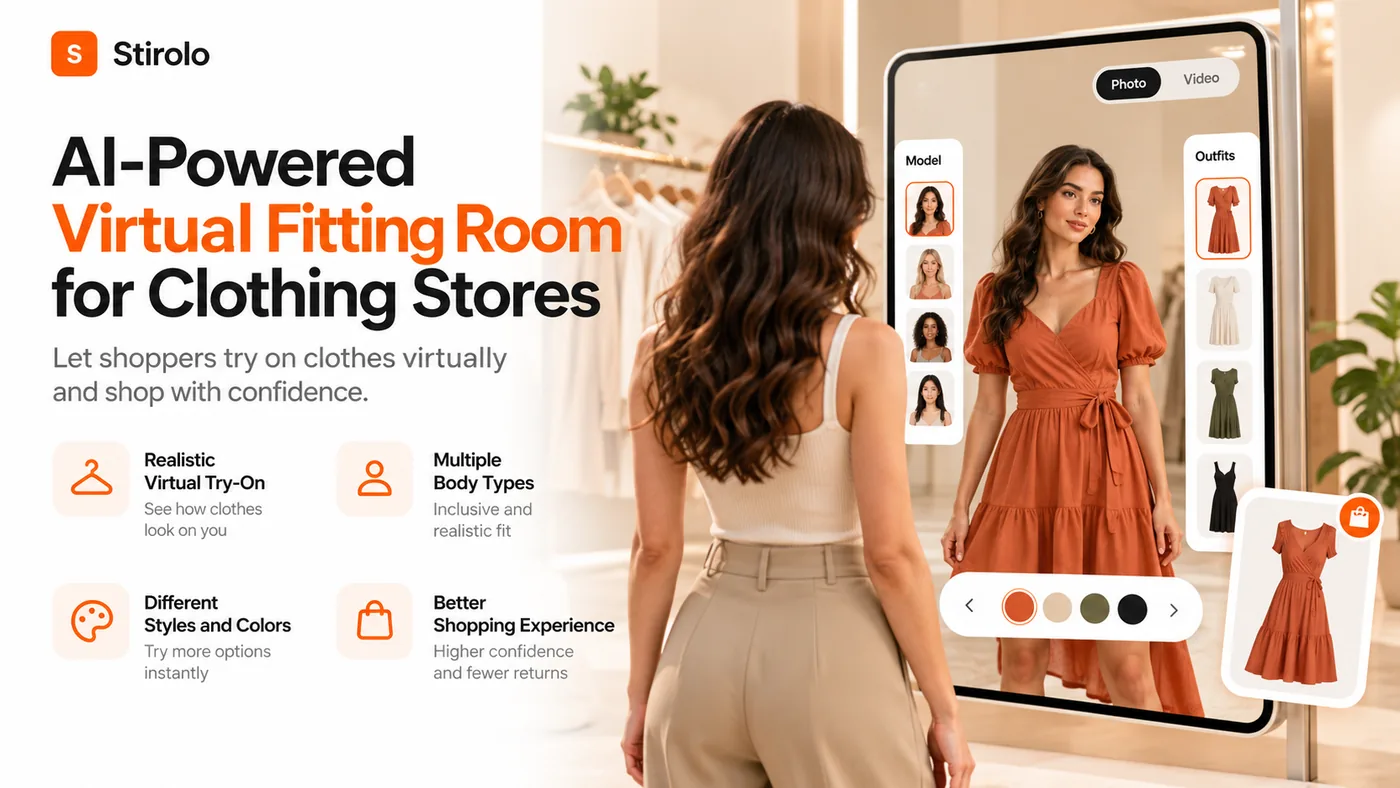
An AI-powered virtual fitting room for clothing stores lets shoppers visualize garments on themselves or a representative body before purchase. The useful version reduces uncertainty about appearance, while clearly separating visual try-on from claims about exact size, pressure, comfort, or physical fit.
For a retailer, that distinction matters. A realistic image can answer “Do I like this shape, color, or proportion on me?” It cannot automatically answer “Will size M feel comfortable across my shoulders?” Some platforms combine visualization with body measurements or size recommendation, but those are separate capabilities that require separate data and validation.
What Is an AI-Powered Virtual Fitting Room for Clothing Stores?
An AI-powered virtual fitting room is a digital shopping feature that creates a visual preview of clothing on a shopper, avatar, or selected model. It may use generative AI, computer vision, augmented reality, 3D graphics, body measurements, or a combination of these technologies.
The term covers several experiences. A photo-based system may ask the shopper to upload a full-body image and then generate a new image with the selected garment. A live virtual mirror may use a camera feed and augmented reality. An avatar system may create a body representation from measurements or photos. Another system may let shoppers choose from diverse preset models instead of sharing their own image.
These experiences should not be confused with merchant-side AI fashion model generation. A merchant tool creates catalog assets for the store to publish. A shopper-facing fitting room is interactive and changes according to the person or model selected during the shopping session.
That interactive layer can also connect with broader AI wardrobe features, where clothing data supports outfit planning and styling rather than a single product visualization. The underlying idea is similar: clothing becomes structured enough for software to reason about how pieces relate to a person and to one another.
How Does an AI Virtual Fitting Room Work?
To create a virtual try-on, the system combines information about the person with information about the garment, then renders a new visual result. The exact pipeline depends on whether the product uses generative AI, augmented reality, 3D simulation, or a hybrid approach.
The shopper provides a usable body image or profile
A photo-based tool usually works best with a clear image where the body is visible and the pose is not heavily obstructed. Some systems use one photo. Others request front and side views, height, measurements, sex, or a clothing size. Preset-model systems avoid personal photo capture by letting the shopper choose a model with relevant proportions.
Every extra input can improve the information available to the system, but it also creates friction. A store should ask only for data that materially improves the result. Requiring an account, multiple photos, measurements, and a long questionnaire before the first preview can turn a helpful feature into another checkout barrier.
The system identifies the garment and shopper
The software analyzes the source garment image, the shopper image, or both. It may identify body regions, pose, garment category, edges, visible construction, color, texture, and occlusion. The system then determines which pixels or 3D regions must change while trying to preserve the shopper’s identity and the product’s recognizable details.
Input quality matters. A clean product image gives the model more reliable evidence about the garment. Hidden details remain a problem. If a jacket is photographed only from the front, software does not suddenly know the exact back construction unless other product data supplies it.
AI generates or overlays the try-on result
Generative systems synthesize a new image that places the garment on the body while reconstructing folds, shadows, overlaps, and pose-dependent details. Augmented reality systems may place or track a digital representation over a live view. More technical 3D systems can use avatars and simulated garments, which require richer body and product data.
Google has publicly described generative virtual try-on that models clothing characteristics such as drape, folds, cling, stretch, wrinkles, and shadows across different real models. That illustrates the visual ambition of current systems, but a rendered appearance should still be treated as a visualization rather than a physical fitting certificate.
Does Virtual Try-On Show the Real Physical Fit?
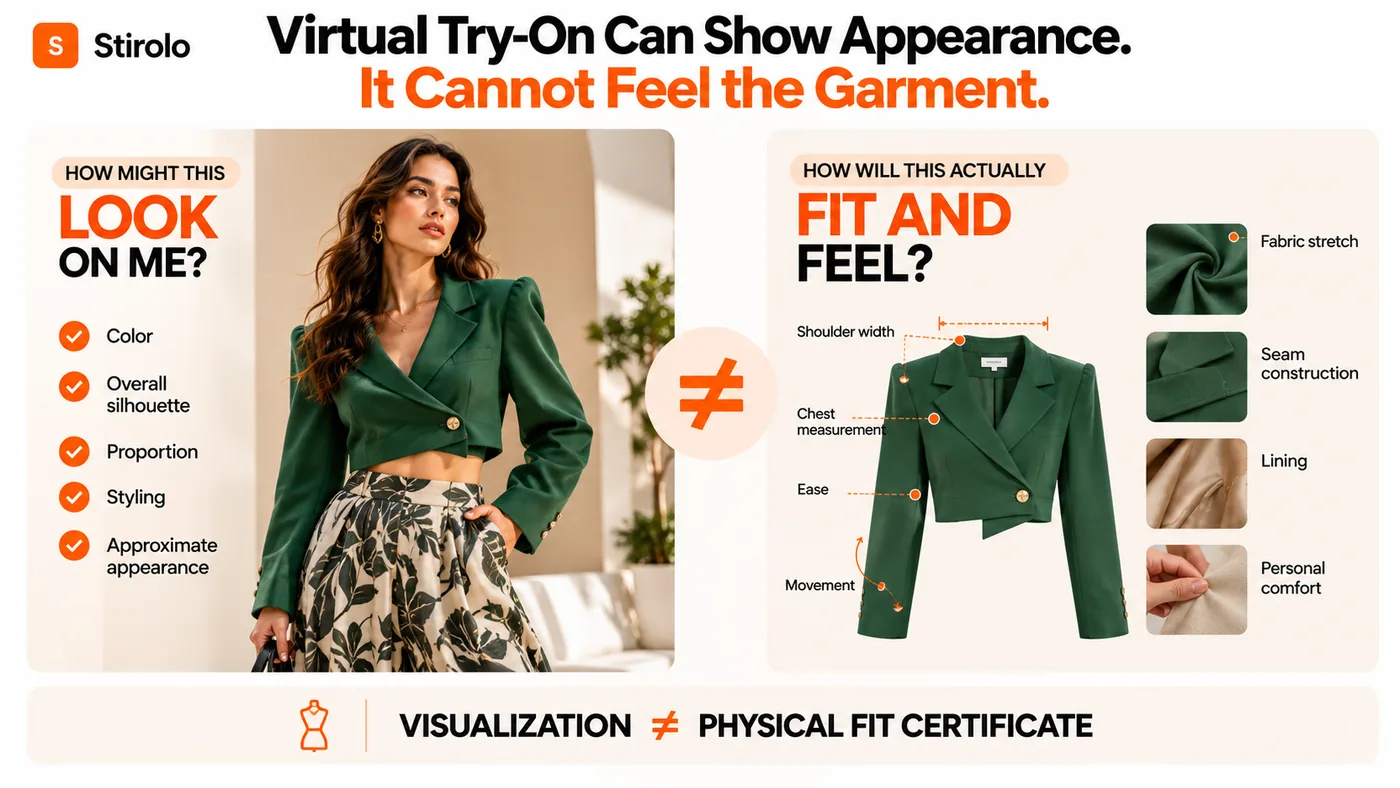
Not necessarily. A virtual try-on can provide a useful visual estimate without proving that the real garment will fit, feel, stretch, or move exactly as shown.
Physical fit depends on information an image may not contain. Relevant variables include garment measurements, grading between sizes, fabric composition, stretch recovery, thickness, seam construction, lining, ease, body measurements, posture, and personal comfort preferences. A generated image can look plausible even when some of those variables are unknown.
Stores should therefore label the capability precisely. If the tool only visualizes appearance, call it virtual try-on or visualization. If it recommends a size, explain what inputs drive the recommendation. If a platform claims physical fit simulation, the retailer should understand what garment and body data support that claim.
This honest boundary can improve trust. A shopper may still gain substantial value from seeing whether a cropped jacket suits their proportions or whether a color works with their appearance. The experience does not need to promise exact physical fit to be useful.
What Should Clothing Stores Test Before Choosing a Virtual Fitting Room?
Test the system with difficult real products, not only polished vendor demos. A store needs to know whether the software preserves its catalog, works for its shoppers, and fits its operational requirements.
Test garment fidelity before visual realism
Start with garments that expose errors. Use a striped shirt, a dress with a border print, an asymmetrical neckline, visible buttons, branded hardware, embroidery, a distinctive pocket, or a layered outfit. Compare the generated result with the original product image.
Check color, pattern scale, logo position, neckline, sleeve length, hem, closures, pockets, silhouette, fabric texture, and layering. A beautiful image of the wrong garment is a poor ecommerce result. Product truth should outrank flattering lighting or a perfect-looking face.
Measure shopper friction
Count the steps between tapping “Try On” and seeing the first useful result. Test the flow on an ordinary phone and a slower connection. Watch for mandatory registration, confusing photo instructions, long generation times, repeated uploads, or a result that removes the shopper from the product detail page.
Check privacy and data handling
A shopper photo can be sensitive personal data. Ask the provider what is uploaded, where it is processed, how long it is retained, whether it is used for model training, how deletion works, and which subprocessors receive it. The store’s privacy notice and consent flow should match the actual implementation and applicable law.
A low-friction fitting room should not become a low-transparency data collection system. Stores can reduce risk by collecting the minimum information needed and by giving shoppers a meaningful alternative, such as preset models, when possible.
How Can a Clothing Store Add an AI Virtual Fitting Room?
To add an AI virtual fitting room, start with one category and one measurable shopper problem instead of deploying it across the entire catalog. A focused pilot makes product quality, integration issues, and commercial impact easier to diagnose.
First, choose the use case. A store selling visually distinctive dresses may prioritize shopper-photo visualization. A retailer with persistent size-related returns may need a size recommendation layer as well. A physical retailer may care more about an in-store smart mirror or assisted styling experience.
Second, prepare the catalog. Standardize product images, verify color, maintain reliable size charts, and supply the data required by the provider. Poor product data cannot be repaired by a polished try-on interface.
Third, place the experience near the decision. For ecommerce, the product detail page is usually the natural location because the shopper can move from product evaluation to try-on without losing context. Keep the normal gallery, size information, reviews, and purchase controls available.
Fourth, test a limited product set with real shoppers. Compare users who engage with try-on against relevant control groups, while accounting for the fact that highly interested shoppers may be more likely to use the feature in the first place.
Retailers can also study how AI styling works to understand the broader difference between showing one product on a body and using personal context to recommend complete outfits. Try-on answers a visualization question; styling answers a coordination and choice question.
Can an AI Virtual Fitting Room Reduce Clothing Returns?
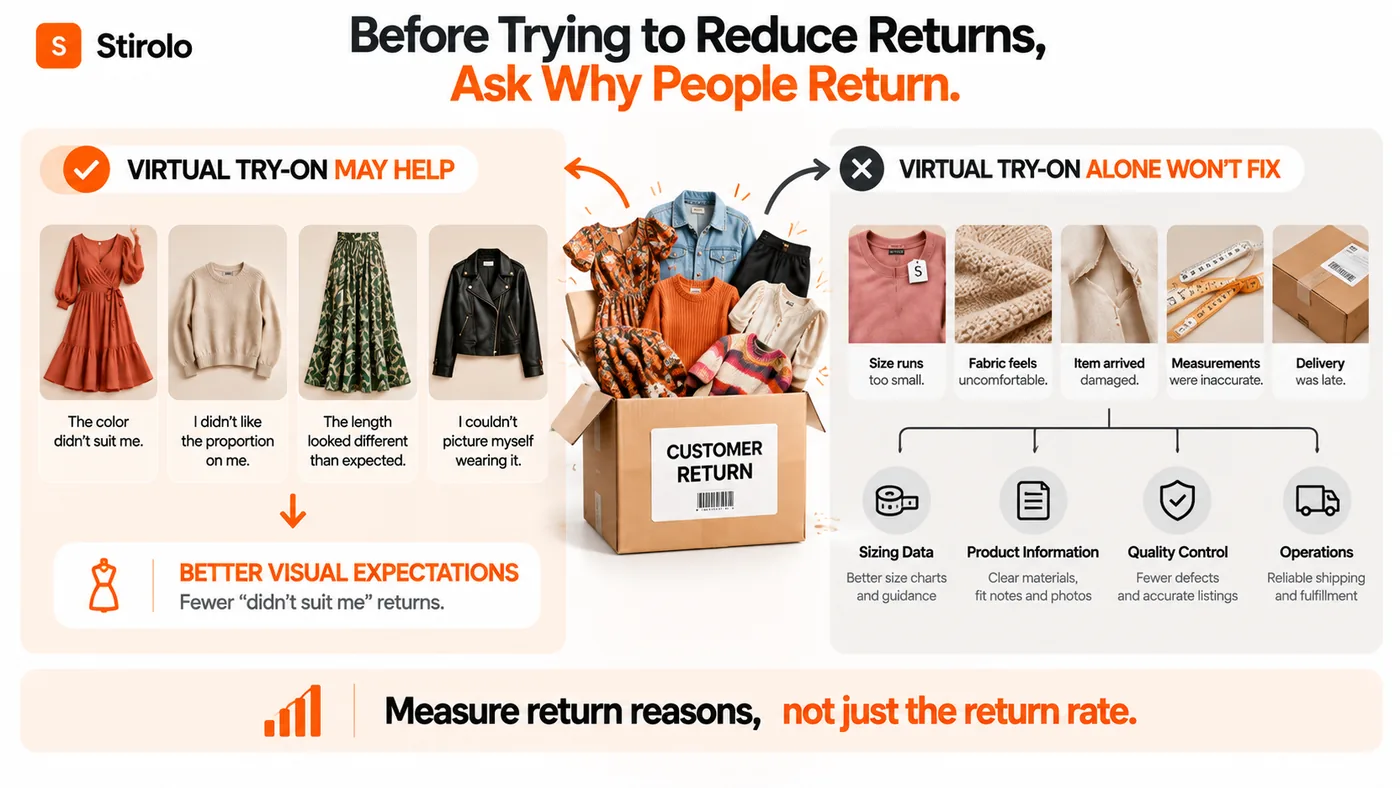
It can help with some return causes, but a store should not assume virtual try-on will reduce every type of return. The effect depends on why customers return products and what the fitting room actually improves.
If shoppers return a garment because its length, proportion, color, or styling looked different on them than expected, better visualization may reduce that uncertainty. If returns are driven by inconsistent sizing, inaccurate garment measurements, fabric discomfort, damaged goods, late delivery, or generous return policies, a visual tool addresses little of the underlying cause.
The correct test is therefore return reason, not just total return rate. Segment returns for try-on users by product and stated reason. A reduction in “did not suit me” may coexist with unchanged “too small” returns if the system visualizes appearance but does not recommend size.
How Is a Virtual Fitting Room Different From Size Recommendation?
Virtual try-on answers how an item may look; size recommendation estimates which available size may suit the shopper. A store can offer either capability independently or combine them in one interface.
| Technology | Primary question | Data commonly needed |
|---|---|---|
| Virtual try-on | How could this garment look on me? | Shopper image or model plus garment image |
| Size recommendation | Which size should I choose? | Body or purchase data plus garment sizing data |
| 3D fit simulation | How might the garment interact with a modeled body? | Body geometry, garment geometry, material and construction data |
| AI stylist | What should I wear or combine? | Wardrobe, preferences, occasion, context and feedback |
The distinction matters because shoppers may interpret the word “fitting” literally. If a store presents a generated picture beside a size selector, the interface should not imply that the image has validated the selected size unless the underlying system actually performed that analysis.
Should Physical Clothing Stores Use Virtual Fitting Rooms Too?
Yes, but the use case is different from ecommerce. A physical store already lets shoppers touch and wear products, so digital fitting should remove a specific friction rather than replace the changing room by default.
A smart mirror can help a shopper explore colors or styles that are not immediately available in the fitting room. It can support endless-aisle browsing, show complementary items, or reduce repeated trips between the changing room and sales floor. It may also help staff demonstrate inventory held in another location.
Physical try-on remains valuable for comfort, tactile feel, mobility, opacity, exact length, pressure, and personal preference. A digital mirror is strongest as an exploration layer before or alongside real fitting, especially for products where material behavior matters.
For shoppers who want ideas beyond a single garment, practical style guides can complement visualization by helping them reason about proportions, combinations, occasions, and repeatable outfit choices. That is a different benefit from simply rendering a garment on a body.
Which Metrics Show Whether Virtual Try-On Is Working?
Measure whether try-on changes useful shopping behavior, not how many AI images the system generates. A high interaction count can still hide poor conversion, repeated failures, or novelty use.
Track try-on start rate, successful completion rate, generation time, product-page exits after starting, add-to-cart rate, conversion rate, items per order, repeat use, and customer support contacts related to the feature. For returns, compare reasons and product categories rather than relying only on one store-wide percentage.
Qualitative feedback matters too. Ask whether the result looked like the shopper, looked like the actual garment, and made the purchase decision easier. Those three questions separate identity quality, product fidelity, and commercial usefulness.
A pilot should also have a failure threshold. If distinctive products are repeatedly altered or shoppers abandon during upload, the right response may be to restrict eligible categories until the underlying problem improves.
What Are the Main Risks and Limitations?
The main risks are inaccurate product representation, overclaiming fit, shopper friction, privacy exposure, bias, and misplaced confidence in generated images. Each risk can be reduced, but none should be hidden behind photorealistic output.
Garment errors are especially serious because the image participates directly in a purchase decision. A missing belt, changed print, shortened hem, altered neckline, or invented drape can misrepresent the product. Stores need a process for excluding unsuitable items and reporting failures to the provider.
Body representation also deserves attention. Test the system across the range of body shapes, skin tones, mobility aids, modest clothing, hairstyles, poses, and garment categories relevant to the store’s customers. A system that works only on narrow demo conditions is not ready for broad deployment.
Finally, keep ordinary shopping possible. A shopper who does not want to upload a photo should still be able to use product photography, model measurements, size charts, reviews, and other decision aids. Virtual fitting should add choice rather than make access to product information conditional on personal data.
AI-Powered Virtual Fitting Room FAQs
Can an AI virtual fitting room tell me my exact clothing size?
No. A visual try-on alone cannot prove exact size. A separate sizing system may estimate a size when it has suitable body and garment data.
Does virtual try-on show how fabric will really feel?
No. It can visualize appearance, but it cannot reproduce tactile qualities such as softness, weight, irritation, compression, or comfort.
Can small clothing stores use AI virtual fitting rooms?
Yes. Hosted apps and storefront integrations can lower the technical barrier, but stores should still test garment fidelity, privacy, speed, cost, and measurable shopper value.
Should shoppers have to upload a photo?
No. A store can offer alternatives such as preset models or conventional product information. Photo upload should be optional when the experience can support another path.
Can virtual fitting rooms replace physical fitting rooms?
No. They can reduce visual uncertainty and support discovery, but physical fitting still provides direct evidence about comfort, movement, fabric feel, and exact fit.
Make the Fitting Room Useful, Not Just Impressive
A useful AI-powered virtual fitting room gives shoppers better evidence for a clothing decision without pretending a generated image knows more than it does. For stores, the strongest implementation preserves the real garment, keeps the interaction fast, protects shopper data, states the limits of fit prediction, and measures whether the feature changes purchase confidence or return reasons. Virtual try-on becomes valuable when it supports the shopping decision, not when it merely produces an impressive picture.