
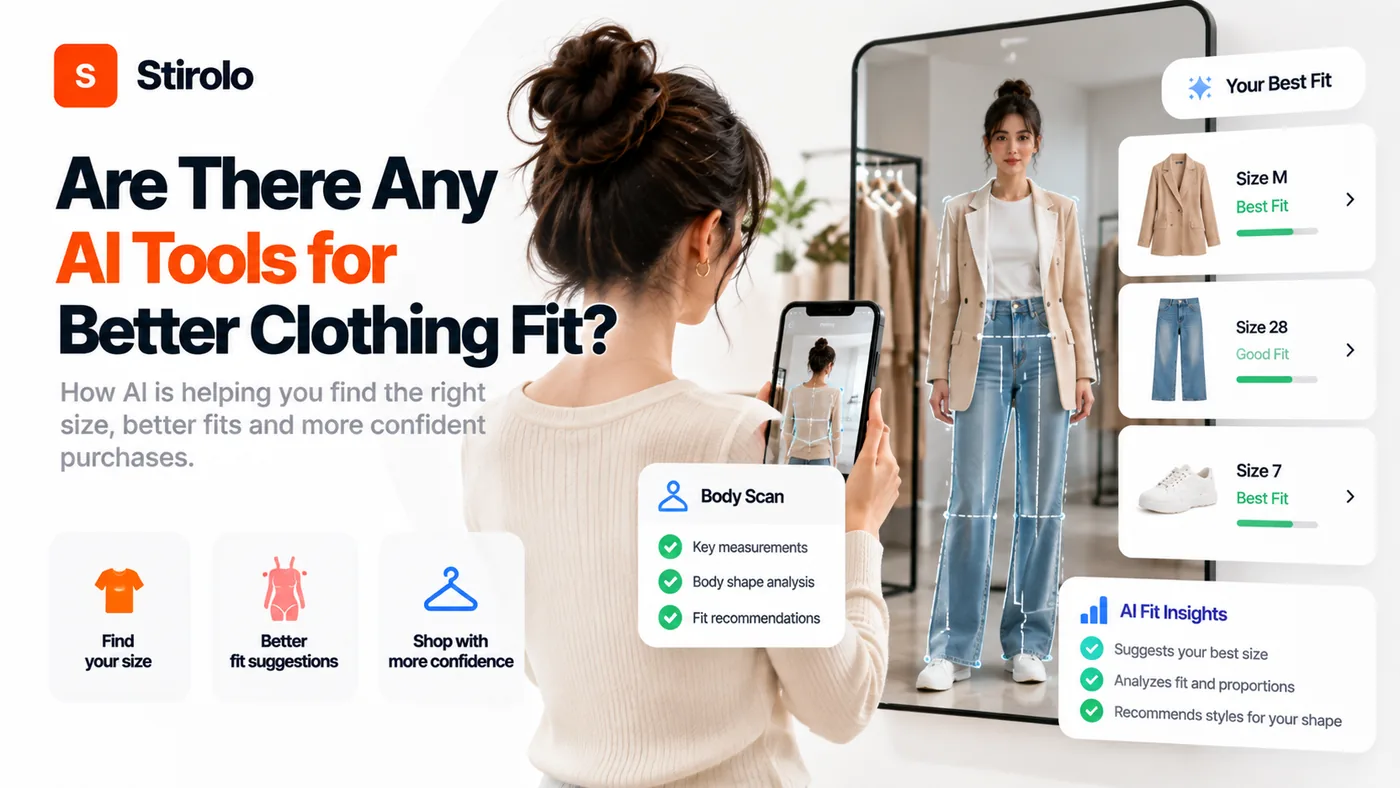
Yes. AI tools can help you choose a better clothing size, estimate body measurements, compare your proportions with garment data, and preview how clothes may look. However, no single AI tool can guarantee physical fit because size, cut, fabric, stretch, posture, and personal comfort all affect the result.
The most useful approach starts by identifying the question you need answered. A size recommender answers which size to buy. A body scanner estimates measurements. A virtual try-on shows appearance. An AI stylist evaluates proportions, silhouette, and how a garment works with the rest of your wardrobe.
Those functions overlap, but they are not interchangeable. Treating every fashion AI tool as a fitting tool creates unrealistic expectations.
What Types of AI Tools Can Help Clothing Fit Better?
AI clothing fit technology falls into several practical categories. Each category uses different inputs and solves a different part of the fit problem.
- AI size recommenders match your profile with a specific brand, garment, and size.
- Photo-based body scanners estimate measurements and proportions from smartphone images.
- Virtual fitting tools model how a garment may sit across different body areas.
- Virtual try-on tools generate a visual preview of how an outfit may look on you.
- AI styling tools use body shape, proportions, taste, and wardrobe context to recommend more flattering combinations.
A strong fit decision may use more than one category. You might use a size recommender for a blazer, a virtual preview for its length, and a styling tool to decide whether the silhouette balances your proportions.
How Do AI Size Recommendation Tools Work?
AI size recommenders compare information about you with information about a specific garment. The system may use height, weight, age, body measurements, fit preference, purchase history, returns, and sizes that worked for similar shoppers.
The Tool Builds a Shopper Profile
Some systems ask only 4 to 6 questions. Others use detailed measurements or past purchase data. The goal is to estimate your body dimensions and preferred amount of ease, such as fitted, regular, or relaxed.
The Tool Reads Garment-Specific Data
Good fit prediction requires more than a generic brand size chart. Useful product data includes chest width, waist, hip, rise, inseam, shoulder width, sleeve length, cut, and fabric stretch. A size M can fit differently across 2 products from the same brand.
The System Returns a Product-Level Recommendation
The result may say size M, but stronger tools also explain where the garment could feel snug or loose. True Fit says its recommendations combine shopper characteristics, past behavior, garment information, and fit preferences. Bold Metrics uses shopper body data with brand-specific garment specifications to provide size and fit guidance.
Can AI Measure Your Body From Photos?
Yes, some computer-vision systems estimate body measurements from smartphone photos. A photo-based system can identify body landmarks and infer dimensions that would otherwise require a measuring tape or 3D scanner.
3D body-scanning systems can be useful when accurate self-measurement feels difficult. Photo quality still matters. Camera angle, pose, loose clothing, lighting, and hidden body contours can affect the estimate.
Photo measurement also creates a privacy question. Before uploading body images, check what the provider stores, how long images remain available, whether you can delete them, and whether images are used to train other models.
Does Virtual Try-On Tell You Whether Clothes Will Fit?
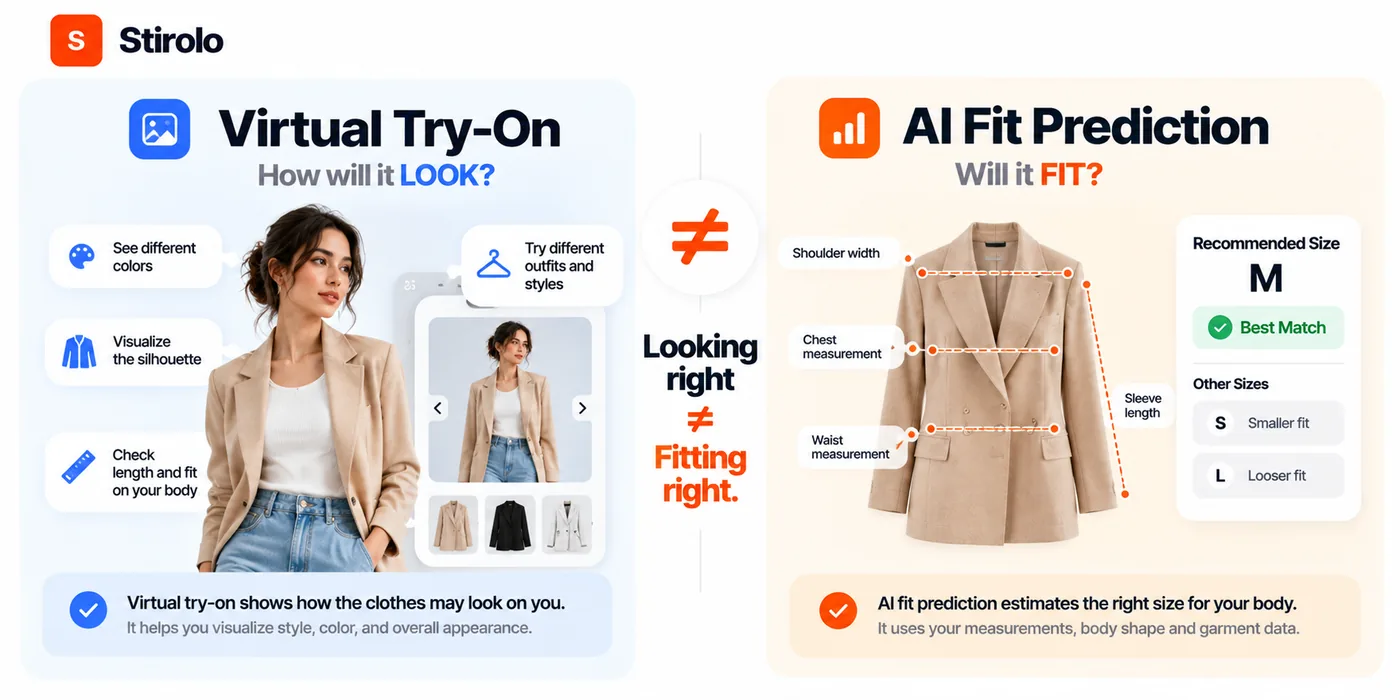
No. Virtual try-on mainly answers how clothing may look, not whether a physical garment will fit correctly. A realistic image can show color, overall silhouette, styling, and approximate length without proving that the waistband closes or the shoulders allow comfortable movement.
Generative images are especially weak evidence for exact size. A preview may make size M and size L look similarly plausible because the system optimizes visual realism rather than physical garment tension.
Use virtual try-on for appearance. Use garment measurements, size recommendations, fit notes, and body data for physical fit.
Which AI Clothing Fit Tools Are Available?
Several types of services already support clothing fit decisions. Availability depends on the retailer because many fit platforms work behind the scenes on product pages rather than as standalone consumer apps.
| Tool or Type | Main Job | Typical Input | Best Use |
|---|---|---|---|
| True Fit | Size recommendation | Profile, behavior, garment data | Cross-brand apparel and footwear sizing |
| Bold Metrics | Digital twin and fit guidance | Short questionnaire plus garment specs | Product-level size and fit context |
| 3D body scanning | Measurement estimation | Smartphone photos | Creating body measurements without a tape |
| Virtual try-on | Visual preview | Photo or body model plus product image | Checking appearance and silhouette |
| AI stylist | Proportion and outfit guidance | Body, wardrobe, taste, occasion | Choosing shapes and combinations that suit you |
These tools should not be ranked by one universal accuracy score. The better choice depends on whether your problem is size, measurements, visual confidence, or styling.
What Information Makes AI Fit Recommendations More Accurate?
Better inputs usually produce better recommendations. Start with current body information rather than an old clothing size. Record height and weight accurately, then add chest or bust, waist, hips, inseam, and other measurements when the tool supports them.
Fit preference matters too. Two people with identical measurements may choose different sizes because one prefers a close fit and the other wants more ease. The system needs that preference to distinguish a technical fit from a comfortable fit.
Garment information matters just as much as body information. A 2 cm or 0.8 in difference can matter in a fitted waistband, while the same difference may barely affect an oversized shirt. Fabric stretch can also change how much room you need.
Why Can AI Fit Tools Still Get Your Size Wrong?
AI fit tools can fail because clothing sizing is inconsistent and physical fit depends on variables that are difficult to model. The algorithm can only work with the data available for your body and the garment.
Brand Sizes Are Not Standard
A medium is not a universal physical measurement. Brands use different blocks, grading rules, target customers, and fit intentions. Even products inside one brand can vary by collection or silhouette.
Fabric Behavior Is Difficult to Predict
Two trousers with the same waist measurement can feel different because denim, wool, linen, ponte, and elastane blends stretch and drape differently. Construction also changes comfort through linings, seams, waistbands, and reinforcement.
Bodies Do Not Follow One Proportion
A single size label compresses several measurements into one category. Your shoulders may align with one size while your waist aligns with another. AI can identify the mismatch, but the garment pattern may still force a compromise.
For that reason, treat confidence scores and recommendations as decision support rather than guarantees.
How Can You Use AI Fit Tools Without Relying on Them Too Much?
To use AI fit tools well, combine the recommendation with objective product information. Check the garment measurements, material composition, stretch, model measurements, fit notes, and customer feedback before ordering.
Use a garment you already own as a reference when possible. Measure a well-fitting shirt, pair of jeans, or jacket flat. Compare those dimensions with the new product. That comparison often catches issues that a generic body profile misses.
Pay extra attention to the measurement that controls the garment. For jeans, that may be waist, hip, rise, and inseam. For a blazer, shoulders and chest can matter more. For shoes, length alone cannot capture width, instep, toe box, and heel shape.
How Does AI Styling Help With Fit Beyond Size?
AI styling addresses a different question: whether the shape and proportions of clothing work for you. A garment can technically fit and still feel visually wrong because of its length, volume, neckline, rise, or balance with other pieces.
Stirolo uses body fit, proportions, body shape, wardrobe items, taste, occasions, and environment when producing recommendations. You can see the broader AI styling process and how those signals work together.
That context is useful after size selection. For example, a jacket may fit your chest correctly but end at an awkward point relative to your torso. A trouser may fit your waist but create a silhouette you rarely wear. Styling intelligence can help identify those issues before you build an outfit around the item.
The AI personal stylist can also consider clothes you already own, which changes the decision from “does this fit?” to “does this fit me and my wardrobe?”
Can AI Help You Shop for Better-Fitting Clothes?
Yes, especially when the system connects body data with product-level garment data. AI can narrow size choices, flag likely fit conflicts, and reduce the need to order several sizes just to compare them at home.
The strongest shopping workflow starts with your existing wardrobe. Identify which cuts, rises, lengths, necklines, and proportions already work. Then use AI to search for similar fit characteristics rather than treating each purchase as a new experiment.
A smart wardrobe system can support that approach by keeping your real clothes, body context, and styling preferences connected instead of separating shopping from what you already own.
What Can AI Judge About Fit, and What Still Needs a Fitting Room?
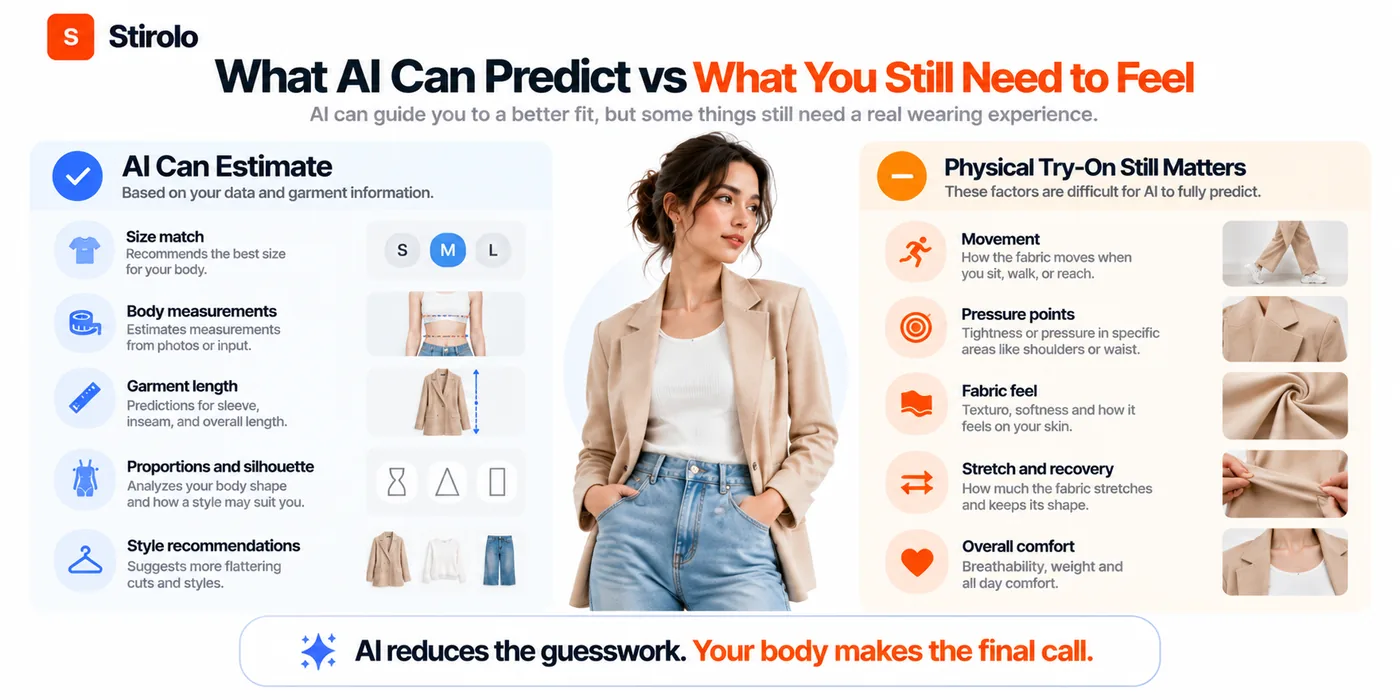
AI can judge measurable relationships more reliably than sensory ones. A fit system can compare your estimated waist with a garment waist, compare inseam lengths, identify whether a cut usually runs small, and use historical outcomes to estimate which size is most likely to work. Styling systems can also evaluate visible proportion, garment length, and silhouette against a body model.
AI has a harder time with pressure, movement, heat, scratchiness, seam placement, and how fabric changes after several hours of wear. A waistband can match your measurements and still dig in when you sit. A jacket can look balanced in a static image but restrict your shoulders when you reach forward. Shoes can match foot length while still creating heel slip or toe pressure.
That difference matters when you evaluate a tool. A system that predicts measurements should be judged on size guidance. A visual generator should be judged on appearance. Neither should claim certainty about comfort unless the system has physical product data and validated feedback for that exact garment.
How to Compare AI Fit Tools Before You Trust a Recommendation
To compare AI fit tools, test the system on clothes whose fit you already know. Choose 3 to 5 garments or brands you have worn recently. Enter accurate information, record each recommendation, and compare the output with the size and fit you experienced in real life. This simple check reveals whether the tool understands your proportions or only repeats a generic chart.
Look at the inputs next. A recommendation based only on height and weight has less information than one that also uses body measurements, fit preference, garment dimensions, fabric properties, and previous outcomes. More inputs do not automatically guarantee accuracy, but the system should collect data that is relevant to the decision.
Check whether the tool explains uncertainty. Useful guidance may say that one size fits your waist better while another gives more room through the hips. That explanation is more actionable than a confident single-letter answer with no context. You should also be able to correct your profile when your measurements, preferences, or body change.
Finally, check privacy before using photo-based features. Look for clear controls covering image storage, deletion, account data, and model training. If the provider cannot explain how sensitive body images are handled, use a questionnaire-based tool or manual measurements instead.
Quick Reference: Which AI Fit Tool Solves Which Problem?
| Task | Typical Timing | Method | Difficulty |
|---|---|---|---|
| Choose a size | Seconds | AI size recommender | Low |
| Estimate measurements | 1-3 minutes | Photo body scan | Medium |
| Preview appearance | Seconds to minutes | Virtual try-on | Low |
| Check garment proportions | Minutes | Body model plus styling analysis | Medium |
| Compare with owned clothes | 5-10 minutes | Garment measurements | Medium |
| Improve future suggestions | Ongoing | Wear and feedback data | Low |
Are AI Clothing Fit Tools Worth Using?
Yes, when you use the right tool for the right question. AI size recommenders can reduce uncertainty between sizes. Body scanners can make measurements easier. Virtual try-on can improve visual confidence. AI stylists can help you judge proportion and silhouette in a broader wardrobe context.
The main mistake is expecting one technology to replace a fitting room completely. Physical comfort depends on movement, fabric feel, construction, and personal preference. Current AI works best as a filter that removes obvious mismatches and gives you better evidence before buying.
The practical goal is not perfect prediction. The goal is fewer bad guesses, fewer duplicate-size orders, and more clothes that you actually want to wear after they arrive.
Frequently Asked Questions About AI Clothing Fit Tools
Can AI tell me what clothing size I am?
Yes, AI can recommend a likely size when the system has enough body and garment data. The result remains a recommendation because sizing varies across brands and products.
Can AI tell whether jeans will fit?
Yes, fit tools can compare waist, hip, rise, inseam, stretch, and fit preference when those inputs are available. Jeans remain sensitive to fabric and cut, so check product measurements too.
Can a photo tell my clothing measurements?
Yes, some computer-vision tools estimate measurements from smartphone photos. Accuracy depends on pose, clothing, camera setup, and the provider’s model.
Is virtual try-on the same as fit prediction?
No. Virtual try-on focuses on appearance. Fit prediction focuses on physical size and garment-to-body compatibility. A realistic preview does not prove comfort or exact fit.
Can AI replace trying clothes on?
No. AI can reduce uncertainty before purchase, but physical try-on still reveals movement, fabric feel, pressure points, and comfort that digital systems cannot fully reproduce.
Better Fit Starts With Better Context
AI clothing fit tools are useful because they replace part of the guesswork with body data, garment data, and learned preferences. The most reliable workflow separates size prediction from visual try-on and styling, then uses each technology for the question it actually answers.
For everyday style, fit is also about proportion, confidence, and whether a garment works with clothes you already own. Build that context into your decisions, and AI becomes more useful than a simple size calculator.