
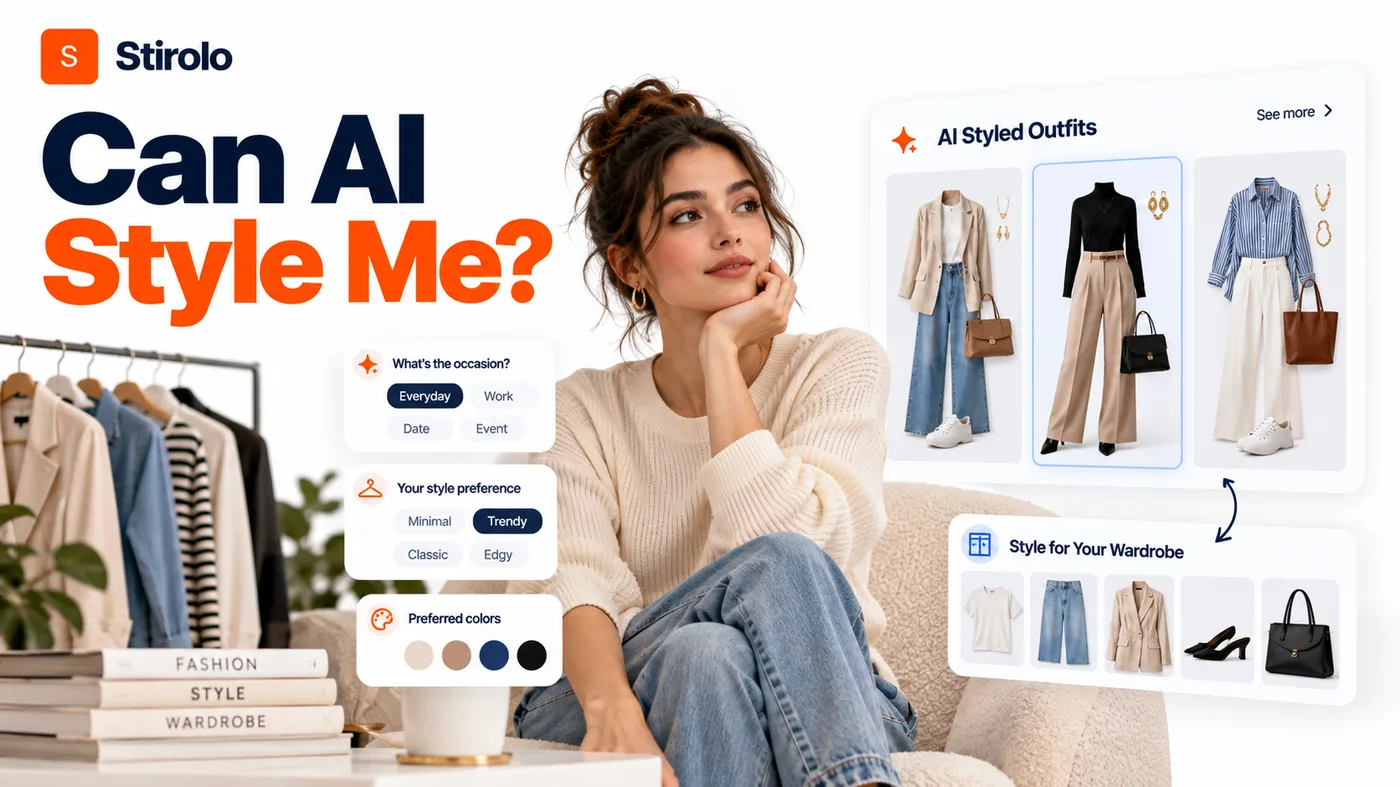
Yes. AI can style you by combining information about your wardrobe, body proportions, fit preferences, taste, occasion, weather, and feedback to recommend outfits that suit your actual situation.
The important question is not whether an AI can produce an outfit. Almost any general AI can suggest a white shirt with dark trousers. The better question is whether it can choose a useful outfit for you, from clothes you can actually wear, and explain why that choice fits your needs.
That difference separates generic outfit generation from personal styling. A useful AI stylist needs context. The more relevant context it has, the less likely it is to give the same safe advice to everyone.
Stirolo, for example, describes an AI styling workflow that combines photos, a wardrobe profile, recommendations, visualization, and ongoing learning. Its recommendations are built from clothes already in the user’s closet rather than from a generic catalog.
How Does AI Personal Styling Actually Work?
AI personal styling turns information about you and your clothes into ranked outfit recommendations. Different apps use different models, but the useful inputs usually fall into 5 groups: the person, the wardrobe, the situation, preferences, and past feedback.
A system may analyze garment categories, colors, fabrics, silhouettes, seasonality, and formality. It can then compare those attributes with your profile and the occasion you describe. Some tools also use photos or measurements to estimate proportions, while others focus mainly on wardrobe combinations.
The result can be a daily outfit, several alternatives, a packing list, a capsule wardrobe, or advice about what to pair with one difficult item. The recommendation is still a prediction. You remain the person who decides whether the outfit feels comfortable, appropriate, and like you.
What Does AI Need to Know to Style You Well?
To style you well, AI needs constraints as much as preferences. “I like minimalist clothes” helps, but “I need a smart-casual outfit for a client dinner, it is 55°F (13°C), I dislike tight trousers, and these are the clothes I own” gives the system much more to work with.
Your wardrobe
A digital wardrobe gives AI a concrete inventory. The system can work with your actual shirts, trousers, dresses, shoes, jackets, and accessories instead of recommending imaginary pieces. Accurate categories, colors, seasons, and fit notes improve the available combinations.
Your body and fit preferences
Photos, measurements, or proportion notes can help an AI reason about silhouette. Fit preference matters just as much. Two people with similar measurements may want completely different amounts of ease, structure, waist emphasis, or leg volume.
Your day and environment
Occasion and weather can change an otherwise good recommendation. An outfit for an air-conditioned office is different from one for a humid commute. Dress codes, walking distance, rain, temperature, and indoor versus outdoor plans are practical styling constraints.
Can AI Style Clothes You Already Own?
Yes. Wardrobe-aware AI can build outfits from clothes you already own, provided those items have been added to a digital wardrobe or otherwise described to the system.
This is one of the most useful forms of AI styling because it changes the task from “show me fashionable clothes” to “help me use these clothes better.” That can surface combinations you have overlooked and reduce the habit of treating every styling problem as a shopping problem.
Stirolo’s wardrobe intelligence features are designed around this approach. The wardrobe is cataloged and searchable, while recommendations can draw from what the user already owns. That context is more actionable than an inspiration image containing 4 pieces you would need to buy.
Wardrobe data also lets a system notice practical gaps. If 8 tops work with only 1 pair of trousers, the useful recommendation may be to improve the wardrobe structure rather than keep generating new combinations.
How Do You Know If AI Is Really Styling You?
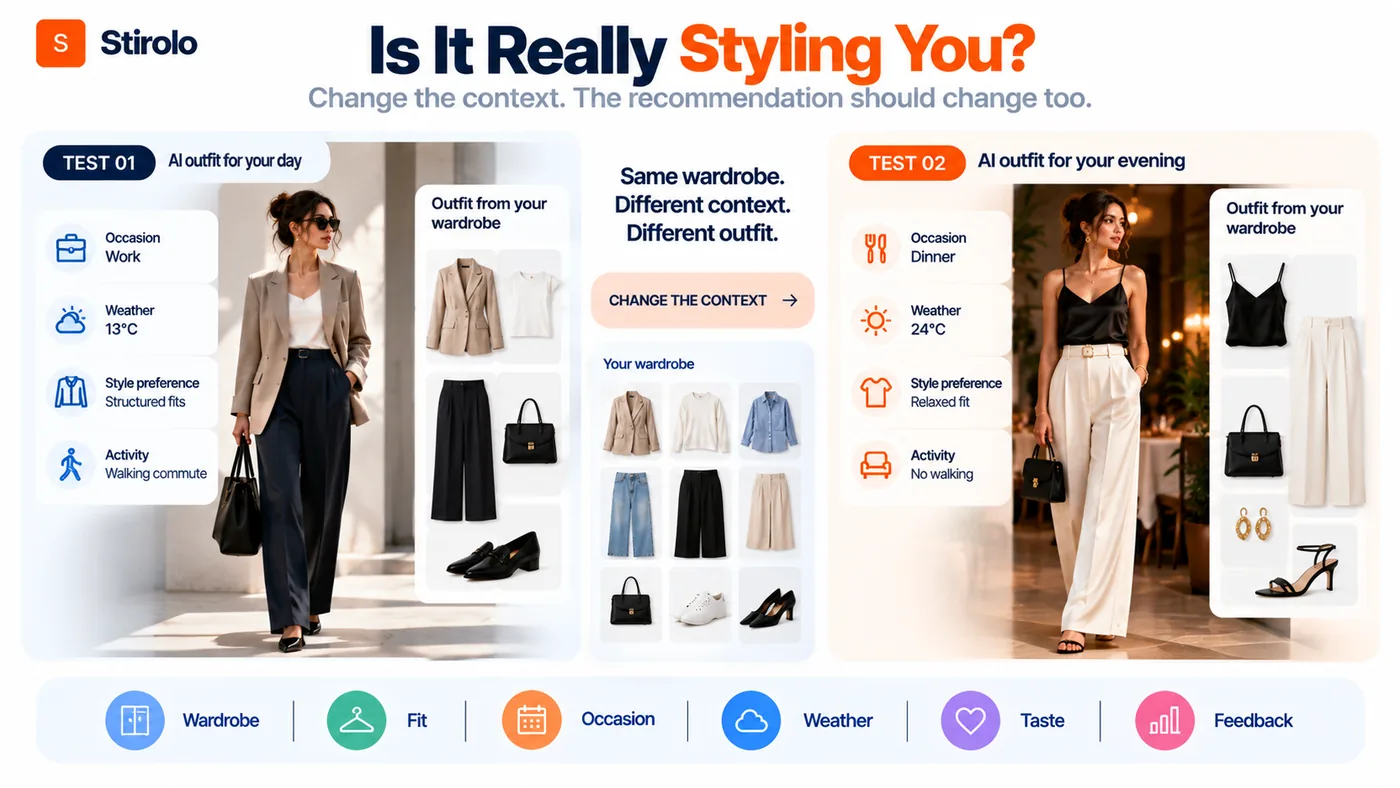
A good test is whether the recommendation would materially change if your information changed. If the AI gives almost the same answer after you change your wardrobe, occasion, fit preference, or weather, the advice is probably not very personal.
Useful styling should also involve judgment. An assistant that calls every outfit “great” is validating you, not necessarily styling you. Constructive advice can identify a proportion problem, explain why a shoe makes the outfit too formal, or suggest changing one piece rather than praising everything.
| Signal | What useful AI should do |
|---|---|
| Wardrobe | Recommend pieces you actually own or clearly label suggested purchases. |
| Fit | Account for proportions, measurements, and your preferred silhouette where supported. |
| Occasion | Change formality, practicality, and styling details for the event. |
| Weather | Adapt layers, fabric weight, footwear, and outerwear to conditions. |
| Taste | Respect preferences without repeating the same formula every day. |
| Feedback | Change later recommendations after you accept, reject, or edit looks. |
| Reasoning | Explain why the combination works and what trade-off it makes. |
Can AI Understand Your Body Shape and Fit?
AI can estimate visual features such as proportions and use measurements or fit preferences when a product supports those inputs. It cannot guarantee how a real garment will fit your body unless it has reliable garment measurements and enough physical information about the item and wearer.
This limitation matters. A generated image can make a jacket appear clean through the shoulders without proving that the real jacket has enough room. Fabric stretch, thickness, drape, construction, sizing inconsistency, and personal comfort are physical variables that an image cannot fully verify.
Treat body analysis as styling guidance, not a tailoring measurement. Use it to explore silhouette and proportion, then confirm actual fit by trying on the garment or checking trustworthy measurements and return policies.
Can AI Learn Your Personal Style Over Time?
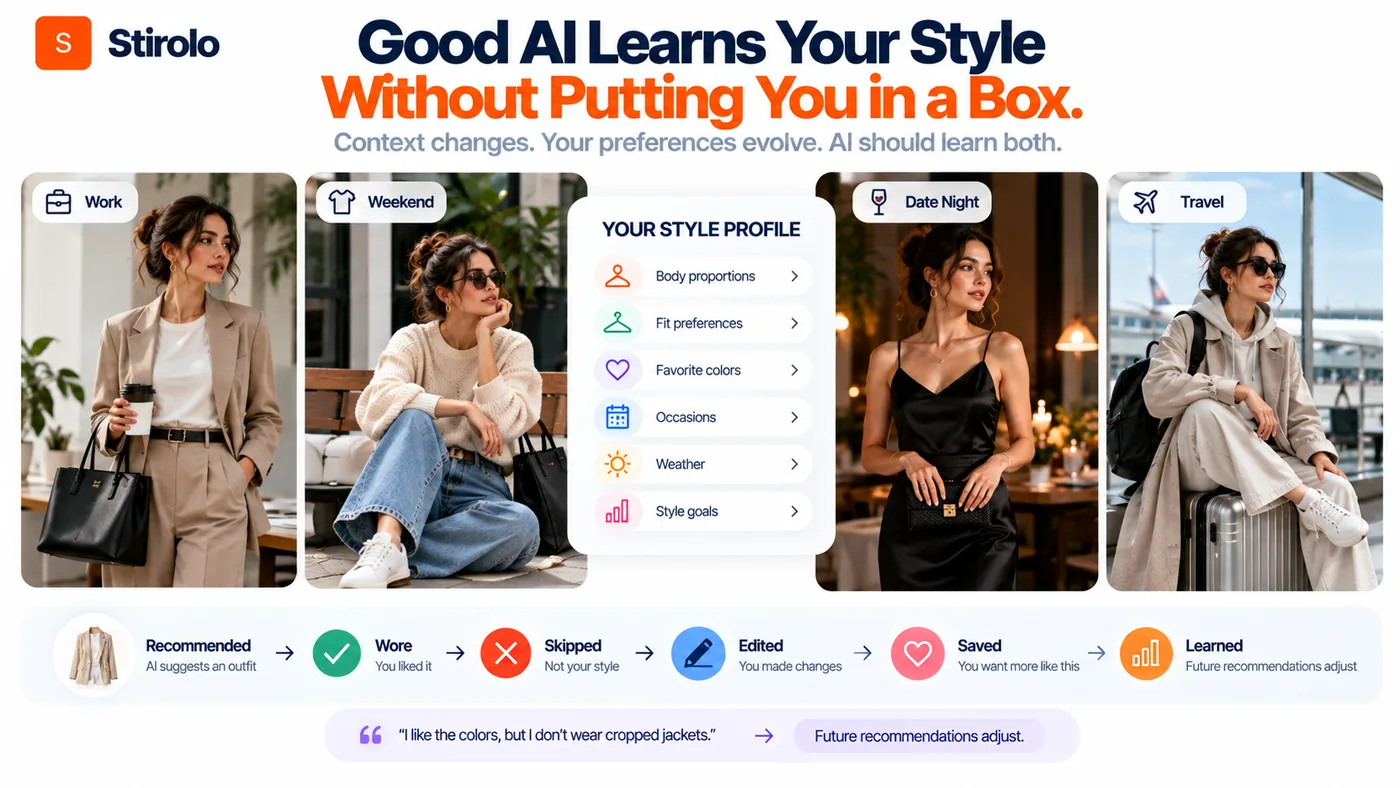
Yes, if the system stores useful feedback and applies it to later recommendations. A learning loop can use outfits you wore, skipped, saved, edited, or rated to infer patterns in your taste.
That does not mean your style should become a fixed label. You may dress differently for work, weekends, travel, dates, cultural events, or different seasons. A useful profile should preserve those contexts instead of reducing you to one aesthetic such as “minimalist” or “streetwear.”
Feedback is especially valuable when it explains why. “I dislike this” is weaker than “I like the colors, but I do not wear cropped jackets.” Specific feedback gives the system a constraint it can apply later.
AI Personal Stylist vs Outfit Generator vs Virtual Try-On
These tools overlap, but they solve different problems. An AI personal stylist decides what may work for you. An outfit generator creates combinations. A wardrobe assistant organizes and reasons over clothes you own. Virtual try-on creates a visual approximation of how a garment or outfit may look on a person.
Google’s virtual try-on tools illustrate the visualization category. Google has used generative AI to show apparel on models and later introduced the ability to visualize garments using a shopper’s own photo. That can help with appearance and shopping exploration, but visualization alone does not make a system a personal stylist.
For daily dressing, wardrobe awareness is often more important than photorealistic output. A beautiful image of an outfit you do not own does not solve the morning decision as directly as a workable combination from your closet.
What Can AI Style You For?
AI can help with everyday dressing, work outfits, smart casual events, dates, weddings, travel, seasonal transitions, capsule wardrobes, and styling a specific garment. The quality depends on how clearly the situation is described.
For travel, tell the system the destination, trip length, forecast, planned activities, laundry access, luggage limit, and footwear needs. For work, add the dress code and whether you commute on foot. For an event, include venue, time, formality, and any cultural expectations you already know.
AI is also useful for constrained questions: “Give me 3 ways to wear these wide-leg trousers without heels” is easier to evaluate than “make me stylish.” Clear constraints create recommendations you can actually compare.
Where Does AI Styling Still Get Things Wrong?
AI styling can fail when its inputs are incomplete, when visual analysis mistakes a garment or proportion, or when the model relies on generic fashion patterns instead of your context. It may also suggest combinations that are visually coherent but uncomfortable or impractical.
Another weakness is excessive agreement. If an assistant is optimized to be pleasant, it may soften criticism until every outfit sounds successful. You can counter this by asking for a specific critique: identify the weakest element, explain the proportion issue, rank 3 alternatives, or state what should be changed first.
AI can also reproduce narrow assumptions from its training data. Style is cultural and personal. Advice about modesty, gender expression, body ideals, professional dress, or “flattering” silhouettes should be treated as a suggestion, not an objective rule.
How to Get Better AI Styling Recommendations
To get better AI styling recommendations, give the system enough information to make trade-offs instead of asking for an unconstrained opinion.
- Build an accurate wardrobe catalog with clear photos and useful garment details.
- Add fit preferences, measurements or body context only when you are comfortable doing so.
- State the occasion, dress code, weather, walking needs and practical constraints.
- Tell the AI what you dislike as clearly as what you like.
- Ask for 2 or 3 distinct options rather than endless variations of one formula.
- Require a reason for each recommendation and ask what the weakest part is.
- Give feedback after wearing an outfit so later suggestions can improve.
You can also improve your own judgment by learning the practical style frameworks behind fit, color, capsules, seasonal transitions, travel, and dress codes. AI works better as a decision aid when you can recognize why a recommendation succeeds or fails.
Can AI Replace a Human Personal Stylist?
Not completely. AI can make routine styling faster and more accessible, but a skilled human stylist can observe fabric and fit in person, read subtle emotional reactions, understand sensitive cultural context, and make creative leaps that are difficult to reduce to profile data.
The comparison also depends on the task. You may not need a human appointment to choose a Tuesday office outfit from clothes you already own. You may value human expertise much more for a wedding wardrobe, major image change, tailoring decisions, or a high-stakes professional appearance.
The practical model is not AI versus human styling. It is choosing the right level of help for the decision. AI is particularly strong at repeated, context-rich wardrobe decisions where speed and memory matter.
Is It Safe to Give an AI Stylist Your Photos?
It depends on the service’s privacy practices. Full-body photos, measurements, wardrobe images, location-linked weather data, and style preferences can be personal information. Check what is collected, why it is needed, how long it is retained, and whether you can delete it.
Only provide information that improves a feature you actually want. Body analysis should not be mandatory for a basic wardrobe organizer. If a service offers optional photo analysis, decide whether the extra personalization is worth sharing those images.
Stirolo states that photos used for its body-analysis setup are encrypted and that body analysis can be skipped while other features continue to work. Privacy claims can change, so review the current policy and in-app controls before uploading sensitive images.
So, Can AI Style You Well?
Yes. AI can style you well enough to make everyday dressing faster, surface new combinations, and reduce decision fatigue when it has accurate context about you and your wardrobe.
The strongest experience is not an AI that invents the most fashionable image. It is one that remembers what you own, respects how you like clothes to fit, understands where you are going, adapts to conditions, explains its choices, and learns when you say no.
Use AI as a stylist that proposes and reasons, not as an authority that decides what your personal style must be. Your comfort, identity, and judgment remain the final filter.
Frequently Asked Questions
Can AI tell me what clothes look good on me?
Yes. AI can suggest colors, silhouettes, proportions, and combinations based on photos, measurements, preferences, or wardrobe data. Treat the result as guidance because physical fit still needs real-world confirmation.
Can AI make outfits from my own clothes?
Yes. A wardrobe-aware AI stylist can recommend combinations from garments you have cataloged, which makes its suggestions more immediately wearable than generic outfit generation.
Can ChatGPT be my personal stylist?
Yes, for conversational styling advice when you provide enough context. A dedicated wardrobe app can be more convenient for persistent clothing catalogs, outfit history, visualization, and repeated daily recommendations.
Does an AI stylist need a photo of me?
No. Many styling tasks can use wardrobe data and written preferences alone. Photos can add proportion, color, or visualization context when a service supports those features and you choose to provide them.
Is AI styling accurate?
It can be useful, but accuracy varies by task and input quality. Outfit coordination is easier to estimate than exact physical fit. Judge the advice by whether it respects your real constraints and improves after feedback.