
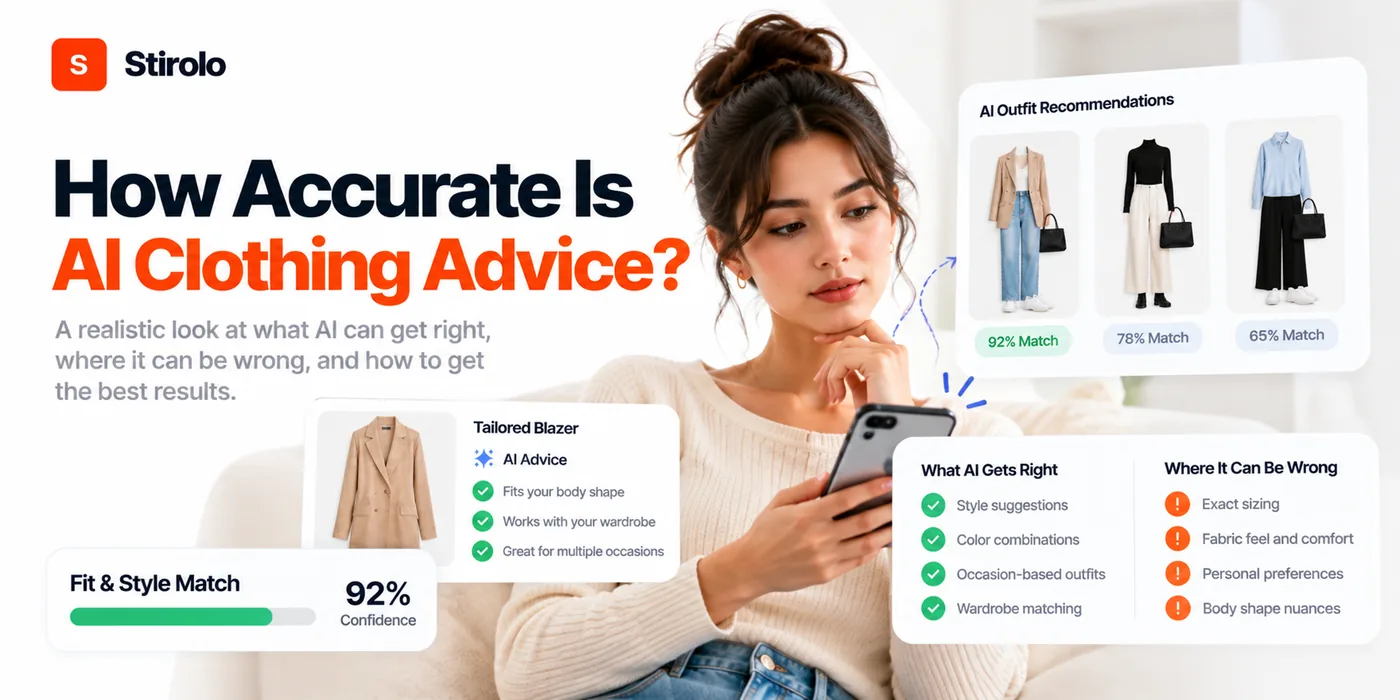
AI clothing advice can be accurate for outfit coordination, color, occasion, wardrobe matching, and repeatable style preferences. Accuracy drops when the advice depends on exact garment fit, fabric feel, cultural nuance, or personal expression the system has not learned.
The useful question is not whether AI is simply accurate or inaccurate. You need to ask what decision the AI is making and what personal context supports that decision. A wardrobe-aware stylist can judge your available combinations better than a generic chatbot. A virtual try-on can preview appearance, but a generated image cannot guarantee physical fit.
How accurate is AI clothing advice for everyday outfits?
**AI clothing advice is most dependable for structured, everyday decisions with clear constraints.** Examples include choosing colors that coordinate, matching formality to an occasion, building outfits from known wardrobe items, or suggesting layers for weather.
FashionAdvice.ai published a 2026 test of 50 outfit photos and reported a 0.78 correlation between its scores and averaged peer ratings. The company also found more disagreement in ambiguous mid-range outfits. That test comes from the product provider, not an independent academic benchmark, so the result should not become a universal accuracy score for AI styling.
No single percentage can describe the whole category. Different systems use different images, wardrobe records, preference profiles, models, rules, and feedback signals. Accuracy also changes by task. A system may coordinate colors well while still misunderstanding how a specific trouser fabric drapes on your body.
What does “accurate” mean in AI fashion advice?
**Accuracy in fashion has several separate dimensions.** Treating every fashion answer as one accuracy problem hides the difference between objective constraints and subjective taste.
Styling accuracy
Styling accuracy asks whether garments work together. AI can evaluate color relationships, visual balance, formality, layering, silhouette, and common coordination rules. These tasks have patterns that image models and recommendation systems can recognize.
Personalization accuracy
Personalization accuracy asks whether a technically sound outfit feels right for you. The system needs your preferred colors, silhouettes, formality range, disliked details, lifestyle, wardrobe, and previous choices. Generic knowledge cannot substitute for personal history.
Fit and visual accuracy
Fit accuracy concerns physical dimensions, ease, tightness, garment construction, and movement. Visual accuracy concerns whether a generated preview resembles the likely appearance. Those tasks overlap, but they are not identical. A realistic image can still hide an incorrect size prediction.
How accurate is AI clothing advice when the system knows your wardrobe?
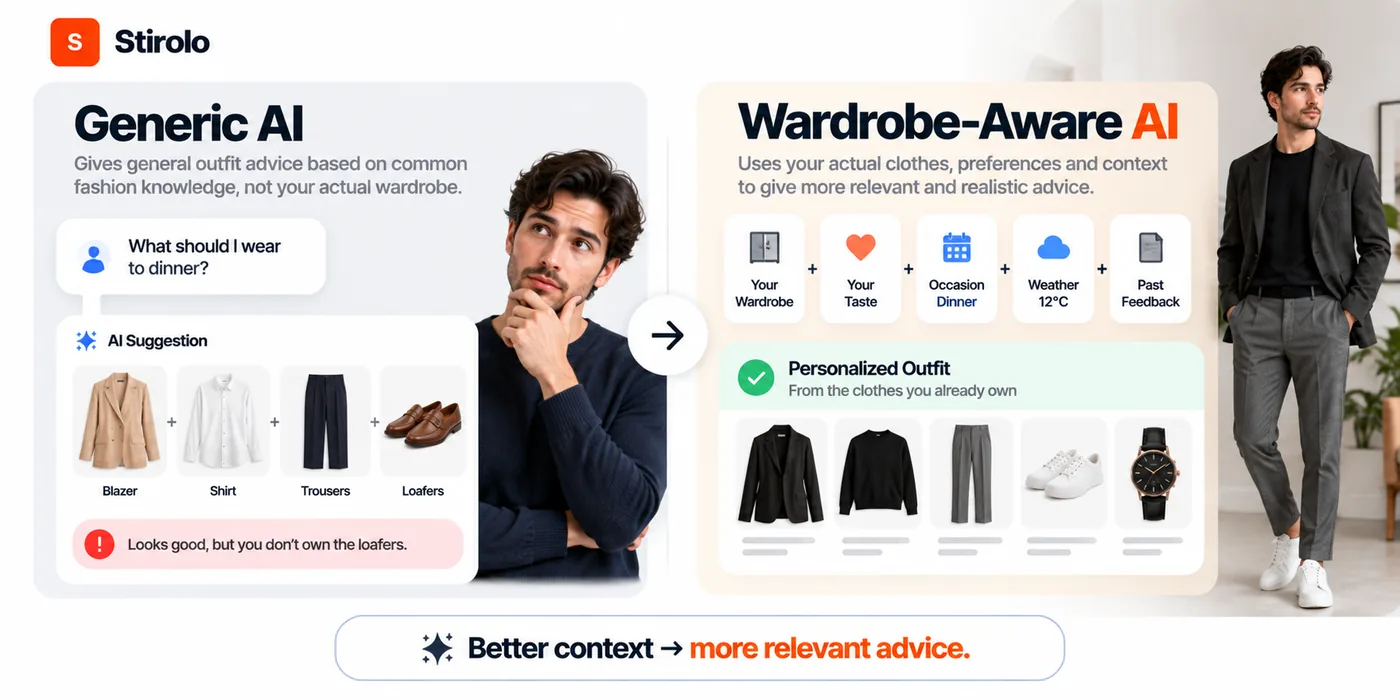
**Wardrobe context usually makes advice more relevant because the system can recommend real options instead of imaginary ones.** The system can compare garments you own, recent wear history, preferred combinations, and gaps before suggesting an outfit or purchase.
Stirolo’s AI styling process uses body, wardrobe, taste, occasion, and environment as separate signals before ranking outfits. The approach also learns from saved, skipped, and edited looks, which gives later recommendations more personal evidence than a one-off prompt.
The quality of the wardrobe record still matters. Missing garments, wrong colors, poor item photos, or inaccurate tags weaken the recommendation. Outflik makes a similar point in its discussion of generic AI advice: an assistant without structured wardrobe information may produce reasonable fashion rules without producing useful personal decisions.
Context also prevents impossible advice. A generic model might suggest loafers for a smart-casual dinner even when you do not own loafers. A wardrobe-aware system should work inside your actual options and explain the best available combination.
Why does generic AI sometimes give flattering but weak fashion advice?
**Generic AI can sound supportive even when stronger criticism would help you more.** Conversational systems often optimize for helpful, agreeable interaction, while fashion itself contains subjective judgments. That combination can produce safe answers that validate your idea instead of testing it.
You can spot weak advice when every outfit receives praise, recommendations repeat generic staples, or the system changes its opinion after small prompt changes. Another warning sign is an answer that ignores the occasion, weather, fit preference, or clothes you already own.
Better fashion systems need permission and evidence to disagree. A useful assistant should explain why a combination misses your stated goal. For example, the assistant can flag a formality mismatch, an unwanted silhouette, or a repeated purchase instead of simply saying the outfit works.
Can AI accurately judge clothing fit and body proportions?
**AI can estimate visible proportions and identify some fit signals, but AI cannot guarantee physical garment fit from an image alone.** A photo may reveal shoulder balance, trouser length, sleeve length, waist placement, or an obviously oversized silhouette. A photo cannot fully reveal fabric tension, comfort, stretch recovery, seam behavior, or movement.
Body analysis can still improve styling. Proportion-aware recommendations can compare garment shapes with your frame and your stated fit preferences. That information helps an AI choose between silhouettes, especially when the system already knows how you prefer clothes to sit.
Stirolo’s personal styling features include optional body analysis, wardrobe intelligence, outfit recommendations, and visualization. The combination matters because body information can filter a recommendation while wardrobe information keeps the result grounded in clothes you actually own.
Treat fit confidence as guidance, not a tailoring measurement. Use exact brand measurements, garment dimensions, fabric composition, return information, and a physical try-on when precise fit matters.
How accurate are AI virtual try-on images?
**Virtual try-on is useful for visual direction, but a generated preview is not proof of size or real-world drape.** Modern systems can create convincing images that preserve much of a garment’s appearance while placing the item on a person or body model.
Google has expanded AI virtual try-on across shopping experiences and describes models designed to represent details such as drape, folds, and stretch. Google also lets shoppers use personal photos or generated body representations in supported experiences. These capabilities make visual comparison easier, but generated pixels still do not measure pressure, comfort, mobility, or construction tolerances.
Use virtual try-on to answer visual questions. Ask whether a neckline feels balanced, whether a jacket length changes your proportions, or whether a color works near your face. Do not use the image alone to decide whether a waistband will feel comfortable after 6 hours.
Which fashion decisions can AI handle most reliably?
**AI works best when the decision has clear inputs and a limited set of reasonable outputs.** Reliability falls as the decision depends more heavily on touch, emotion, identity, or unspoken social context.
| Task | Typical reliability | Best method | Difficulty |
|---|---|---|---|
| Color coordination | High | Clear garment photos plus color preferences | Low |
| Occasion matching | High | State dress code, venue and role | Low |
| Wardrobe combinations | High with full data | Use a complete digital wardrobe | Medium |
| Silhouette guidance | Moderate to high | Add body proportions and fit preferences | Medium |
| Exact size prediction | Variable | Use garment and body measurements | High |
| Virtual appearance | Moderate | Use a clear full-body image | Medium |
| Fabric comfort | Low | Touch, wear and move in the garment | High |
| Personal expression | Variable | Give feedback and reject poor suggestions | High |
How much can AI learn from a single outfit photo?
**A single photo can reveal visible styling signals, but it cannot reveal your complete wardrobe, comfort, or intent.** AI can inspect color relationships, visible proportions, garment lengths, layering, contrast, and the apparent formality of a look. Those observations can support useful first-pass feedback.
Photo quality directly affects that first pass. Cropped feet can hide the effect of footwear. A seated pose changes trouser and jacket proportions. Warm indoor lighting can shift color. A mirror angle can distort the apparent width of garments. Use a straight, full-body image in neutral lighting when you want visual outfit analysis.
The larger problem is missing context. The model cannot see that you chose loose trousers because you will sit on a flight for 10 hours. The model may not know that your office treats sneakers as normal business wear. The model also cannot infer that an inherited jacket matters to you even if another cut looks more balanced.
Treat photo analysis as observation rather than biography. Let the AI describe visible strengths and possible changes. Then add the facts that the image cannot show. The combination produces better advice than asking the model to infer your lifestyle from appearance alone.
What information makes AI clothing advice more accurate?
**Give the AI the same context you would give a competent stylist.** Better inputs reduce guessing and make criticism more specific.
- Your real wardrobe, including accurate colors, categories, patterns, and garment shapes.
- Clear full-body photos when you want proportion or outfit feedback.
- Your preferred fit, such as relaxed, fitted, structured, cropped, or oversized.
- The occasion, venue, dress code, weather, and expected activity.
- Colors, silhouettes, fabrics, and details you actively dislike.
- Previous outfits you saved, skipped, edited, or wore repeatedly.
- Your goal for the outfit, such as authoritative, relaxed, creative, understated, or practical.
Feedback matters after the first answer. Reject a suggestion and state the reason. Swap one garment instead of restarting the conversation. A system that stores those corrections can learn a stable preference instead of treating every request as a new user.
When should you ignore AI fashion advice?
**Ignore AI advice when the recommendation conflicts with physical comfort, a known dress code, your identity, or information the system cannot observe.** Clothing has social and sensory details that a model may miss.
High-stakes events deserve extra checking. Weddings, interviews, religious events, formal ceremonies, performances, and culturally specific settings can involve expectations that generic training data handles unevenly. Ask a knowledgeable person when local nuance matters.
You should also reject advice that pushes you toward a style you consistently dislike. Personal styling should clarify your choices, not erase your taste. A technically balanced outfit can still feel wrong because style communicates identity as well as coordination.
How should you test an AI stylist before trusting it?
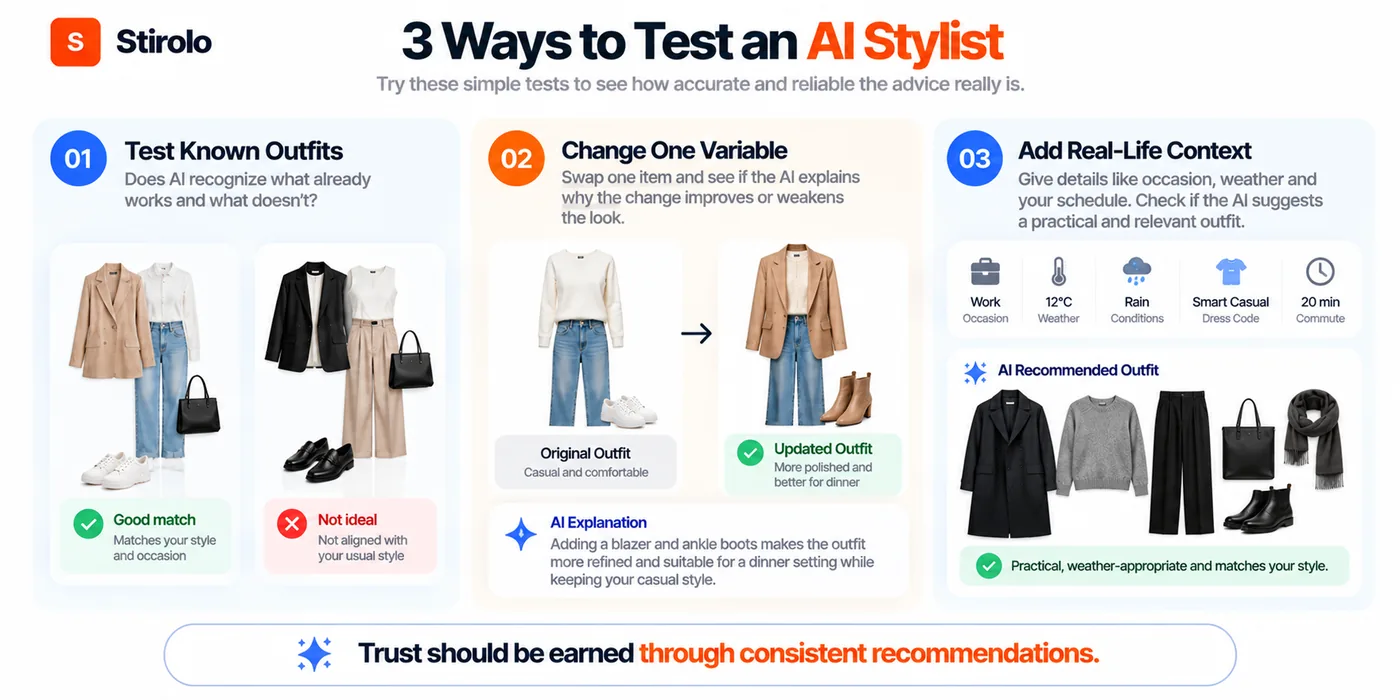
**Test the system against decisions where you already know the answer, then increase the difficulty.** A short calibration period reveals whether the assistant understands your wardrobe and whether the feedback remains consistent.
Start with known outfits
Submit 3 outfits you wear often and 2 combinations you know do not work for you. Check whether the AI identifies the same strengths and problems. Look for reasoning, not just scores or praise.
Change one variable
Swap one shoe, jacket, or trouser while keeping the rest of the outfit constant. Useful advice should explain how that change affects proportion, formality, color, or practicality. Randomly changing explanations indicate weak consistency.
Test real-life context
For work routines, Stirolo’s approach to AI styling for professionals shows how weather, formality, wardrobe availability, and time pressure can become part of one recommendation instead of separate guesses.
After calibration, use AI for low-risk daily choices first. Keep your own judgment for fit-sensitive purchases and high-stakes events until the system has earned trust through repeated useful decisions.
So, how much should you trust AI clothing advice?
**Trust AI as a decision-support tool, not as an unquestionable fashion authority.** AI can process wardrobe data, visual patterns, preferences, weather, and occasion context faster than you can compare every option manually. That strength makes AI valuable for narrowing choices and finding combinations you overlooked.
Accuracy becomes more meaningful when the advice stays consistent with your real wardrobe and improves after corrections. Generic answers deserve less confidence. Exact fit claims deserve extra caution. Visual previews deserve interpretation rather than blind trust.
The strongest use of AI is collaborative. Let the system handle comparison, memory, filtering, and repetition. Keep control of comfort, identity, cultural judgment, and the final decision. That division makes AI styling useful without pretending fashion has one objectively correct answer.
FAQs about AI clothing advice accuracy
Is AI clothing advice accurate?
Yes, for many structured styling decisions. Accuracy is strongest for coordination, occasion, wardrobe matching, and learned preferences, but weaker for exact fit and subjective taste.
Can AI tell whether an outfit looks good?
Yes, AI can evaluate visible color, balance, silhouette, and formality. The result still reflects learned patterns and may not match your personal or cultural taste.
Can AI replace a personal stylist?
No, not in every situation. AI works well for frequent everyday decisions, while a skilled human remains stronger for tactile fit, emotional nuance, and complex high-stakes styling.
Does AI fashion advice improve over time?
Yes, if the system stores useful feedback. Saved looks, rejected suggestions, fit preferences, and wardrobe history can make later recommendations more personal.
Can AI virtual try-on show exact fit?
No. Virtual try-on can preview appearance and proportions, but a generated image cannot guarantee size, comfort, fabric behavior, or movement.
Use AI advice as a sharper second opinion
AI clothing advice becomes more useful when the system knows what you own, how you like clothes to fit, where you are going, and what you rejected before. The goal is not to surrender your taste. The goal is to spend less time guessing and more time choosing from relevant options.
Stirolo connects wardrobe data, body context, personal taste, occasions, environment, and ongoing feedback so recommendations can start from your real life rather than generic fashion rules. Explore Stirolo’s styling workflow to see how contextual AI can support better daily outfit decisions.
Research Sources Reviewed
- FashionAdvice.ai — Does AI Fashion Advice Actually Work? A Real-World Test
- Corlen — AI Personal Stylist Apps: What They Actually Do (and Miss)
- Style3D AI — Which AI Fashion Stylist App Gives the Most Accurate Advice?
- Outflik — Why Your AI Stylist Gives Bad Advice
- sunday.style — AI Personal Stylist vs Human Stylist
- Google — Virtual Try-On With Generative AI
- Google — Digital Wardrobe in Google Photos
- Stirolo — How It Works
- Stirolo — Features