
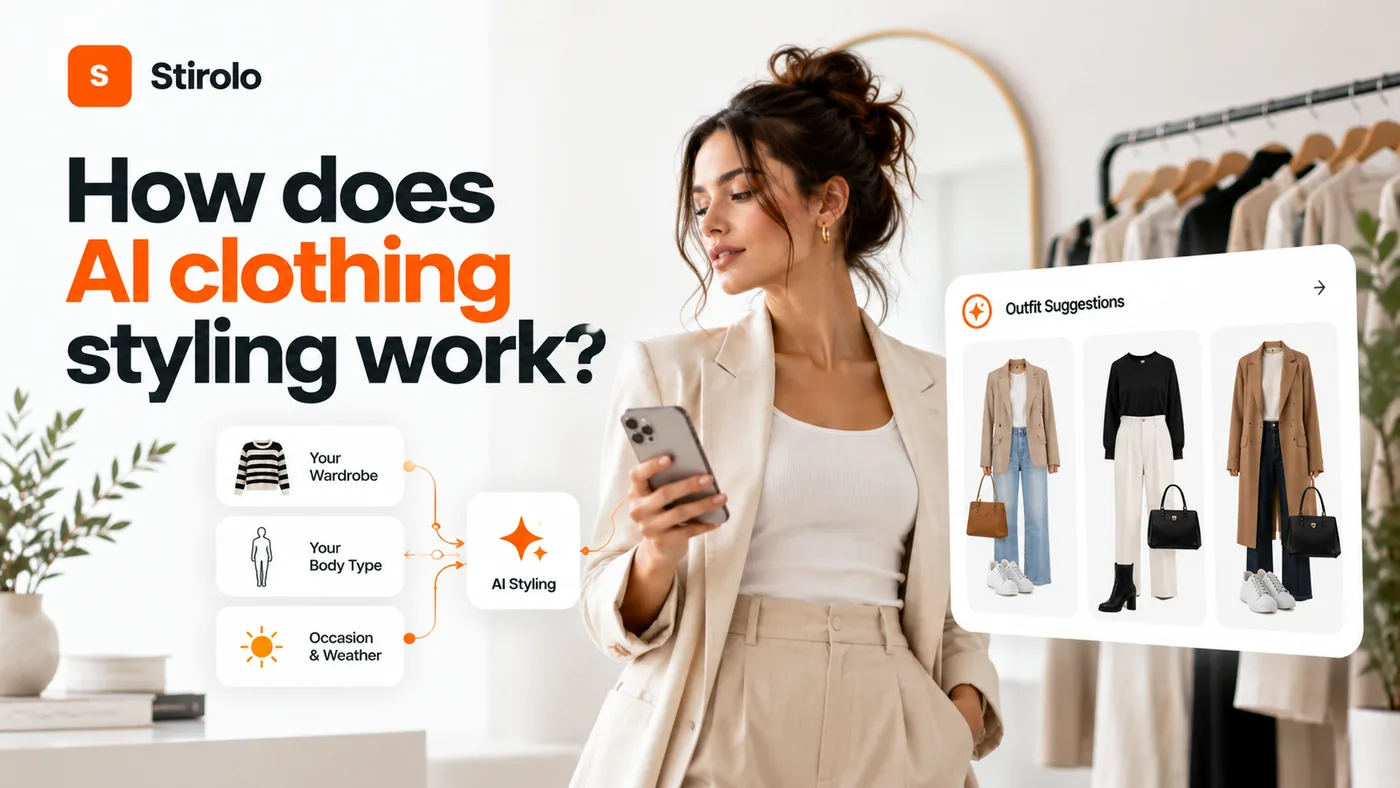
AI clothing styling works by analyzing your wardrobe, preferences, body information, and context before ranking suitable outfit combinations. The system then learns from your saves, skips, edits, and repeat wears to improve later recommendations.
An AI stylist does more than match a top with trousers. Strong systems identify garment attributes, interpret your request, filter unsuitable choices, and score complete looks against your personal context.
The quality of the result depends on the information the system receives. A complete wardrobe, clear preferences, and specific occasion details produce more useful suggestions than a vague prompt alone.
How Does AI Clothing Styling Work From Input to Outfit?
AI clothing styling follows 5 core stages: wardrobe recognition, profile building, context analysis, outfit ranking, and feedback learning. Each stage removes unsuitable choices before the system presents a recommendation.
A wardrobe-first platform can connect these stages into one AI styling process, so the recommendation starts with clothes you actually own rather than a generic product catalog.
Step 1: AI Reads Your Wardrobe
Computer vision examines clothing photos and converts visual information into structured garment data. The system can identify categories such as shirts, trousers, coats, shoes, and dresses.
The system can also record attributes such as color, pattern, formality, season, silhouette, and visible material cues. Those tags turn a folder of images into a searchable digital wardrobe.
Accurate input matters. Clear garment photos against simple backgrounds help the system separate the clothing from surrounding objects and identify colors more consistently.
Step 2: AI Builds Your Style Profile
A style profile tells the system what you prefer, avoid, and repeatedly choose. Inputs can include preferred colors, fits, silhouettes, formality levels, style references, sizes, and body information.
Some systems ask you to complete a quiz. Other systems learn preferences from behavior, including outfits you save, pieces you reject, and combinations you edit.
Step 3: AI Reads the Occasion and Environment
Context prevents technically matching clothes from becoming impractical outfits. An AI stylist can consider work, dinner, travel, weddings, weekends, weather, temperature, and planned activities.
A request for a client meeting at 50°F (10°C) requires different clothing from a casual lunch at 86°F (30°C). The occasion changes formality, while temperature changes layers and fabric weight.
Step 4: AI Ranks Outfit Combinations
The recommendation engine compares possible combinations and scores each look against your available clothes, taste, context, and system rules. Higher-ranked combinations should satisfy more relevant constraints.
A system can rank a navy blazer, cream knit, charcoal trousers, and loafers above a heavier suit for a mild business day. The result reflects several signals rather than one color-matching rule.
Step 5: Feedback Improves Future Suggestions
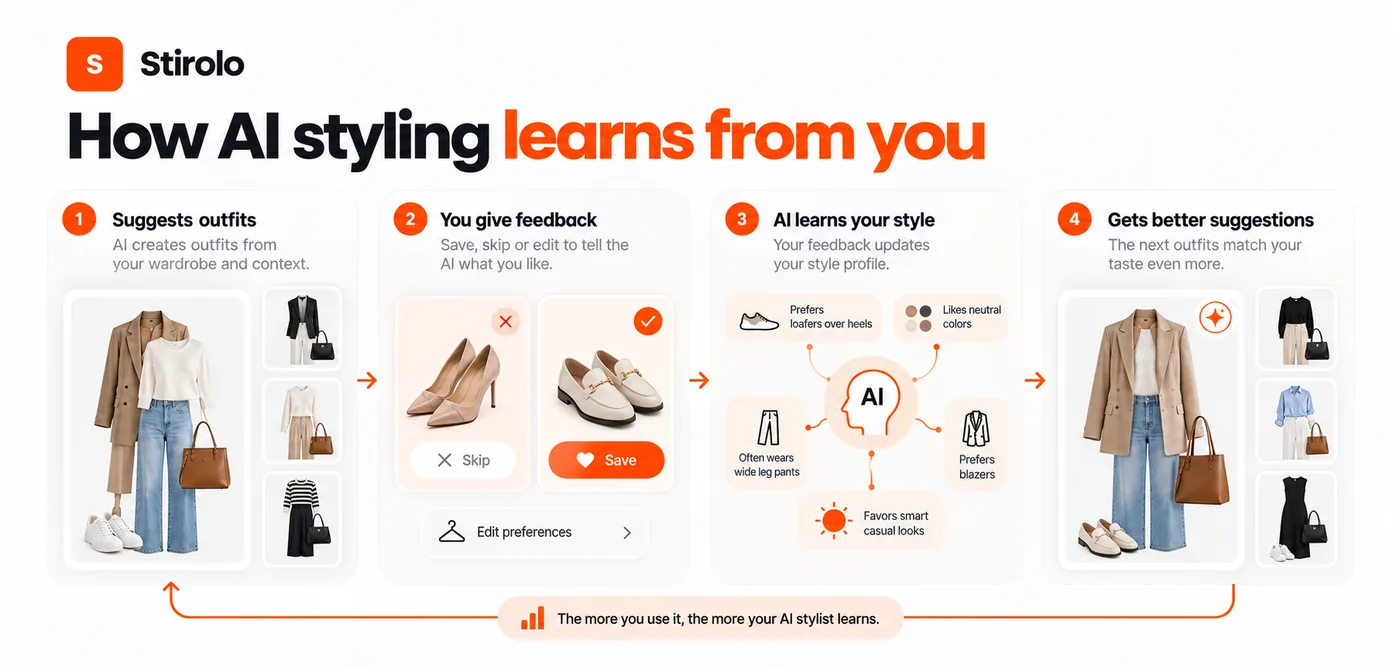
Feedback gives personalization a memory. Saving a look signals approval, while skipping or changing a piece signals that the original combination missed something important.
Explicit edits often provide stronger information than passive browsing. Replacing heels with loafers repeatedly, for example, teaches the system a practical footwear preference.
What Technology Powers AI Clothing Styling?
AI clothing styling usually combines computer vision, Natural Language Processing (NLP), and recommendation systems. Different products add body analysis, image generation, weather data, or retail catalogs around those core functions.
Computer Vision Identifies Garments
Computer vision extracts useful information from wardrobe and body images. Garment recognition can classify category, dominant color, pattern, shape, and other visible features.
Body-analysis tools can estimate proportions and posture from suitable images. A styling system can use those estimates as additional ranking signals rather than treating every wearer identically.
NLP Interprets Styling Requests
Natural Language Processing (NLP) helps the system interpret requests written in ordinary language. A prompt can contain an occasion, dress code, weather concern, preferred item, and unwanted feature.
“Style my black trousers for a relaxed dinner and avoid heels” gives the system 3 clear constraints. NLP converts those words into conditions the recommendation process can apply.
Recommendation Systems Rank Combinations
Recommendation systems score options instead of showing every possible combination. The ranking can use wardrobe attributes, user preferences, feedback history, weather, formality, and recent wear data.
Machine learning can update those rankings as new behavior appears. Personalization becomes useful when the system changes its suggestions after learning what you actually accept and wear.
What Information Does an AI Stylist Need From You?
An AI stylist needs enough information to understand your clothes, your preferences, and the situation you are dressing for. More data does not automatically mean better styling; relevant and accurate data matters more.
- Photograph wardrobe items clearly, including tops, bottoms, outerwear, dresses, shoes, and accessories.
- Describe preferences such as colors, silhouettes, formality, comfort needs, and styles you avoid.
- Add body or fit information when the platform supports proportion-aware recommendations.
- Specify context such as office, dinner, travel, temperature, rain, walking, or dress code.
- Give feedback by saving, rejecting, rewearing, or editing recommended outfits.
A partial wardrobe limits the recommendation pool. A system cannot select the brown jacket in your closet if the digital wardrobe does not contain that jacket.
How Does AI Clothing Styling Personalize Recommendations?
AI clothing styling becomes personal by combining stable preferences with changing daily context. Stable signals include your wardrobe, body information, favorite silhouettes, and color preferences.
Daily signals include weather, occasion, schedule, recent wears, and the item you want to build around. The system can weigh both signal groups before ranking a look.
Personalization also requires negative information. Telling the system that you dislike cropped jackets or avoid stiff shoes can remove unsuitable combinations before ranking begins.
Connected styling systems can combine wardrobe management, body analysis, outfit recommendations, visualization, and conversational styling in the same decision flow.
Is AI Clothing Styling the Same as Virtual Try-On?
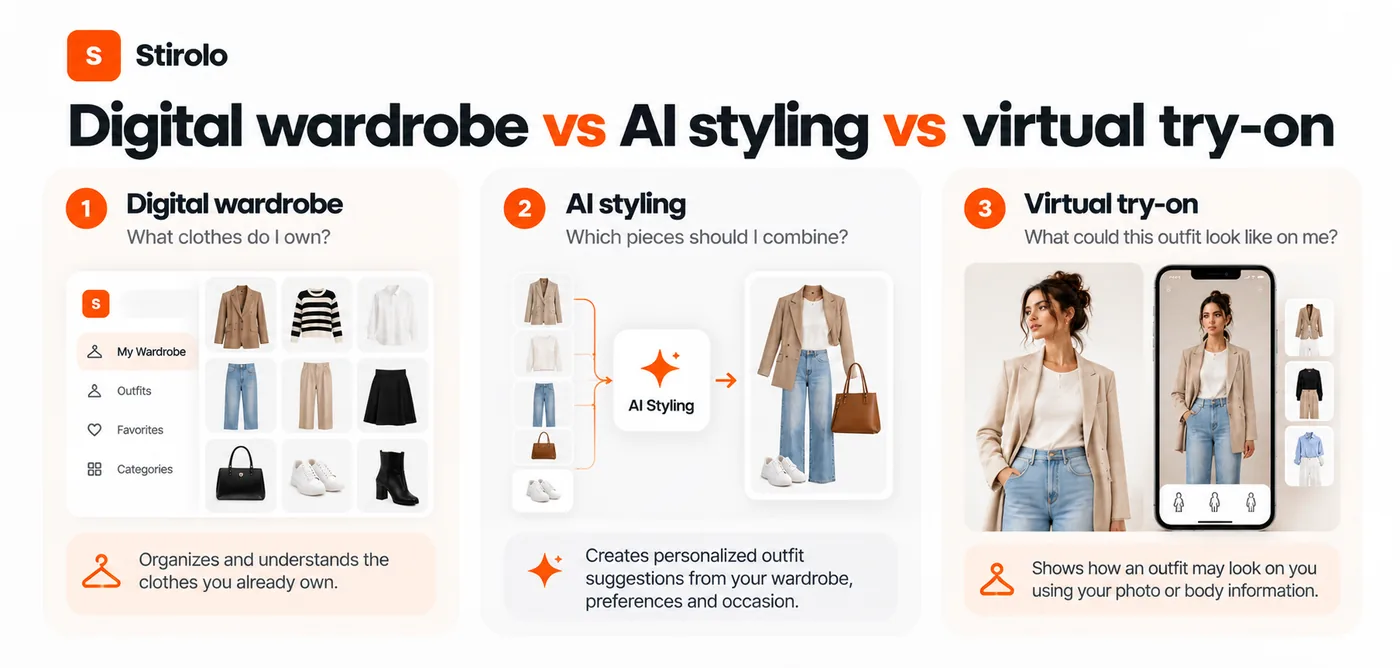
No. AI clothing styling recommends what to wear, while virtual try-on creates a visual preview of clothing on a person or body model. The 2 functions can work together, but they solve different questions.
Styling answers, “Which pieces should I combine?” Virtual try-on answers, “What could this combination look like on me?” A digital wardrobe answers another question: “What clothes do I actually own?”
Generated previews do not prove exact physical fit. Fabric stretch, weight, texture, tailoring, and comfort depend on the real garment and your body.
Quick Reference: What Happens During AI Styling?
The table maps each styling task to its typical timing, method, and user effort.
| Task | Typical Timing | Method | Difficulty |
|---|---|---|---|
| Add clothing | One-time, then ongoing | Photo recognition and garment tagging | Low |
| Build style profile | During setup | Quiz, preferences, body data | Low |
| Read daily context | Before each outfit | Occasion, weather, schedule | Low |
| Rank outfits | Seconds per request | Recommendation engine | Low |
| Preview a look | After recommendation | Virtual try-on or body rendering | Low |
| Improve suggestions | Ongoing | Saves, skips, edits, rewears | Low |
Why Do Some AI Styling Recommendations Feel Generic?
Generic results usually come from weak context, incomplete wardrobe data, limited preference signals, or a system designed mainly for product discovery. AI cannot personalize information that the system never receives.
A prompt such as “give me an outfit” leaves almost every styling decision open. A stronger request names an anchor piece, occasion, temperature, comfort need, and anything you want to avoid.
Training coverage also matters. Mainstream casual, business, and occasion dressing often has broader visual representation than narrow aesthetics such as archival vintage, technical workwear, or avant-garde styling.
Some tools also prioritize shopping rather than wardrobe use. A product-discovery engine can suggest attractive items without knowing whether similar pieces already exist in your closet.
How to Get Better Results From an AI Clothing Stylist
To get better AI clothing styling results, give the system accurate wardrobe data, clear constraints, and specific feedback. Better instructions reduce the number of assumptions the system must make.
- Upload clear clothing photos and correct any wrong category, color, pattern, or season tags.
- Complete your style profile with preferred fits, colors, silhouettes, and formality levels.
- Describe the real occasion, including dress code, weather, walking, travel, or comfort requirements.
- Anchor the request around 1 piece when you want to wear something specific.
- Edit recommendations precisely by naming the piece or styling decision you want changed.
Specific feedback works better than “try again.” “Keep the trousers and coat, replace the shoes with something lower-profile” gives the system a concrete correction.
What Can AI Clothing Styling Do Well?
AI clothing styling performs well at organizing options, finding overlooked combinations, applying repeated constraints, and reducing daily decision time. The system can examine more combinations than you would reasonably test by hand.
Wardrobe-aware styling also helps you use existing clothes before shopping. A complete catalog can reveal that one jacket works across work, dinner, and travel outfits without requiring another purchase.
Context-aware systems can filter combinations for weather and occasion. A busy professional can receive office-ready choices without rebuilding the brief every morning.
That workflow becomes especially useful for AI styling for professionals, where weather, meetings, formality, and limited morning time shape the decision.
What Can AI Clothing Styling Not Reliably Judge?
AI cannot reliably judge every physical sensation, social nuance, or real-world fit detail from images alone. You still need to check comfort, movement, fabric feel, tailoring, and the actual dress code.
A photo cannot tell a system that wool irritates your skin after 2 hours. A generated preview cannot guarantee that a waistband stays comfortable while sitting.
Lighting also changes color perception. Camera processing can shift shades, while real fabrics reflect light differently across indoor and outdoor settings.
Treat AI recommendations as decision support. Your mirror, comfort, workplace expectations, and personal judgment still determine whether you wear the final outfit.
How Are AI Styling Apps Different From Shopping Recommendation Tools?
AI styling apps and shopping recommendation tools can use similar technology, but the systems optimize for different outcomes. A wardrobe-first stylist tries to create useful combinations from clothing you already own. A shopping engine tries to surface products you could buy.
The distinction changes the user experience. A shopping system can recommend a green overshirt because the product matches your browsing history. A wardrobe-aware stylist can first check whether you already own 2 similar overshirts and whether either one works with your trousers and shoes.
Some platforms combine both functions. A combined system should clearly separate wardrobe recommendations from optional shopping suggestions, because the user goal changes from getting dressed to considering a purchase.
Ask one practical question before trusting a recommendation: does the system know what is actually in your closet? A system without wardrobe data can personalize taste, but the system cannot reliably prevent duplicate purchases or build only wearable outfits from your real inventory.
How Does AI Create Realistic Outfit Visuals?
AI outfit visualization uses image-generation or virtual try-on models to create a visual representation of selected garments on a person or body model. The styling engine chooses the outfit first, while the visualization system renders the proposed look.
A realistic preview needs clean source images and enough body information to preserve useful proportions. Image models can still alter garment details, hems, logos, textures, or drape. You should compare the generated image with the original clothing before making a fit or purchase decision.
Visualization helps most when you compare styling directions. You can compare a tucked shirt against an untucked version, a short jacket against a longer layer, or 2 shoe choices before changing clothes.
Virtual images work as decision aids rather than measurement tools. A convincing render cannot confirm that a sleeve has the correct length, a waistband has enough ease, or a fabric moves comfortably while walking.
How Does AI Clothing Styling Work for Everyday Decisions?
AI clothing styling works best when the request describes a real decision rather than a broad desire to look better. Everyday styling needs change with schedule, temperature, travel, comfort, and the clothes currently available.
For work, the system can prioritize formality, repeat-wear history, weather, and comfortable footwear. For travel, the system can favor pieces that create multiple combinations across 3 or 4 days. For dinner, the system can shift toward a more expressive silhouette while keeping your preferred colors.
The same wardrobe can therefore produce different answers without changing your underlying taste profile. Context changes the ranking, while your stable preferences keep the recommendations recognizable as your style.
A useful AI stylist also lets you refine one decision without restarting. You can keep the trousers, replace the jacket, reduce formality, or request warmer shoes. That interaction turns outfit generation into an editing process rather than a random shuffle.
Is Your Wardrobe and Photo Data Private?
Privacy depends on the platform, so review its privacy policy, deletion controls, storage practices, and photo requirements before uploading personal images. Styling apps can process wardrobe photos, body images, preferences, purchase records, and behavioral feedback.
Use only the personal information the service actually needs. Remove unrelated people, documents, addresses, and background details from photos where possible.
Check whether you can delete body images, export wardrobe data, close your account, and remove generated content. Privacy controls matter more as your digital wardrobe becomes more detailed.
Frequently Asked Questions About AI Clothing Styling
Can AI choose outfits from clothes I already own?
Yes. A wardrobe-connected AI stylist can rank outfit combinations from the garments you upload, provided the catalog contains enough compatible pieces.
Does AI clothing styling understand body shape?
Yes, some systems use body photos or profile information to include proportions and fit preferences. Other systems rely only on wardrobe and style data.
Is an AI outfit generator the same as an AI stylist?
No. An outfit generator can create combinations or images, while a fuller AI stylist also uses your preferences, context, wardrobe, and feedback.
Do AI stylist recommendations improve over time?
Yes, systems with feedback learning can adjust recommendations using your saves, skips, edits, and repeat wears. Improvement depends on the product and data quality.
Can AI styling replace a human personal stylist?
No. AI handles repeated outfit decisions quickly, but a human stylist can assess tactile fit, nuanced social context, and personal reactions in greater depth.
AI Styling Works Best When the System Knows Your Real Wardrobe
AI clothing styling works by turning clothing images, personal preferences, body information, context, and feedback into ranked outfit choices. The strongest experience starts with accurate inputs and keeps learning from your decisions.
You should expect AI to narrow options and surface useful combinations, not replace your judgment about comfort or exact fit. A wardrobe-first system also keeps the focus on clothes you can actually wear.
Explore Stirolo styling features to see how wardrobe intelligence, body analysis, recommendations, and visualization connect in one styling workflow.