
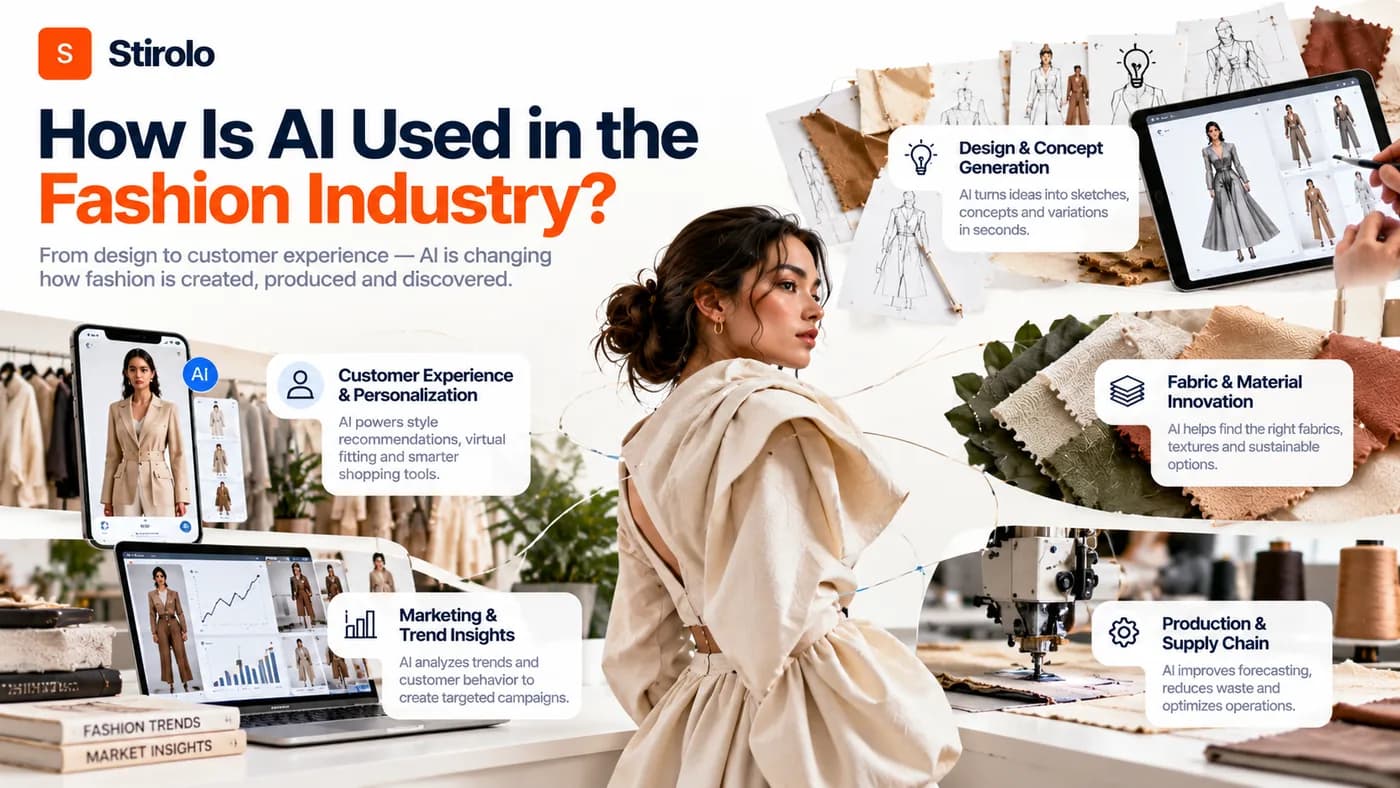
AI is used in the fashion industry to analyze trends, generate product concepts, forecast demand, plan inventory, create content, personalize shopping, support fit decisions, and style existing wardrobes. Different AI systems handle different jobs, so the useful question is not whether a brand “uses AI.” The useful question is which decision the system improves and what evidence supports that decision.
Fashion companies work with images, text, measurements, sales histories, product attributes, customer behavior, weather, and cultural signals. AI can process those inputs at a scale that manual teams cannot match. Designers, merchandisers, marketers, planners, store teams, and shoppers can then use the output to make faster decisions.
The strongest applications combine machine speed with human review. A generated dress image can accelerate ideation, but the image cannot prove construction feasibility. A demand forecast can guide a buy, but a merchant still needs context about promotions, supply constraints, and brand strategy. The same pattern appears throughout the industry.
What Does AI Actually Do in Fashion?
Fashion AI mainly performs 4 jobs: generation, prediction, recognition, and recommendation. Understanding those categories makes the industry easier to map because the same underlying methods appear in several departments.
- Generative AI creates new text, images, video, design variations, campaign concepts, and other content from prompts or reference material.
- Predictive AI estimates future outcomes, such as demand, sell-through, inventory needs, or emerging product preferences.
- Computer vision recognizes visual information, such as garment categories, colors, patterns, silhouettes, body landmarks, or visually similar products.
- Recommendation systems rank products, outfits, content, or actions using customer behavior, product attributes, context, and feedback.
Natural language processing also helps systems understand search queries, reviews, customer-service messages, and product copy. Many commercial fashion systems combine several methods rather than relying on one model.
For example, an AI shopping assistant can interpret a request with language processing, search a structured catalog, rank suitable products, and generate a conversational response. A wardrobe stylist can combine garment recognition, preference modeling, occasion context, and recommendation scoring.
How Is AI Used in Fashion Design and Product Development?
AI speeds up early design exploration by producing more concepts and variations before teams commit to samples. Designers can start with sketches, moodboards, reference images, written briefs, archive material, color directions, or silhouette constraints.
Generative systems can turn those inputs into visual directions, alternative colorways, print ideas, styling variations, or photorealistic concept renders. Designers can compare options faster and communicate a direction before investing in detailed development.
How to Turn Design Inputs Into Faster Concepts
To turn design inputs into faster concepts, define the garment before asking AI to visualize it. Specify the product category, silhouette, length, construction cues, material character, color palette, intended customer, and use case. Add references that reflect the brand rather than relying on a generic prompt.
A designer can generate several directions, reject weak options, and refine a smaller set. AI works well as an iteration engine because changing one controlled variable is faster than redrawing every concept from zero. The designer still decides which idea deserves development.
How to Use AI Without Treating Images as Specifications
To use AI safely in product development, treat generated visuals as concepts rather than factory instructions. A convincing image may contain impossible seams, inconsistent closures, unrealistic fabric behavior, or details that change between views.
Production still needs verified measurements, construction methods, material specifications, graded sizing, patterns, tolerances, trims, and sample approval. Physical drape, stretch, recovery, comfort, and durability also require material knowledge and testing. AI can shorten the route to a concept without removing technical development.
How Does AI Predict Fashion Trends and Demand?
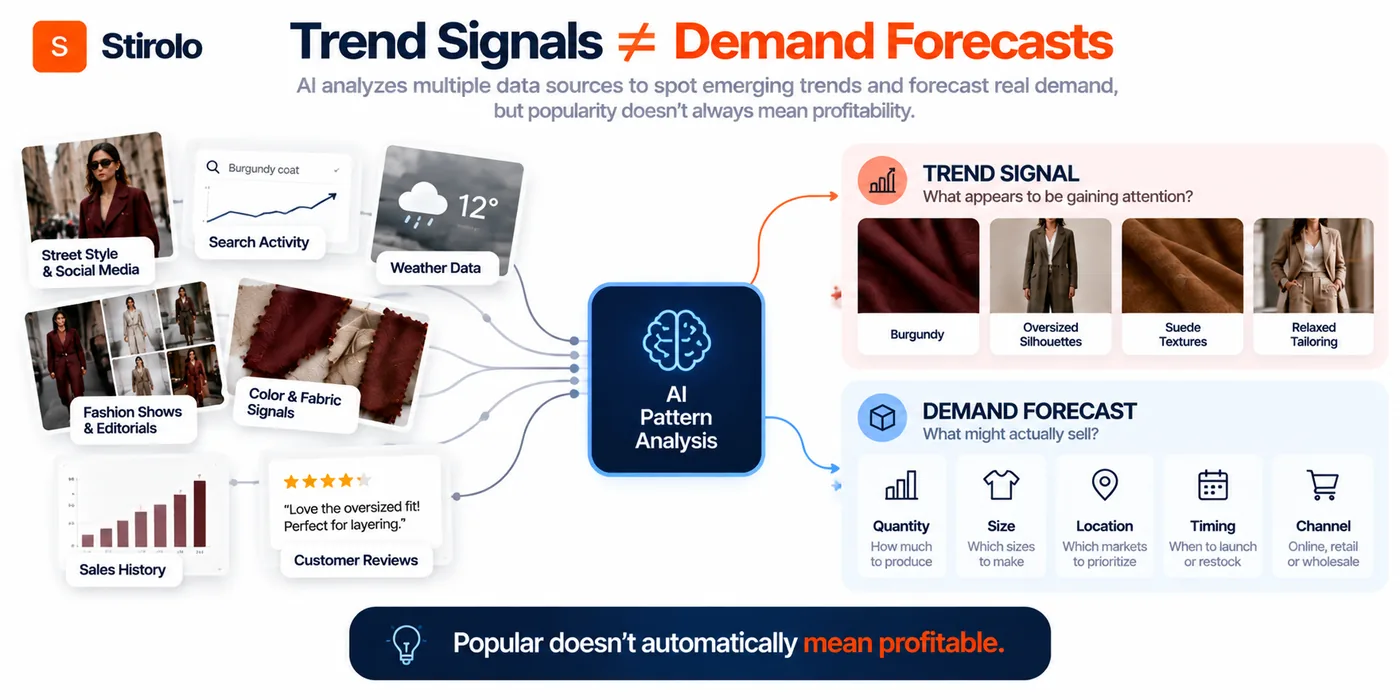
AI identifies patterns across large datasets to help teams estimate what customers may want and how much demand may exist. Inputs can include historical sales, search behavior, product views, social imagery, reviews, regional differences, weather, promotions, and broader market signals.
Computer vision can classify visible fashion attributes across large image collections. Language models and other text systems can analyze descriptions, reviews, and consumer conversations. Predictive models can then connect those signals with past commercial outcomes.
Trend analysis and demand forecasting solve different problems. Trend analysis asks which colors, silhouettes, materials, or aesthetics appear to be gaining attention. Demand forecasting estimates quantities, timing, locations, sizes, or channels. A popular aesthetic does not automatically produce profitable demand for every brand.
Human teams still need to judge whether a signal fits the brand, target customer, price point, product calendar, and sourcing reality. Fashion data can amplify temporary hype, platform bias, or historical underrepresentation. A forecast should inform a decision, not become the decision.
How Is AI Used in Manufacturing and Supply Chains?
AI supports manufacturing and supply chains by improving planning, inspection, sourcing analysis, and operational visibility. These uses receive less public attention than generated fashion images, but they can affect cost, lead time, and waste directly.
Planning systems can compare expected demand with supplier capacity, lead times, material availability, and inventory positions. Teams can use those forecasts to adjust purchase quantities or allocation earlier. AI can also help summarize supplier information, detect anomalies, and prioritize operational exceptions for human review.
Computer vision can flag visible production defects in controlled environments. Predictive maintenance can identify equipment patterns associated with failures. Warehouse systems can also improve routing, picking, and stock visibility when operational data is reliable.
AI cannot make a supply chain sustainable by itself. Poor demand data can still produce excess inventory. A more accurate forecast can reduce avoidable overproduction, but sourcing choices, labor standards, material impacts, product durability, and end-of-life systems remain management decisions.
How Does AI Improve Fashion Merchandising and Inventory?
AI helps merchandisers decide what to buy, where to place it, and when to react to changing demand. The systems can analyze sales by product attribute instead of looking only at broad category totals.
A merchandising model can compare performance by color, size, silhouette, fabric, price, location, channel, or season. Teams can use the output to identify strong combinations, weak assortment gaps, regional differences, and potential stock imbalances.
Inventory optimization can recommend allocation or replenishment changes as demand shifts. Pricing teams can also use predictive models to study elasticity, markdown timing, and promotion effects. These recommendations need commercial controls because maximizing short-term sell-through can conflict with margin, brand positioning, or customer trust.
The quality of the catalog matters. If product attributes are inconsistent, size data is incomplete, or sales history mixes unrelated promotions, AI can produce precise-looking but weak recommendations. Clean product data is part of the AI system, not an administrative detail.
How Is AI Used in Fashion Marketing and Content?
Generative AI helps fashion teams create and adapt marketing content faster across product pages, campaigns, email, social media, and advertising. Common outputs include product copy, image variations, backgrounds, campaign concepts, localization drafts, video assets, and audience-specific messaging.
The speed advantage is strongest when teams need many versions of an approved creative direction across formats, markets, products, or channels.
AI-generated models and synthetic campaign imagery can also reduce some photography requirements or expand creative possibilities. Brands need clear review standards because generated people, garments, logos, textures, and product details can be inaccurate. A marketing image should not imply a fit, finish, color, or construction that the delivered product cannot match.
Copyright, licensing, consent, disclosure, and brand safety also require attention. Teams should know what data a tool accepts, what rights apply to outputs, and whether customer or proprietary assets can be used for model training. Human approval remains necessary before publication.
How Does AI Personalize Fashion Ecommerce?
AI personalizes ecommerce by ranking products and experiences around a shopper instead of showing every customer the same catalog. Systems can use browsing history, purchases, stated preferences, product attributes, search language, size information, location, and session behavior.
How to Use Recommendations and Visual Search
To use recommendation AI well, connect customer intent with accurate product attributes. A shopper looking for a relaxed black jacket for work needs more than a list of popular jackets. The system needs information about color, silhouette, formality, material, price, availability, and possibly previous preferences.
Visual search adds another route. Computer vision can analyze an uploaded image and retrieve products with related colors, shapes, patterns, or categories. Conversational search can translate a natural request into structured catalog filters and ranked results.
How to Interpret Virtual Try-On and Fit Tools
To interpret virtual try-on correctly, separate appearance visualization from physical fit prediction. A generated image can show a plausible look without proving pressure, ease, mobility, garment balance, or comfort on a real body.
Size recommendation systems can use measurements, brand sizing, returns, purchases, or fit feedback to estimate a suitable size. Virtual try-on systems may focus more on appearance. Both can reduce uncertainty, but neither should claim more precision than the underlying data supports.
How Is AI Used After a Customer Buys Clothes?
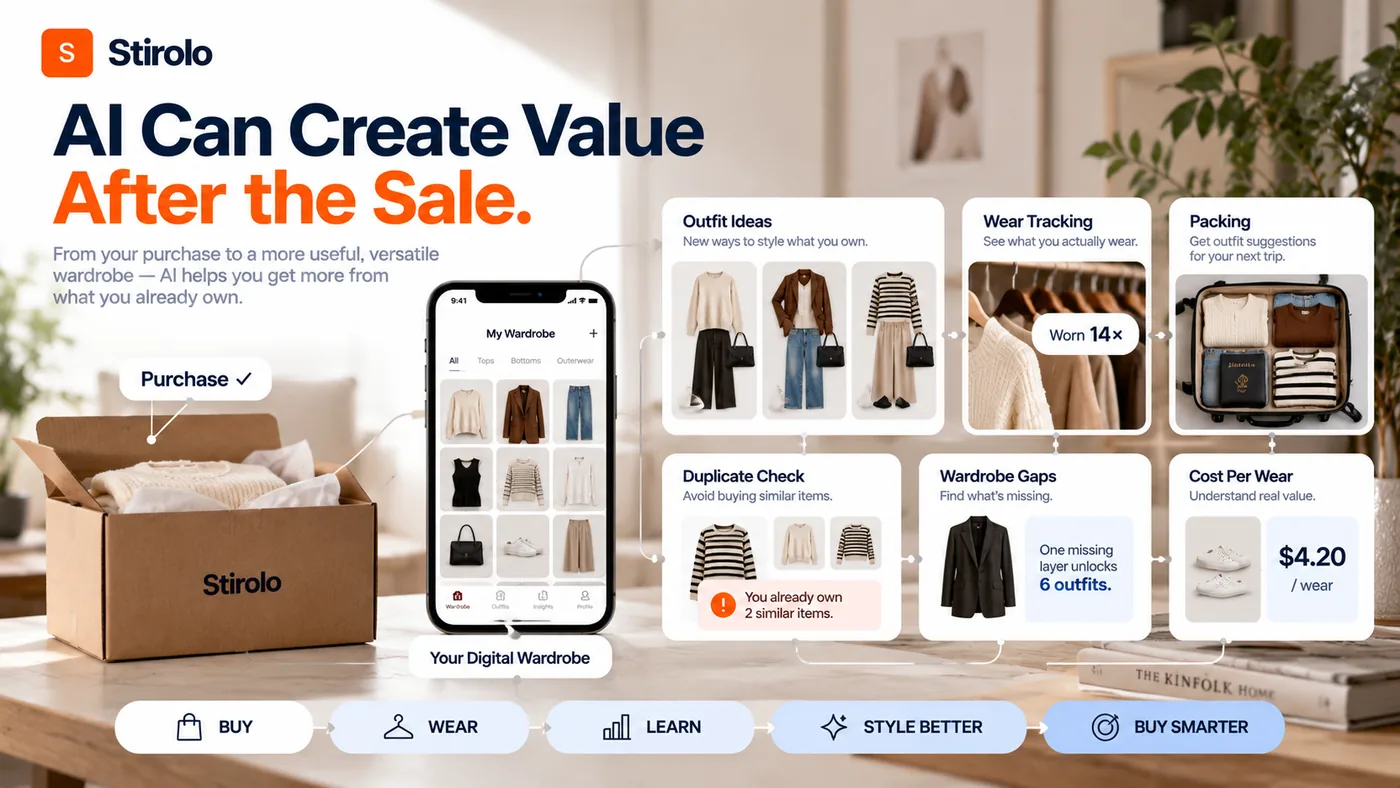
Post-purchase AI helps customers use clothing after the transaction instead of treating checkout as the end of the fashion experience. Digital wardrobes can catalog owned items, identify combinations, track wear, support packing, and flag duplicate purchases.
Stirolo shows this consumer-side application through its AI styling process, which combines body context, wardrobe items, taste, occasions, and environment before ranking outfits from clothes a user already owns.
That approach changes the optimization target. Traditional recommendation engines often optimize discovery or conversion. Wardrobe intelligence can optimize usefulness after purchase by asking whether an item works with the customer’s existing closet and whether owned pieces are being used.
Its wardrobe intelligence features include wardrobe management, outfit recommendations, conversational styling, visualization, packing support, shopping guidance, and style analytics within one connected workflow.
Post-purchase data can also reveal different questions from sales data. Wear frequency, outfit compatibility, repeated skips, and cost per wear can help a customer understand practical value. These signals can support more deliberate future purchases instead of simply increasing product exposure.
For a focused example, Stirolo’s capsule wardrobe system ranks owned pieces by combination potential, identifies a high-utility core, and highlights gaps that would create useful new outfits.
What Are the Main Risks of AI in Fashion?
The main risks are inaccurate outputs, biased data, weak privacy controls, intellectual-property problems, unrealistic representation, and automation without accountable review. Fashion AI often works with personal images, body information, proprietary designs, customer behavior, and commercially sensitive data.
Bias can enter through training data, product catalogs, historical sales, photography, sizing systems, or feedback loops. A recommendation system can repeatedly favor what sold before and make it harder for new aesthetics or underserved customers to surface. Body-related systems can perform unevenly if training and validation data lack diversity.
Generative systems can also invent details. A model may produce a plausible garment, supplier summary, product description, or customer answer that contains false information. High-impact outputs need verification against product specifications, inventory systems, policies, or physical samples.
Privacy deserves particular care in personalization. Businesses should minimize unnecessary data collection, define retention rules, control access, and explain how sensitive inputs are used. A useful personalization feature does not justify collecting every available signal.
Which Fashion AI Uses Should Businesses Prioritize?
Businesses should prioritize AI where a repeated decision has measurable inputs, measurable outcomes, and a clear human owner. The best starting point is usually a narrow workflow with enough reliable data to evaluate whether the system improves speed, quality, cost, conversion, returns, stock efficiency, or customer satisfaction.
A small brand may gain more from product copy, catalog enrichment, support, or creative variants than from a custom forecasting model. A large retailer with clean historical data may gain more from demand planning, allocation, personalization, and search.
Teams should define the baseline before deployment. Measure the current time, error rate, conversion rate, return rate, forecast error, or other relevant outcome. Then test the AI-assisted workflow against that baseline. A polished demo is not evidence of business value.
Quick reference: where AI fits across fashion
| Fashion task | Typical AI input | AI output | Human check |
|---|---|---|---|
| Design concepts | Briefs, sketches, references | Visual options, colorways | Feasibility and brand fit |
| Demand planning | Sales, inventory, context | Forecasts and quantities | Events and commercial context |
| Merchandising | Product and sell-through data | Assortment or allocation signals | Margin and brand strategy |
| Marketing | Approved creative and product data | Copy and visual variants | Accuracy, rights, disclosure |
| Personalization | Behavior, preferences, catalog | Ranked products or outfits | Bias and relevance |
| Fit support | Measurements and sizing data | Size or visual guidance | Physical fit limitations |
| Wardrobe styling | Owned items and personal context | Outfit recommendations | User preference and feedback |
A practical AI roadmap starts with the decision, not the technology. Define the user, the input data, the expected output, the human reviewer, and the metric that proves improvement. Expand only after the first workflow performs reliably.
FAQs About AI in the Fashion Industry
Is AI actually used by fashion companies today?
Yes. Fashion companies use AI in product development, content creation, search, recommendations, customer service, merchandising, demand planning, and other operational workflows. Adoption varies by company size, data quality, and business need.
Can AI design clothes by itself?
AI can generate clothing concepts, but a generated concept is not automatically production-ready. Designers and technical teams still need to validate construction, patterns, materials, measurements, fit, cost, and manufacturability.
How does AI help fashion retailers?
AI helps retailers analyze demand, manage assortments, improve search, personalize recommendations, support customer service, and optimize inventory. The value depends on reliable product, customer, sales, and inventory data.
Does virtual try-on show exact clothing fit?
No. Virtual try-on can help visualize appearance, while some fit systems estimate size using measurements and historical data. Neither method can guarantee physical comfort, drape, movement, or fit in every garment.
Can AI make fashion more sustainable?
AI can support lower-waste decisions, but AI does not make fashion sustainable on its own. Better demand forecasts, inventory planning, wardrobe use, and material analysis can reduce some waste. Production volumes, materials, labor, durability, and circular systems still require business decisions.
AI Is Becoming an Operating Layer Across Fashion
AI matters most when it improves a real fashion decision rather than adding technology for its own sake. The industry already uses AI before a product exists, while it is being sold, and after it enters a customer’s wardrobe.
Design teams can explore faster. Planners can model demand. Merchandisers can read product performance at greater detail. Marketing teams can create variants quickly. Retail systems can make discovery more personal. Wardrobe tools can help customers get more use from what they already own.
The common requirement is trustworthy context. AI needs accurate product data, relevant customer signals, clear constraints, and human review. Fashion remains physical, cultural, emotional, and commercial. Models can process signals and generate options, but people still decide which outputs deserve to become products, purchases, or outfits.
To see this principle applied at the personal-styling end of fashion, explore Stirolo and compare how personal context can turn AI signals into practical outfit decisions.