

Technology is remaking fashion by changing how clothes are imagined, presented, discovered, bought, styled and even understood. The shift is bigger than putting artificial intelligence into a design studio: digital systems increasingly influence fashion’s speed, visual language, commercial decisions and relationship with the person wearing the clothes.
Fashion has always absorbed new tools, from industrial sewing machines to synthetic fibers and ecommerce. What feels different now is that software can participate in decisions once made almost entirely by people. Algorithms can detect patterns in demand, generative systems can produce visual concepts, 3D tools can simulate garments, and recommendation engines can decide which styles an individual sees first.
What Does It Mean to Say Technology Is Remaking Fashion?
To say technology is remaking fashion means digital systems now influence both the process and the result. Technology no longer sits only behind the scenes in inventory systems or online checkout. It can affect which silhouettes are developed, which products are promoted, how campaigns look, what shoppers discover and how people assemble outfits from their own wardrobes.
The change operates at several levels. Designers have new creative tools. Brands have more behavioral data. Retailers can personalize storefronts. Consumers can visualize products without entering a fitting room. Digital garments can exist without a physical equivalent. Wearable devices and smart textiles can give clothing functions beyond appearance and protection.
How Is Technology Changing the Way Fashion Is Designed?
Technology is moving more of fashion design into searchable, editable and simulated digital environments. Designers can explore references, create variations, test colorways, build 3D samples and communicate production details before a physical sample exists.
This changes the economics of experimentation. A physical prototype requires material, labor and time. A digital variation can often be created and compared much earlier in the process. The digital version does not prove how a real garment will drape, feel or survive wear, but it can help teams reject weak directions before committing to physical development.
AI expands the number of concepts designers can test
Generative AI can rapidly create visual directions from text, images or existing design material. Its strongest role is often exploration rather than final authorship. A designer can use generated outputs to test proportions, surface treatments, styling directions or campaign concepts, then decide what deserves human development.
The creative risk is obvious: a system trained on existing material can make novelty look like recombination. Designers still need judgment, knowledge of construction, material awareness and a distinct point of view. More concepts do not automatically produce better fashion.
3D tools move more decisions into a digital workspace
Three-dimensional garment software lets teams construct and visualize clothing on digital avatars. This can support design review, fit communication and sampling decisions before every option is physically produced. Digital prototyping also makes remote collaboration easier because teams can discuss the same simulated garment instead of relying only on sketches.
Simulation has limits. Fabric behavior depends on material properties, construction and finishing, while comfort depends on a real body in motion. The physical sample remains important when the question is actual fit, hand feel or durability.
How Are Algorithms Changing What Becomes Fashionable?
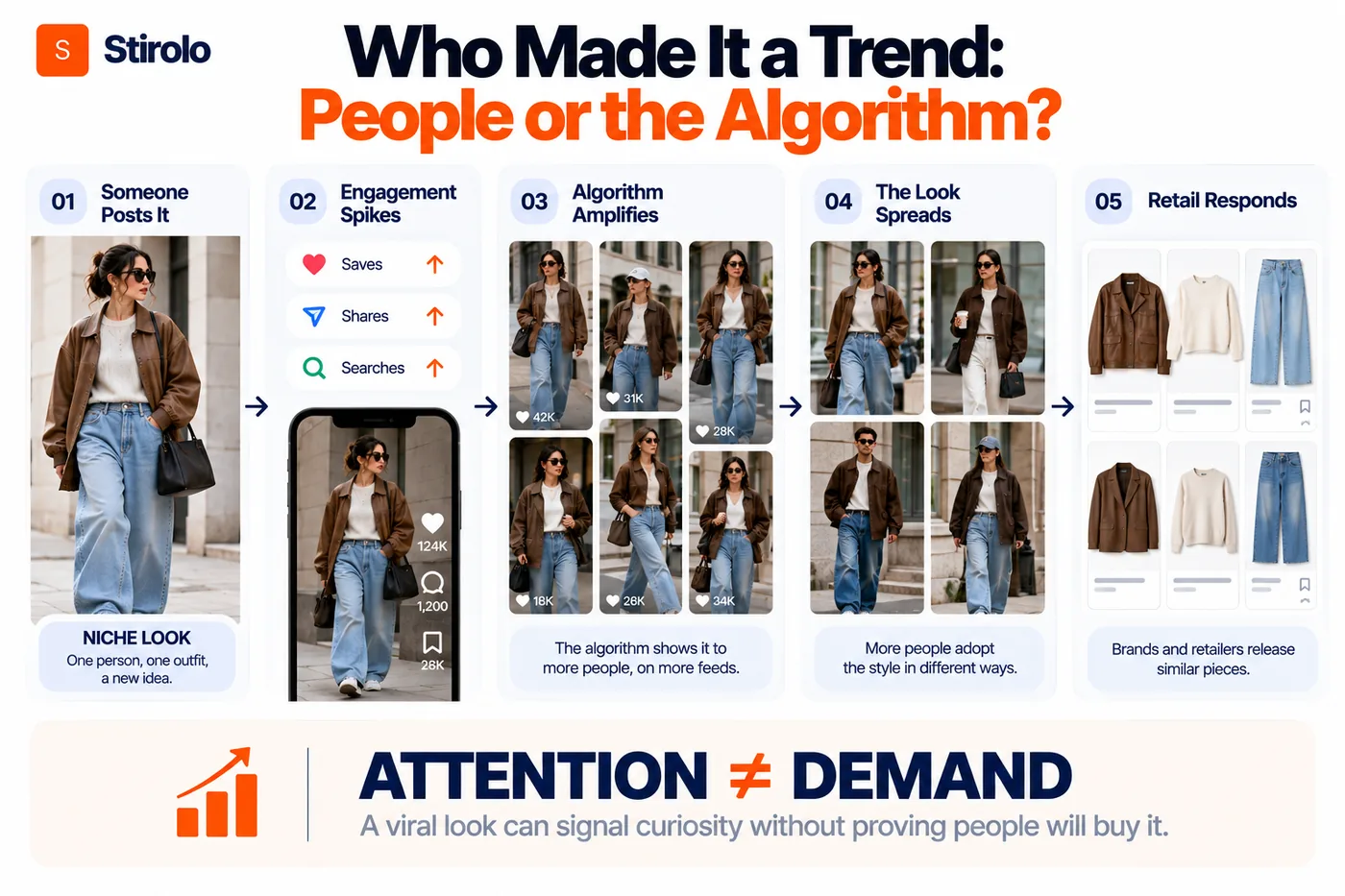
Algorithms influence fashion by controlling visibility. On social platforms, marketplaces and shopping feeds, people rarely see every available style. Ranking systems decide which posts, products and creators receive attention first. That makes software part of the pathway through which a look becomes recognizable.
A trend can now move from a small online community to a broad audience quickly because platforms detect engagement and distribute similar content. The same mechanism can shorten the distance between inspiration, imitation and retail response. A style does not need to wait for a seasonal magazine cycle to become culturally visible.
This creates a tension between discovery and convergence. Personalized feeds can expose someone to highly specific aesthetics. At the same time, systems that reward proven engagement can repeatedly amplify similar shapes, colors and visual formats. Technology can therefore create more niches while also making successful niches easier to copy.
Trend forecasting is changing for the same reason. Historical sales still matter, but brands can also study search behavior, social signals and product interaction data. These signals describe attention, not guaranteed future demand. A viral image may indicate curiosity rather than purchase intent, so human interpretation remains necessary.
How Is Technology Changing Fashion Images and Models?
Fashion imagery is becoming less dependent on a camera capturing a physical scene. Generative image systems can create models, environments, poses and garments that appear photographic even when some or all of the scene is synthetic. That expands creative options, but it also changes what a fashion image can be trusted to prove.
A campaign image has traditionally suggested that a garment existed and was photographed on a person, even when retouching altered the result. Synthetic imagery weakens that assumption. A convincing picture may represent a real product accurately, represent it loosely, or depict a garment that cannot be manufactured as shown.
For consumers, disclosure and product accuracy become more important. An imaginative editorial image can function as creative expression. A product image has a different job: it should help someone understand what is being sold. Brands that blur those purposes risk creating expectations the physical garment cannot meet.
Digital models also raise questions about representation and labor. A synthetic model can be generated in many appearances, but visual diversity created by software is not the same as hiring, paying and listening to diverse people. Technology changes the production method; it does not automatically resolve the social questions surrounding fashion imagery.
How Is Retail Technology Changing the Way People Buy Clothes?
Retail technology is turning shopping from a fixed catalog into a responsive interface. Search results, homepages, recommendations, promotions and product order can change according to behavior. The store increasingly adapts to the shopper rather than presenting every shopper with the same sequence of products.
Computer vision can identify visually similar items. Recommendation systems can connect products through browsing and purchase patterns. Conversational assistants can translate a natural-language need, such as an outfit for a humid outdoor wedding, into product criteria. These tools reduce search effort when the underlying product data is accurate.
Virtual try-on reduces one kind of uncertainty
Virtual try-on can help a shopper visualize color, styling or approximate appearance before purchase. Google, for example, has developed virtual try-on experiences that use generative AI to show apparel on models and, in newer experiences, to visualize clothing using a shopper’s own image. The technology is useful for visual exploration, but an image is not a physical fitting room.
A rendered result cannot reliably tell you whether a waistband pinches, a shoulder seam sits correctly or a fabric feels comfortable after several hours. Visualization should therefore support fit decisions rather than replace measurements, garment specifications and return information.
Recommendation systems turn stores into individual feeds
Personalization can make a large catalog manageable by prioritizing items that fit a shopper’s signals. The downside is that a recommendation engine may keep repeating what has already worked. If every click teaches the system to show more of the same, convenience can narrow discovery.
Good personalization needs room for exploration. A useful fashion system should understand preferences without treating them as permanent rules. Personal style changes with work, climate, age, confidence, social context and simple curiosity.
How Are Digital Fashion and Virtual Clothes Changing the Meaning of Clothing?
Digital fashion separates some of clothing’s visual and social functions from physical fabric. A digital garment can dress an avatar, appear in a game, exist in an image or become part of an online identity without being manufactured as a conventional item.
That matters because clothing has never been purely functional. People also use fashion to signal taste, group membership, status, mood and experimentation. As more social interaction takes place through screens and virtual environments, some of those signals can be expressed through digital objects.
Digital clothing will not replace physical clothing because bodies still need real garments. Its more plausible role is an additional layer of fashion. People may own physical wardrobes for daily life while using virtual garments for games, social content, creative experimentation or digital identities.
How Is Technology Making Fashion More Personal?
Technology makes fashion more personal when it can connect general style knowledge with individual context. The useful inputs are not limited to what is trending. They include the clothes a person owns, preferred silhouettes, fit needs, colors, lifestyle, weather, dress codes and feedback on previous recommendations.
This is where digital wardrobes change the role of fashion software. Instead of treating every styling question as a shopping opportunity, a wardrobe-aware system can begin with existing clothes. It can search combinations, identify underused pieces and help a person compare outfit options for a specific situation.
Stirolo’s wardrobe and styling features reflect this shift toward personal context: the value comes from connecting AI assistance with the wearer’s clothes and preferences rather than producing generic fashion inspiration.
Personalization also changes the relationship between trend and identity. A trend may provide an input, but software can help translate that input into something compatible with a person’s wardrobe. The goal is not necessarily to dress everyone according to an algorithm. It can be to reduce the distance between broad fashion information and an individual decision.
A system becomes more useful as the wearer understands how personalized styling works and gives it better context about real constraints, preferences and occasions.
How Do the Main Fashion Technologies Change the Experience?
| Technology | What it changes | What it cannot prove alone |
|---|---|---|
| Generative AI | Concepts, imagery and creative variation | Manufacturability, originality or physical quality |
| 3D garment tools | Digital prototyping and design review | Real comfort, hand feel or final fit |
| Recommendation AI | Product and outfit discovery | Whether a suggestion feels personally right |
| Virtual try-on | Visualizing possible appearance | Exact physical fit and comfort |
| Digital wardrobes | Using owned clothes as searchable data | Accurate advice if wardrobe data is incomplete |
| Smart textiles | Adds sensing, response or electronic function | Whether the garment is desirable as fashion |
Are Smart Textiles Turning Clothes Into Technology Products?
Smart textiles push fashion technology into the garment itself. Conductive fibers, embedded sensors and responsive materials can allow clothing to measure movement, react to temperature, provide feedback or interact with other devices. In these cases, clothing becomes both an object to wear and an interface.
The design challenge is that technology has to survive fashion’s ordinary demands. A useful feature is not enough if the garment is uncomfortable, difficult to wash, visually unappealing or obsolete quickly. Electronics also introduce questions about repair, batteries, recycling and data collection.
The strongest wearable products tend to make the technology serve a clear human need. Fashion still matters because people choose what to put on their bodies. A technically impressive garment that people do not want to wear has failed as clothing.
Is Technology Making Fashion More Creative or More Similar?
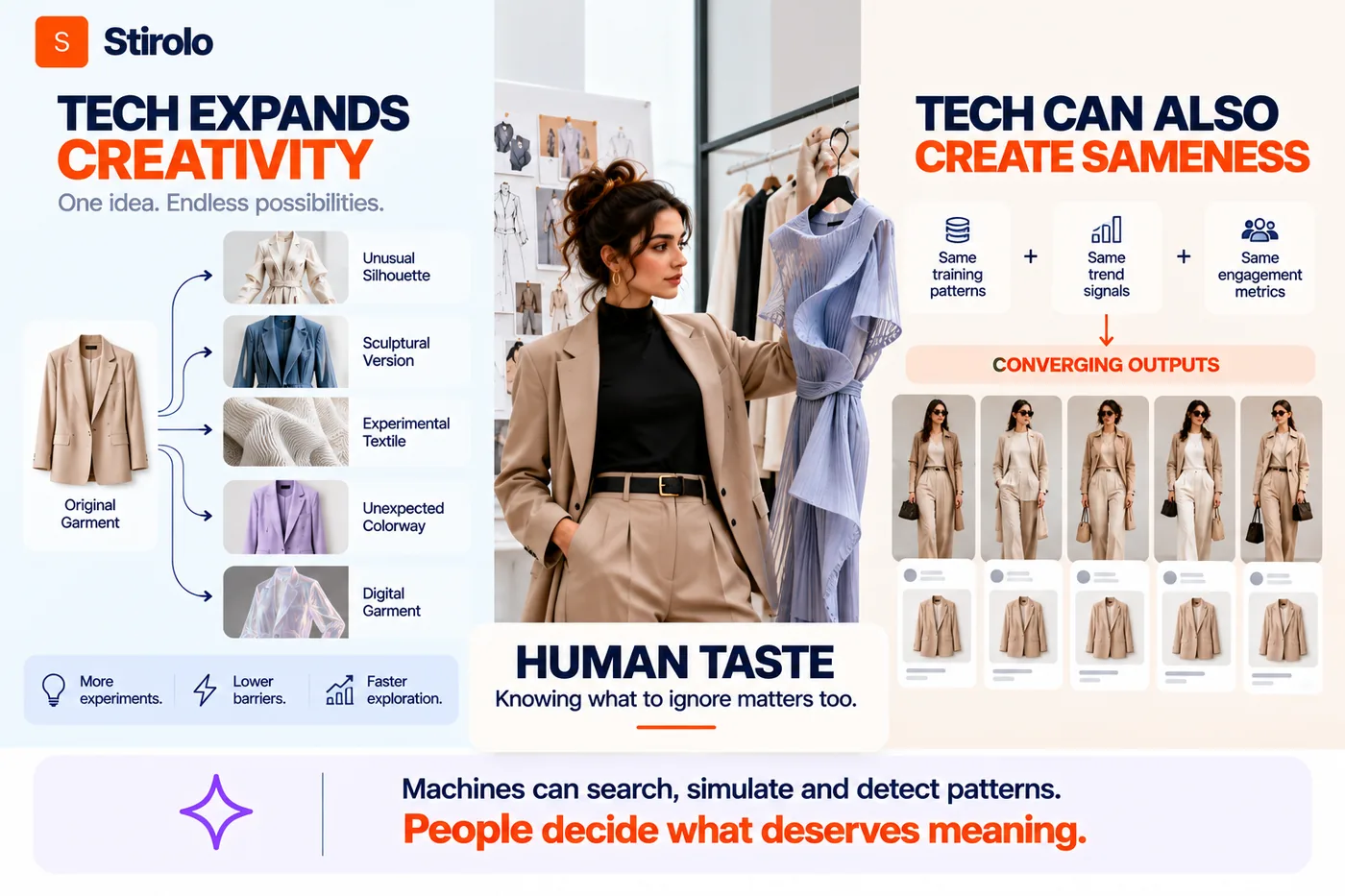
Technology can do both. Creative tools lower the cost of experimentation and give more people access to capabilities that once required specialist software, equipment or production resources. A small team can visualize a campaign, prototype a garment or build a digital collection with fewer barriers than before.
The same systems can create sameness. Generative tools learn from existing patterns. Recommendation engines favor measurable engagement. Social platforms reward recognizable formats. Trend data can encourage brands to chase signals already visible in the market. If everyone uses similar inputs and optimizes for similar metrics, outputs can converge.
Human direction therefore becomes more valuable, not less. A designer, stylist or wearer has to decide which signals to ignore. Taste includes exclusion: choosing not to follow a trend, keeping an unusual proportion, repeating a favorite garment or combining pieces that a popularity model would not prioritize.
The most interesting future is not a contest between human creativity and technology. It is a division of labor in which machines handle search, simulation and pattern detection while people retain responsibility for meaning, judgment and identity.
What Should Consumers Keep Human in a Technology-Shaped Fashion System?
Consumers should keep final judgment human. Technology can surface options, visualize possibilities and organize information, but the wearer still knows whether an outfit feels comfortable, appropriate and recognizably theirs.
A useful way to work with fashion technology is to treat recommendations as candidates rather than commands. Ask why a suggestion works. Check whether it fits the actual occasion. Compare it with clothes already owned. Reject recommendations that require unnecessary purchases. Correct the system when it misunderstands a preference.
Privacy deserves similar attention. Personalization may involve photos, body information, purchase history, location, wardrobe images or preference data. People should understand what a service collects, why it needs the information and whether they can remove it.
For people using technology to develop rather than outsource their taste, practical style guidance can provide a useful human-readable layer alongside algorithmic recommendations.
FAQs About Technology Remaking Fashion
Is technology replacing fashion designers?
No. Technology can automate or accelerate parts of research, visualization, variation and production planning, but designers still make decisions about concept, construction, material, meaning and final quality.
Will AI-generated fashion images replace photography?
Not completely. Synthetic imagery can handle some concept and campaign work, while photography remains valuable when brands need to document real garments, materials, fit and people.
Is digital fashion real fashion?
Yes, when it serves fashion’s expressive or identity functions in digital environments. It is different from physical clothing because it does not need to protect or fit a physical body.
Can technology make personal style better?
Yes, when it helps you understand and use your own wardrobe, preferences and context. It becomes less useful when it simply pushes popular products or repeats previous choices.
What fashion technology will matter most to ordinary shoppers?
Personalization, visual search, digital wardrobes, conversational shopping and virtual try-on are likely to be especially visible because they directly affect discovery, outfit planning and purchase decisions.
Fashion Is Becoming a Conversation Between People and Technology
Technology is remaking fashion in its own image, but the process is not one-way. Fashion also forces technology to deal with qualities that are difficult to reduce to data: taste, identity, comfort, cultural meaning and the pleasure of wearing something that simply feels right. The most useful tools will not make every person dress according to the same optimized formula. They will help designers and wearers explore more possibilities while leaving room for judgment, surprise and change. As fashion becomes more digital, the human task is to decide which technological possibilities deserve a place in the clothes, images and personal style we actually want to live with.