
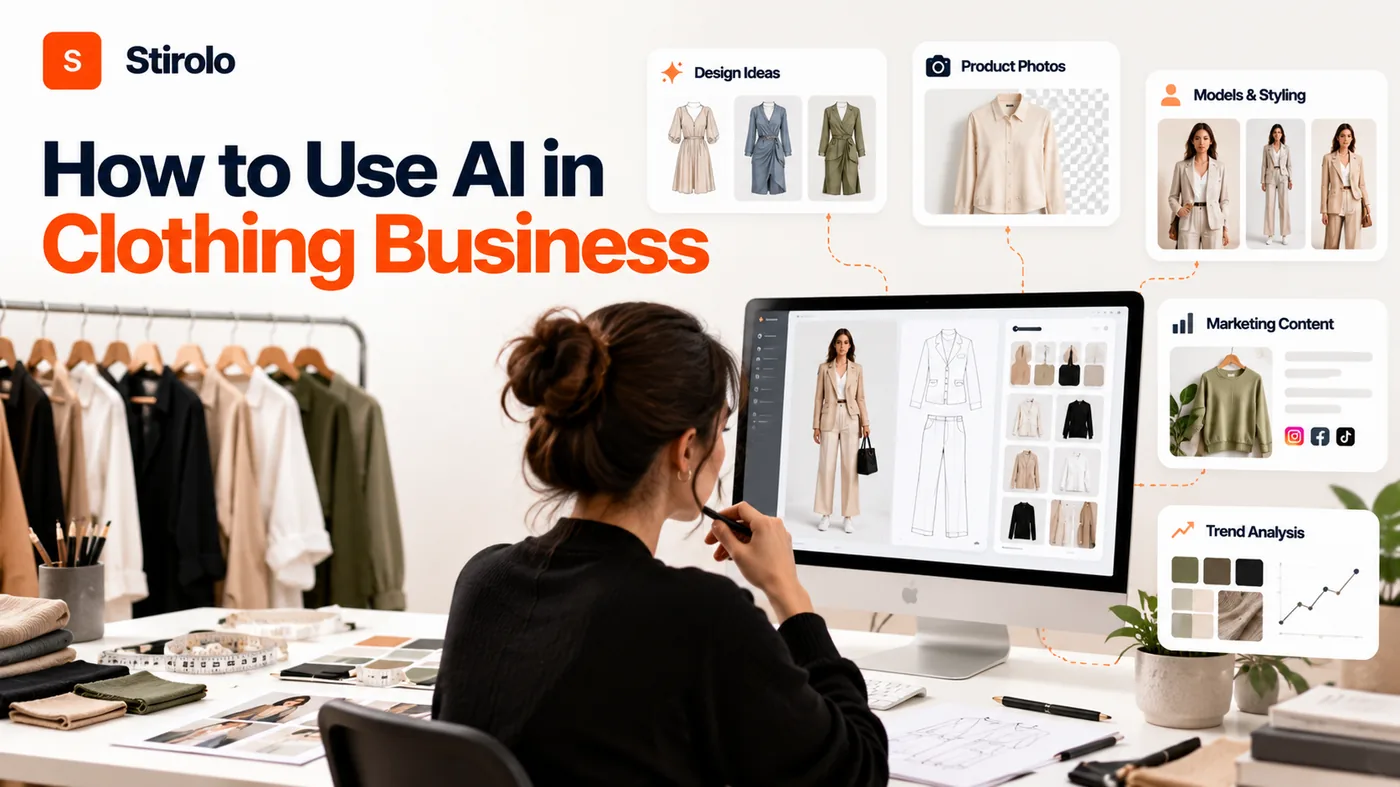
AI can help a clothing business research demand, develop products, create content, personalize ecommerce, forecast inventory, support customers, and improve retention. The best results come from applying AI to a specific business decision, then measuring whether the workflow becomes faster, cheaper, or more accurate.
A clothing brand does not need to automate the entire company. Start with one repeated task that has clear inputs and a measurable output. Keep human review wherever fabric, fit, brand identity, product claims, or customer trust can be damaged by a wrong answer.
Where Can AI Create the Most Value in a Clothing Business?
AI creates the most value when a clothing business uses it for high-volume pattern recognition, repetitive content work, customer personalization, or decisions supported by structured data. Fashion teams can apply machine learning and generative AI across product development, merchandising, marketing, ecommerce, supply chains, and customer experience.
The first question should not be, “Which AI tool should we buy?” Ask which decision currently consumes time, creates avoidable cost, or causes inconsistent customer experiences. A small brand may begin with product descriptions and creative variations. A larger retailer may gain more from forecasting, assortment planning, recommendation systems, or service automation.
Treat AI as a workflow component rather than a substitute for fashion judgment. The system can sort signals and generate options quickly. Designers, merchandisers, marketers, and operators still decide which outputs fit the customer and brand.
How to Use AI for Product Research and Clothing Development
To use AI for product research and clothing development, feed the system reliable sales, search, review, trend, and product data. Ask AI to identify recurring patterns, summarize customer complaints, group preferences, and compare proposed concepts against known demand.
Use AI to organize signals, not dictate taste
A clothing business can use AI to summarize hundreds of reviews into recurring issues such as sleeve length, fabric feel, pocket placement, color demand, or sizing inconsistency. Teams can also group search terms and customer questions to see which needs appear repeatedly.
Trend analysis needs context. A spike in online conversation does not automatically justify a production run. Compare external interest with your own customer profile, historical sell-through, price point, climate, and brand identity before committing inventory.
Turn concepts into faster product decisions
Generative AI can expand a creative brief into silhouette variations, color directions, print concepts, mood-board options, or draft product narratives. Product teams can use those outputs to explore more directions before selecting a smaller group for technical development.
Do not treat a generated image as a production specification. Fabric behavior, construction, grading, tolerances, trims, compliance, and manufacturing feasibility still require technical review. AI is strongest at early exploration and information processing, not at approving a garment for production.
How to Use AI for Fashion Product Images and Virtual Models
To use AI for fashion product images, begin with verified garment references and define what the system may change. AI can support background generation, campaign concepts, model variations, localization, image resizing, and some on-model visualization.
This workflow can help smaller clothing businesses test creative directions without producing a full shoot for every concept. It can also help ecommerce teams create channel-specific crops or contextual scenes from an approved visual system.
Protect garment accuracy and brand trust
The product must remain truthful. Check color, print scale, hem length, neckline, closures, seams, pockets, fabric texture, drape, and proportions against the real garment. Reject images that invent details or make a fabric behave differently from the product a customer will receive.
Label or disclose synthetic imagery when local rules, platform policies, or customer expectations require it. Keep original product photography for factual reference. AI campaign imagery should support the product rather than create a different product.
Create an approval checklist for every generated asset. A human reviewer should confirm garment fidelity, anatomy, brand tone, rights, representation, and any claims implied by the image before publication.
How to Use AI in Clothing Ecommerce and Merchandising
To use AI in clothing ecommerce, connect product data with customer behavior and use AI to improve discovery, merchandising, descriptions, and recommendations. The goal is to reduce the distance between what a shopper wants and the products that genuinely match that need.
AI can enrich product attributes such as color family, neckline, pattern, formality, season, silhouette, and occasion. Better attributes improve site search, filters, recommendations, and merchandising rules. Computer vision can also support visual search when customers want products similar to an uploaded image.
Generative AI can draft product descriptions, category copy, size guidance explanations, FAQs, and merchandising notes. Ground every output in the product information management system. Never let a language model invent fabric composition, care instructions, measurements, sustainability claims, or stock information.
Improve discovery, descriptions, and outfit context
Product recommendations become more useful when the system considers intent instead of only popularity. A shopper looking for a summer wedding outfit needs different ranking signals from someone replacing everyday black trousers.
Outfit context can also make individual products easier to evaluate. Show realistic pairings, occasion ideas, and compatibility with related pieces. For a deeper example of how personal context can shape recommendations, see the AI styling workflow.
How to Use AI for Clothing Marketing Without Producing Generic Content
To use AI for clothing marketing, build a controlled content system around approved brand messages, customer segments, product facts, and campaign goals. Use AI to generate variations and speed production, then let marketers choose and refine the strongest work.
Build a repeatable content system
Start with a source pack containing your brand voice, prohibited claims, customer profiles, product facts, visual rules, offers, and successful past examples. Ask AI to create channel-specific versions for email, paid social, product launches, short video scripts, landing pages, and customer follow-ups.
Use AI for variation where volume matters. A team can test different hooks, benefits, calls to action, image crops, and audience angles without rebuilding every campaign from zero. Track which variants improve click-through rate, conversion rate, revenue per recipient, or customer acquisition cost.
Keep human control over positioning
AI often produces polished but interchangeable fashion copy. Human marketers should protect the brand point of view, edit clichés, remove unsupported claims, and check whether the message actually fits the customer.
Do not publish generated content simply because production became faster. More content can create more noise. A smaller set of distinctive, accurate campaigns can outperform a large stream of generic assets.
How Can AI Personalize the Fashion Shopping Experience?
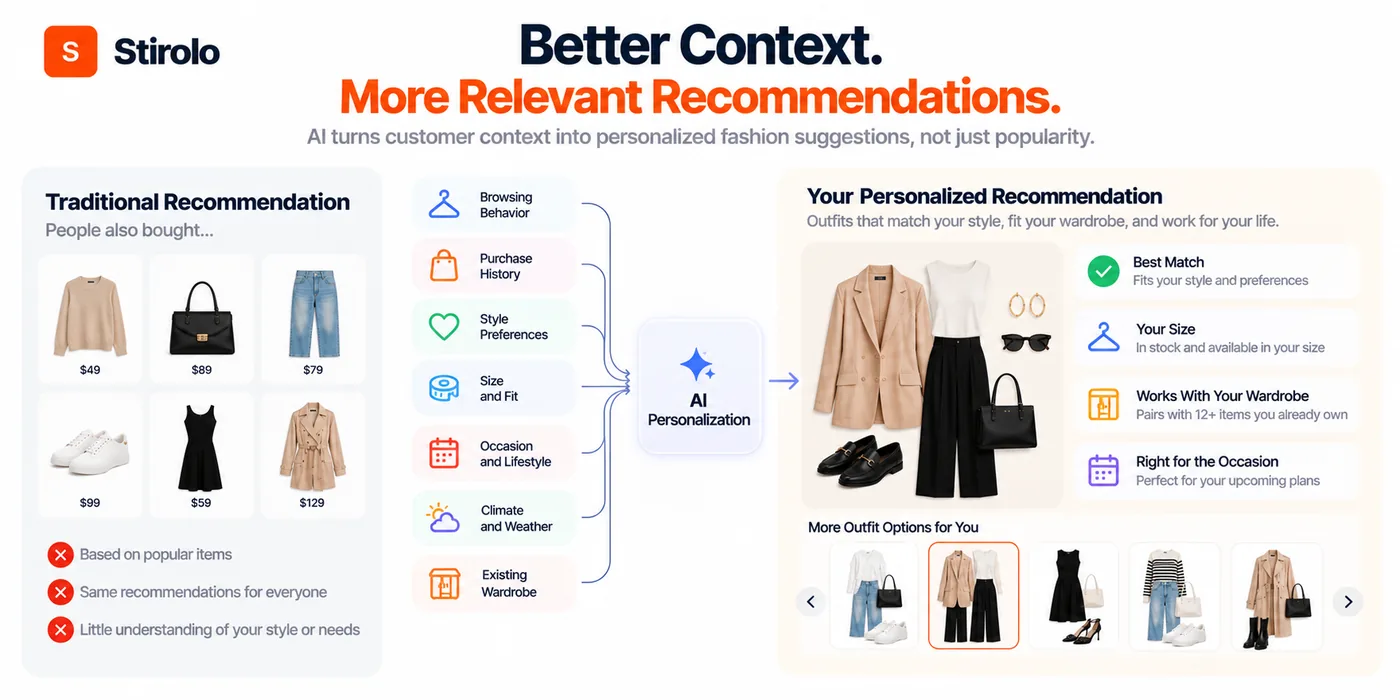
AI can personalize fashion shopping by combining signals such as browsing behavior, purchase history, stated preferences, size information, style attributes, occasion, climate, and feedback. Strong personalization narrows irrelevant choices without trapping the shopper inside a repetitive recommendation loop.
Recommendation engines can rank products, suggest complementary items, reorder category pages, or tailor messages. Virtual try-on can help customers visualize appearance, while size-recommendation systems address a different question: which size is more likely to fit. Keep those functions separate because visual similarity does not prove physical fit.
Clothing businesses can extend personalization beyond checkout. Post-purchase systems can help customers understand how a new item works with clothes they already own. That approach shifts the goal from one transaction toward long-term product usefulness.
Stirolo demonstrates this wardrobe-first model through its wardrobe intelligence features, which combine wardrobe data, wear history, body context, occasion, and shopping guidance. A retailer can use the same principle conceptually: recommendations become more useful when they reflect the customer’s real context rather than a generic “people also bought” pattern.
How to Use AI for Inventory and Demand Forecasting
To use AI for inventory and demand forecasting, combine clean sales history with stock levels, returns, promotions, seasonality, product attributes, location, and relevant external signals. Forecast at the level where the business can actually act, such as category, style, color, size, store, or stock keeping unit.
AI can flag likely stockouts, slow-moving products, regional differences, replenishment needs, and markdown risk. Merchandising teams can use those predictions to focus attention on exceptions instead of manually reviewing every product line.
Forecasting quality depends on data quality. A model cannot repair inconsistent SKU naming, missing returns, inaccurate stock counts, or promotions that were never recorded. Clean the operational data before judging the AI.
Keep planners responsible for unusual events. Supplier disruption, a viral product, an unexpected weather shift, a celebrity appearance, or a one-off campaign can break historical patterns. The system should support a decision and show the evidence behind it, not silently place irreversible orders.
How to Use AI for Customer Service and Retention
To use AI for customer service, connect the assistant to verified policies, order data, product information, and escalation rules. Let AI answer repetitive questions quickly, but route refunds, complaints, sensitive cases, and uncertain answers to a person.
Useful fashion-service questions include order status, return windows, garment care, product availability, size-chart navigation, and basic styling guidance. The assistant should say when information is unavailable instead of improvising.
Retention systems can summarize customer history, identify likely replenishment needs, recommend relevant products, or trigger follow-up messages after purchase. Avoid turning every signal into a sales message. Helpful retention gives the customer a reason to use the product more successfully.
A useful design principle is personal over generic: recommendations should reflect the individual’s context and should not exist merely to push another purchase.
What Should Clothing Businesses Not Automate With AI?
Clothing businesses should not fully automate decisions where an error can misrepresent the product, harm a customer, create a legal claim, or weaken the brand. Keep accountable people in the loop for final design approval, technical specifications, product safety, fit validation, claims, pricing exceptions, sensitive service cases, and campaign sign-off.
Do not upload confidential supplier documents, unreleased collections, customer data, or proprietary patterns into consumer AI tools without understanding data retention and training terms. Use approved business systems and restrict access by role.
Watch for bias in generated models, recommendations, sizing logic, and customer segmentation. Test across different body types, skin tones, ages, gender presentations, and accessibility needs where relevant to your market. A visually convincing output can still encode poor assumptions.
AI also needs intellectual-property controls. Review generated designs and campaign assets for unwanted similarity, trademarks, copyrighted characters, recognizable people, or restricted source material before commercial use.
How to Start Using AI in a Clothing Business in 30 Days
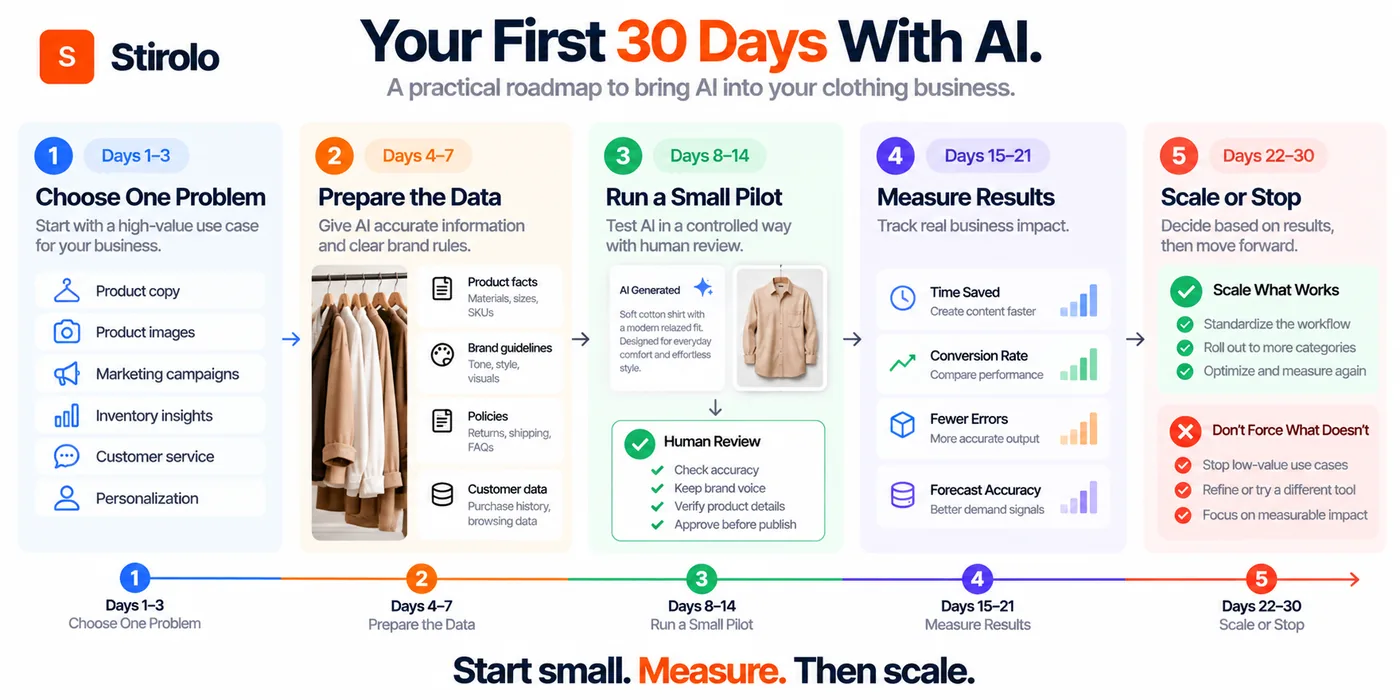
To start using AI in a clothing business in 30 days, choose one workflow, define a baseline, run a limited pilot, and expand only after the result improves a measurable business metric.
- Days 1-3: Choose one problem. Pick a repeated task with enough volume to measure. Examples include product-copy drafting, review analysis, campaign variations, service FAQs, or weekly demand exceptions.
- Days 4-7: Prepare the source data. Collect approved product facts, brand rules, historical examples, policies, or operational data. Remove duplicates and obvious errors before connecting AI.
- Days 8-14: Build a controlled pilot. Create prompts, templates, approval rules, and a small test set. Compare AI-assisted work with the current process.
- Days 15-21: Measure quality and economics. Track time saved, error rate, conversion, forecast error, service resolution, return reasons, or another metric tied to the workflow.
- Days 22-30: Standardize or stop. Document the workflow if it works. If quality does not improve after reasonable iteration, stop the pilot instead of forcing AI into the process.
Assign an owner to every production AI workflow. Someone should know which model is used, which data feeds it, how output is checked, and what happens when the system fails.
Quick Reference: AI Workflows for Clothing Brands
| Business task | AI method | Review focus | Difficulty |
|---|---|---|---|
| Customer-review analysis | Text clustering and summarization | Source coverage and false themes | Low |
| Product concept exploration | Generative text and images | Brand fit and feasibility | Medium |
| Product descriptions | Grounded text generation | Product facts and claims | Low |
| Campaign variations | Generative copy and imagery | Brand voice and garment fidelity | Low-Medium |
| Personalized recommendations | Recommendation models | Relevance, diversity, privacy | Medium-High |
| Demand forecasting | Predictive machine learning | Data quality and exceptions | High |
| Customer service | Grounded conversational AI | Policy accuracy and escalation | Medium |
| Post-purchase styling | Wardrobe and context models | Usefulness over upselling | Medium-High |
FAQs About Using AI in a Clothing Business
Can a small clothing business use AI without a large budget?
Yes. Start with low-risk workflows such as review analysis, product-copy drafts, customer FAQ support, or campaign variations. Measure time and quality before paying for a larger system.
Can AI design clothes for a fashion brand?
Yes, AI can generate concepts and variations. A designer and technical team should still validate originality, construction, fabric behavior, sizing, and production feasibility.
Can AI create realistic models for clothing products?
Yes, some systems can create or modify on-model imagery. Check every output against the real garment and reject changes to color, construction, print, drape, or proportions.
Can AI help a clothing business reduce unsold inventory?
Yes, predictive systems can improve demand, allocation, and markdown decisions when the underlying sales and inventory data are reliable. Forecasts still need human review for unusual events.
What is the best first AI use case for a clothing brand?
Choose the repeated workflow with the clearest cost or delay. For many small brands, content or customer analysis is easier to pilot than forecasting because the data requirements are lower.
Build AI Around the Customer, Not Around the Tool
The strongest clothing-business AI strategy starts with a customer or operating problem, not with a new model release. Use AI where the system can process more information, create useful variations, or surface better decisions. Keep people responsible for taste, truth, fit, risk, and the final customer promise.
Over time, the most valuable systems can connect what a brand knows before the sale with what the customer needs after the sale. Better product data can improve discovery. Better wardrobe context can improve recommendations. Better feedback can improve the next assortment.
For a consumer-side example of that connected approach, explore how Stirolo combines wardrobe, body, taste, occasion, and environment in its AI styling workflow. The principle is useful for clothing businesses too: AI becomes more valuable when it works from relevant context instead of generating generic output.