
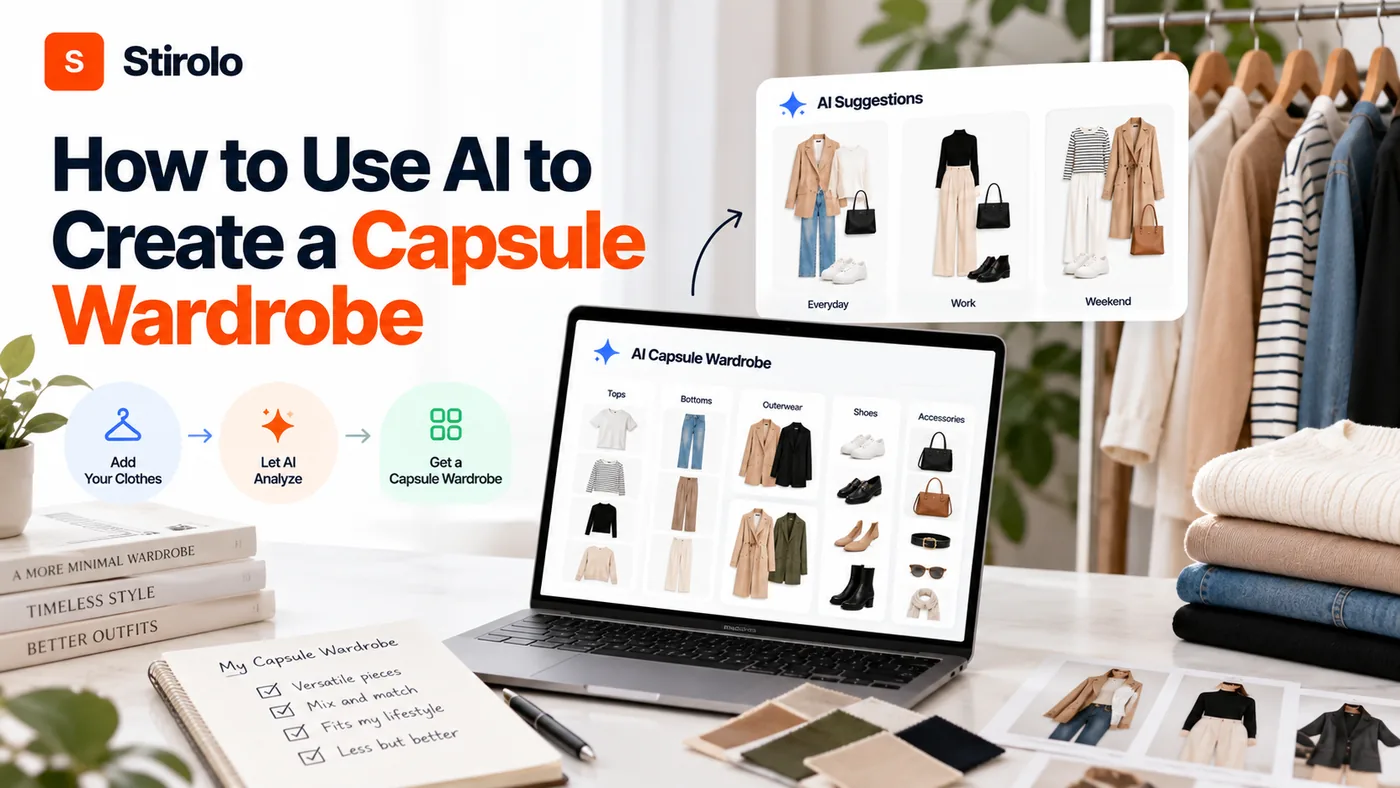
To use AI to create a capsule wardrobe, start with the clothes you already own. Give the AI your lifestyle, climate, dress codes, preferences, and wardrobe data. Then use AI to rank versatile pieces, test combinations, identify real gaps, and validate purchases before you buy.
AI works best as an analysis and planning tool. It can process more combinations than you would reasonably test by hand. It can also organize wardrobe data, spot repeated categories, and suggest outfits around specific constraints.
AI should not decide your capsule from a generic list. A useful capsule reflects your work, weekends, weather, laundry habits, body, comfort, and personal style. The goal is not to own the fewest clothes. The goal is to make the clothes you keep work harder.
You can use a dedicated AI wardrobe app, an AI personal stylist, or a general AI assistant. Dedicated wardrobe tools usually work better when they can see your actual clothing inventory and remember feedback over time.
What Should You Tell AI Before Building a Capsule Wardrobe?
Tell AI how you actually live before asking it what to keep. Your schedule and constraints matter more than a fashionable list of essentials.
Start with your typical week. Estimate how many days you dress for work, remote work, errands, exercise, social plans, religious or cultural settings, and formal occasions. Include any uniform or dress-code requirements.
Add your climate and season. A capsule for a humid summer needs different fabrics and layers from a capsule for a cold, wet winter. If your weather changes sharply, build seasonal modules instead of forcing one capsule to cover every month.
Include your laundry cycle. Someone washing clothes twice a week can work with fewer everyday pieces than someone washing every 10 days. Tell the AI how often you repeat trousers, knitwear, jackets, and shoes before cleaning them.
Finally, state your style preferences and hard limits. Name colors you avoid, silhouettes you dislike, shoes you cannot wear comfortably, modesty requirements, fabric sensitivities, and any pieces you must keep. These constraints stop AI from optimizing a wardrobe you would never enjoy wearing.
How to Digitize and Audit Your Existing Wardrobe With AI
To digitize your wardrobe with AI, add the clothes you wear most first. A clean record of 25 useful pieces is better than 100 poorly tagged items.
Photograph garments individually when possible. Some wardrobe apps can separate items from outfit photos or batch images. Check every automatic tag because computer vision can misread colors, materials, garment categories, or formality.
Stirolo explains a wardrobe-first setup in its AI styling process, where clothing data combines with body, taste, occasion, and environment signals.
For each item, capture useful attributes such as category, color, pattern, season, formality, fit preference, and availability. Add purchase price only if you want cost-per-wear analysis. Archive clothes that need repairs or no longer fit so AI does not build outfits around unavailable pieces.
Then ask AI to audit the wardrobe. Useful questions include: Which categories are overrepresented? Which pieces combine with the most other items? Which garments duplicate the same function? Which pieces rarely appear in viable outfits?
Do not remove a garment because an algorithm gives it a low score. A black-tie dress, waterproof shell, or funeral outfit may have low everyday versatility but still cover an important need. Use AI scores as evidence, not commands.
How to Use AI to Choose the Core Pieces for Your Capsule
To choose capsule pieces with AI, rank garments by usefulness across your real situations. Versatility should include fit, comfort, frequency, weather, and outfit compatibility.
Ask the AI to score each item against your weekly needs. A strong core piece should work in several complete outfits and cover a situation you face often. A neutral trouser is not automatically useful if you dislike its fit or never wear the shoes that suit it.
Use categories as guardrails, not quotas. Most capsules need enough tops, bottoms, layers, shoes, and occasion-specific pieces to cover the owner’s routine. Dresses, jumpsuits, suits, uniforms, or cultural clothing can change that balance substantially.
Keep a few identity pieces. A capsule made only from maximum-combination basics can become visually flat. A patterned shirt, bright knit, sculptural jacket, or distinctive shoe can still earn a place if you wear it often and it works with several core pieces.
Ask AI to explain each recommendation. A useful answer should say why a garment belongs: for example, “works with 5 bottoms, covers work and dinner, layers under both jackets, and suits 3 seasons.” Explanations make weak recommendations easier to catch.
How to Use AI to Create More Outfits From Fewer Clothes
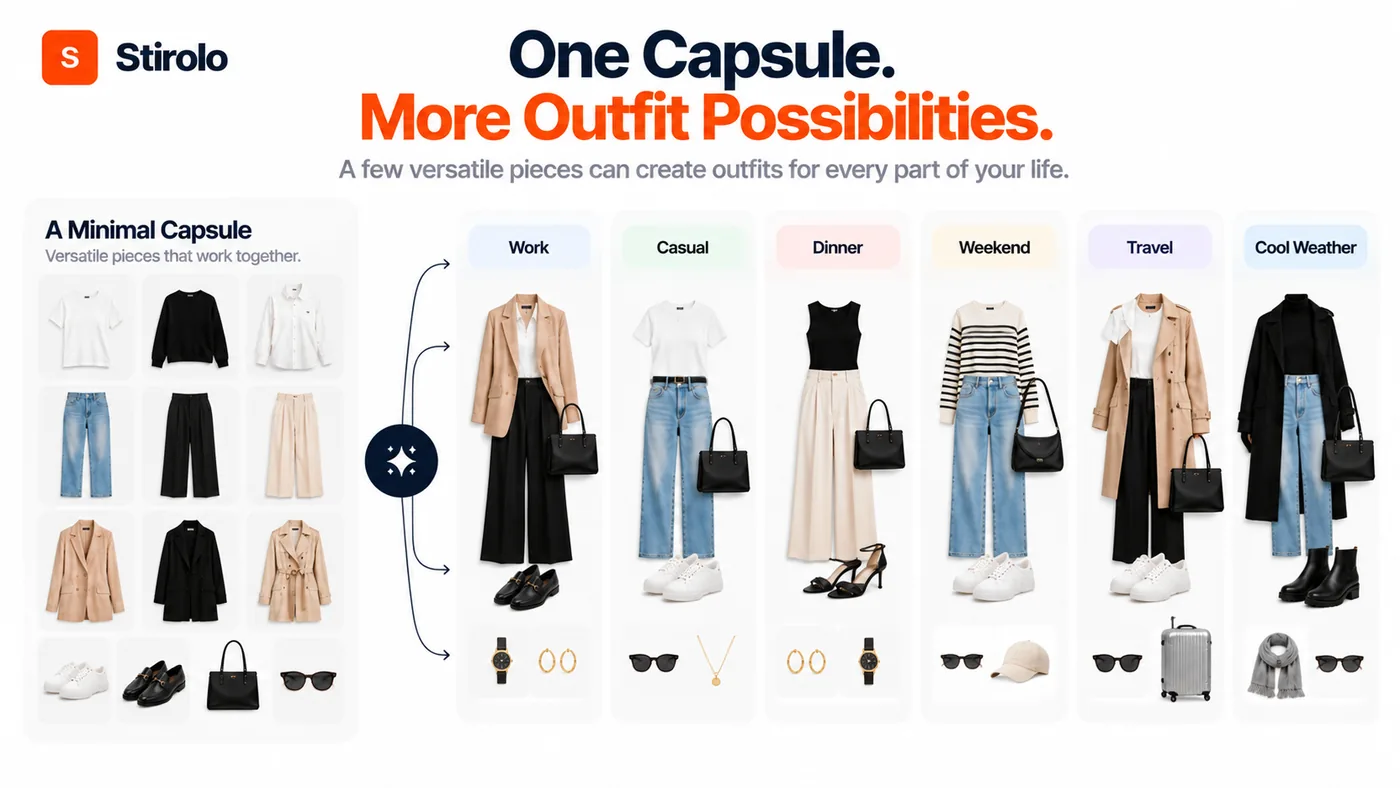
To create more outfits from fewer clothes, ask AI to generate complete combinations from the selected capsule. Then remove combinations you would not realistically wear.
Outfit count alone can mislead you. An algorithm can create dozens of mathematically different combinations that feel nearly identical or ignore practical issues. Test for useful variety across work, casual, social, travel, and weather conditions.
Ask for outfit formulas before individual outfits. Examples include knit plus trousers plus coat, shirt plus jeans plus blazer, or dress plus cardigan plus boots. A small set of reliable formulas makes a capsule easier to use on busy mornings.
Next, ask the AI to rotate anchor pieces. If one jacket only appears with one pair of trousers, the jacket may not be as versatile as expected. If one pair of shoes works across 12 strong outfits, the shoes deserve more weight in the capsule.
Visual previews can help with color and proportion, but generated images do not prove physical fit. Try important combinations on your body before finalizing the capsule.
How to Use AI to Choose a Capsule Wardrobe Color Palette
To choose a capsule color palette with AI, start from colors you already wear successfully. Do not ask the model to invent a palette before it sees your wardrobe and preferences.
Upload or list your most-worn pieces and ask AI to identify recurring neutrals, accent colors, and patterns. A useful palette often contains a few easy-to-combine base colors plus accents that make the wardrobe feel personal.
Test color relationships across actual garments. “Navy” can range from almost black to bright blue. Cream can lean yellow, pink, or gray. Photos taken under different lighting can also distort color, so confirm borderline combinations in daylight.
If you want a new accent color, ask AI which existing pieces could support it. The accent should create several outfits without requiring a second wave of purchases.
How to Use AI to Find Genuine Wardrobe Gaps
To find wardrobe gaps with AI, look for missing functions rather than missing trends. A real gap prevents multiple useful outfits or leaves a recurring situation uncovered.
Ask AI to identify where outfit generation repeatedly fails. You may discover that 6 tops have no suitable work trousers, your winter layers clash with your main shoes, or your social outfits lack one practical outer layer.
Then test a hypothetical purchase. Ask how many existing outfits the proposed item would create, what it duplicates, which occasions it covers, and whether a piece you already own can solve the same problem.
The capsule wardrobe workflow on Stirolo follows this logic: digitize what you own, score pieces by combination power, draw the capsule line, and fill only justified gaps.
A purchase that unlocks 8 strong outfits can be more useful than a trendy item that creates 1. AI cannot judge fabric quality or comfort from a product image, so verify those factors before buying.
How Many Pieces Should an AI Capsule Wardrobe Include?
There is no universal capsule wardrobe size. Choose enough pieces to cover your lifestyle, climate, laundry cycle, and desired variety without adding redundant options.
Some capsule methods use fixed numbers, but fixed targets can become arbitrary. A person with a formal office, active weekends, and 4 seasons may need more pieces than someone with a casual uniform and stable climate.
A practical starting range is often around 25 to 40 pieces for a focused seasonal capsule. Stirolo also notes that capsule size depends on climate, work, and life rather than a quota. Shoes, accessories, workout clothes, underwear, and special-event clothing may be counted differently depending on your system.
Ask AI to test smaller versions. Compare a 28-piece, 32-piece, and 36-piece capsule against the same schedule. Look for the point where removing more items creates obvious outfit or laundry problems. That point matters more than a fashionable number.
Quick Reference: AI Capsule Wardrobe Workflow
| Task | Timing | AI method | Difficulty |
|---|---|---|---|
| Define lifestyle needs | 15-20 min | Summarize schedule, climate, laundry, dress codes | Easy |
| Digitize core wardrobe | 30-90 min | Photo tagging and garment catalog | Moderate |
| Score core pieces | 10-20 min | Versatility and outfit coverage analysis | Easy |
| Generate outfit tests | 20-30 min | Create formulas and complete looks | Easy |
| Validate wardrobe gaps | 10-15 min | Test missing functions and hypothetical buys | Easy |
| Physical try-on | 30-60 min | Human check for fit, comfort, movement | Moderate |
| Monthly review | 15 min | Wear history and gap recheck | Easy |
How to Test an AI Capsule Before Removing or Buying Clothes
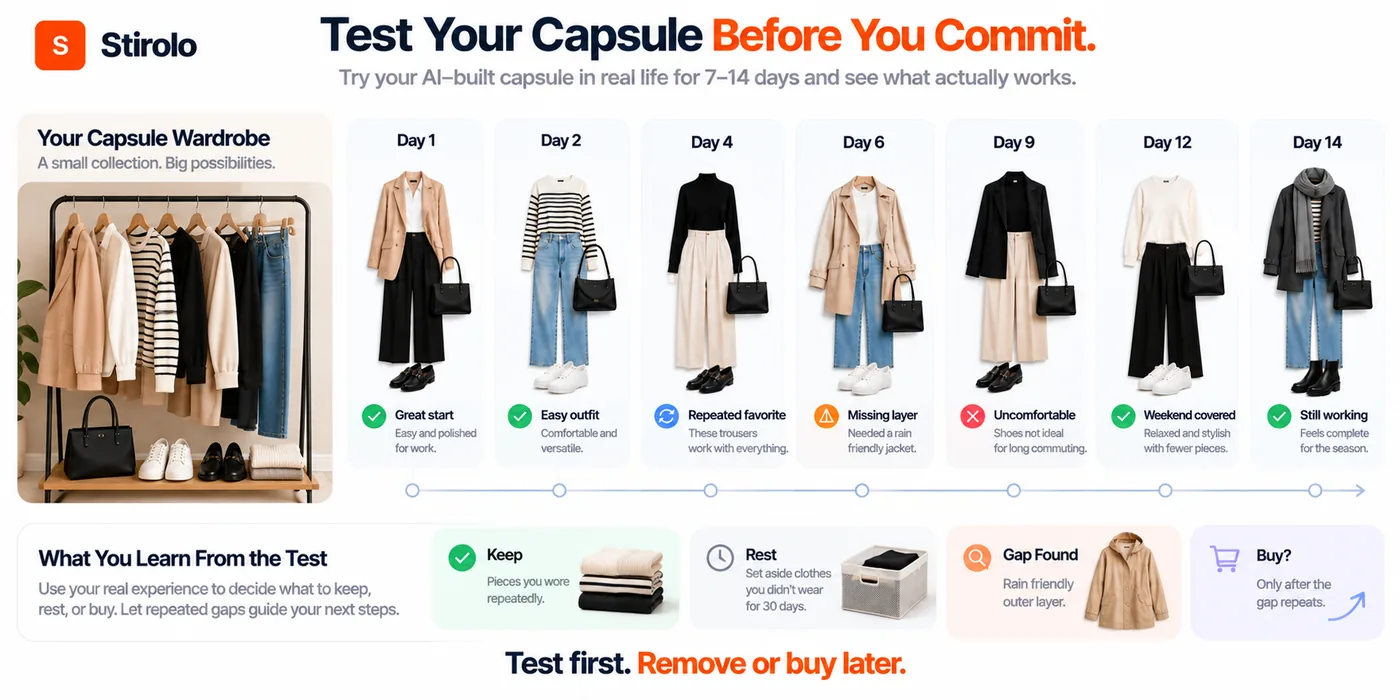
Test the capsule for 7 to 14 days before making permanent decisions. A trial exposes problems that outfit generation cannot predict.
Move the proposed capsule to one section of your closet or mark the items in your wardrobe app. Dress only from that group for normal days. Keep special-purpose clothing available if an unusual event occurs.
Track what happens. Note outfits you repeat willingly, items you avoid, laundry bottlenecks, weather problems, missing layers, and situations the capsule cannot cover. Feed those observations back to the AI.
Do not donate the excluded clothes immediately. Create a resting group for 30 days. If you repeatedly retrieve an item, the AI may have underestimated its role. If you forget the item exists, you have stronger evidence for releasing it.
Delay new purchases until the test reveals a repeated gap. This prevents AI-generated shopping lists from becoming another route to closet expansion.
What Can AI Get Wrong About a Capsule Wardrobe?
AI can misjudge fit, comfort, fabric behavior, emotional value, and real-world practicality. Those limits matter because a capsule gives every selected piece more responsibility.
Photos cannot reliably show how a waistband feels after 8 hours, whether wool irritates your skin, whether a shoe causes pain, or how a fabric behaves after washing. Product images can also hide construction details and color differences.
AI may overvalue visual compatibility. Two pieces can match in color but fail in proportion, temperature, movement, or dress code. A generated image can make a combination look convincing even when the real garments sit differently.
Generic AI can also drift toward familiar capsule aesthetics: beige, white, black, denim, simple tailoring. Reject recommendations that erase your style. A good capsule should make your personal style easier to wear, not replace it with minimalism as an aesthetic.
Privacy also matters. Wardrobe tools may process clothing photos, body photos, purchase data, measurements, calendar information, or location. Review the service’s privacy controls and upload only the information needed for the features you want.
How to Maintain Your Capsule Wardrobe With AI
To maintain a capsule wardrobe with AI, keep the wardrobe record current and review real wear patterns. The capsule should change when your life changes.
Log outfits or use automatic wear tracking if your chosen tool supports it. After several weeks, compare predicted versatility with actual use. A piece that looked essential but never gets chosen may need restyling, tailoring, replacement, or removal.
Review the capsule at seasonal transitions, after a job change, before major travel, or when your body and comfort needs change. Do not rebuild the whole wardrobe because one trend changes.
Use shopping guidance as a filter. Before buying, ask whether the item fills a documented gap, works with several capsule pieces, suits your climate, and improves outfit coverage enough to justify its cost.
For non-AI principles such as capsule foundations, color, fit, seasons, and travel, Stirolo also provides practical style guides that you can apply alongside wardrobe data.
The strongest system combines AI speed with your judgment. Let the model calculate combinations and surface patterns. Keep control over comfort, identity, quality, and what deserves space in your closet.
Frequently Asked Questions About AI Capsule Wardrobes
Can AI really create a capsule wardrobe?
Yes. AI can organize wardrobe data, rank versatile pieces, generate outfit combinations, and identify possible gaps. You still need to verify fit, comfort, quality, and personal preference.
Should I use ChatGPT or a dedicated wardrobe app?
Both can help. A general AI assistant works well for planning and prompts. A dedicated wardrobe app is usually better for garment photos, persistent closet data, wear tracking, and outfit generation from items you own.
Do I need to buy new clothes for an AI capsule wardrobe?
No. Start with your existing wardrobe. Buy only after testing reveals a recurring gap that your current clothes cannot cover.
How many outfits should a capsule wardrobe create?
There is no required number. Aim for enough useful combinations to cover your normal schedule, weather, laundry cycle, and desired variety.
Can AI choose which clothes I should donate?
AI can flag low-use, duplicate, or low-combination pieces, but it should not make the final decision. Consider fit, sentimental value, special occasions, replacement cost, and seasonal use.
Build the Capsule Around Your Life, Not a Template
AI can make capsule wardrobe planning faster because it can organize your closet, test combinations, and reveal patterns that are difficult to see from a crowded rail. The biggest advantage is not generating a perfect list. The advantage is making better decisions from evidence.
Start with your existing clothes. Give the system real constraints. Test the proposed capsule in daily life. Buy only when a repeated gap survives that test. That process creates a smaller wardrobe because the pieces work together, not because you forced the closet to hit a number.
A useful capsule still looks like you. Keep the colors, silhouettes, and distinctive pieces that make getting dressed enjoyable. Use AI for the outfit math, then use your own judgment for the final edit.