
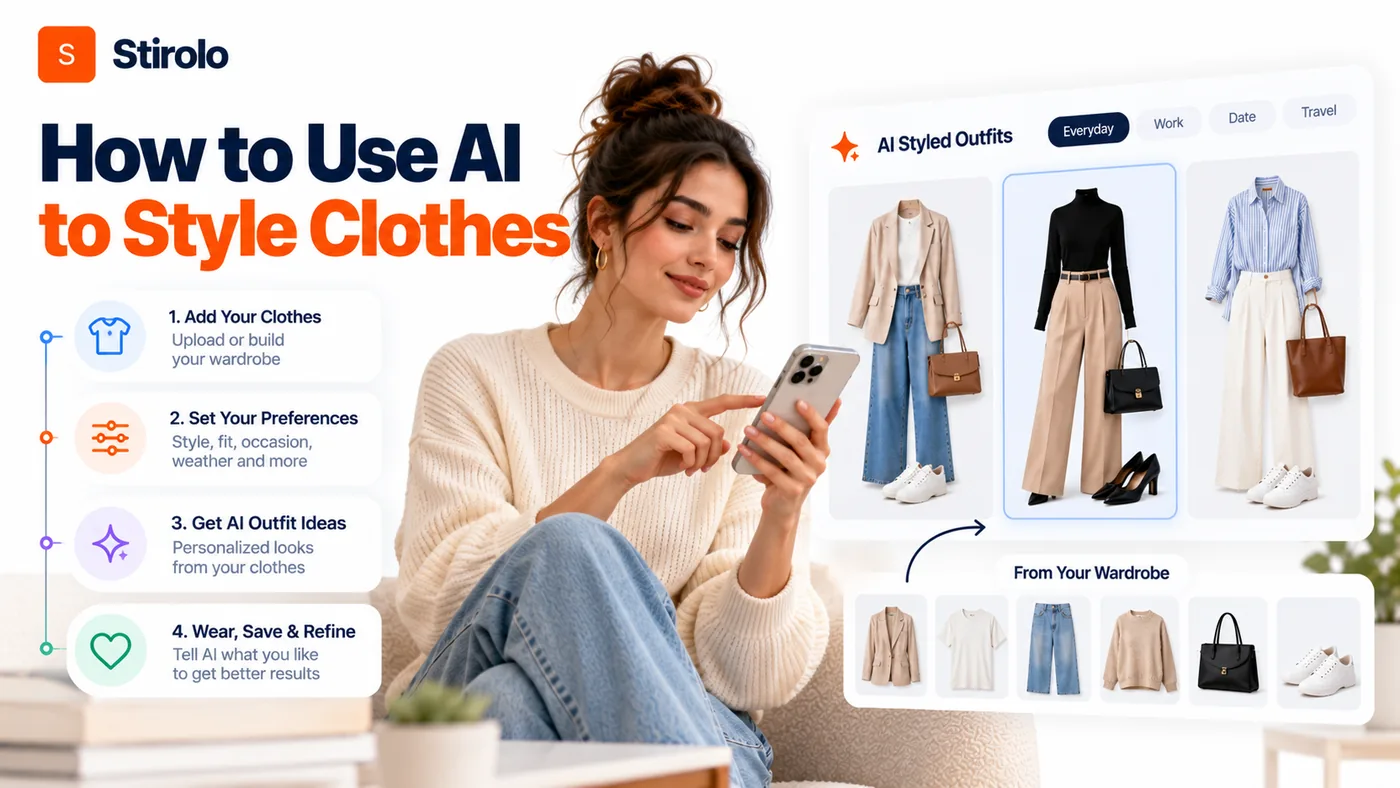
To use AI to style clothes, start by giving the system accurate information about your wardrobe, taste, fit, occasion and environment. Then ask for outfit combinations, review the logic, and refine the recommendations through feedback.
AI styling works best when the system knows what you actually own. Generic prompts can produce attractive ideas, but wardrobe-aware tools can build practical outfits from real pieces instead of imaginary ones.
What Does It Mean to Use AI to Style Clothes?
Using AI to style clothes means asking software to combine clothing items into outfits based on personal context. That context can include your digital wardrobe, color preferences, silhouette preferences, body proportions, dress code, weather and recent wear history.
A general AI assistant can explain styling rules. A dedicated AI wardrobe stylist can go further because it can work from your own closet and remember which suggestions you save, skip or edit.
How to Use AI to Style Clothes Step by Step
Step 1: Build a Digital Wardrobe the AI Can Understand
To build a digital wardrobe the AI can understand, photograph or import the clothes you actually wear. Clear item images make category, color, pattern and formality tagging more reliable.
Start with the pieces that drive most outfits: tops, bottoms, dresses, outerwear, shoes and everyday accessories. You do not need a perfect catalog before the system becomes useful.
A wardrobe-aware tool becomes much more useful once the catalog reflects your real closet. Stirolo’s wardrobe setup process shows how clothing data, recent wear and context can feed outfit recommendations.
Step 2: Tell the AI What Your Style Actually Looks Like
To tell the AI what your style looks like, define preferred colors, silhouettes, formality levels, fabrics and reference looks. Include dislikes as well as likes.
A useful preference profile can say: relaxed tailoring, neutral base colors, limited logos, straight-leg trousers, clean sneakers, structured outerwear and minimal accessories. Specific signals reduce generic recommendations.
Step 3: Add Body and Fit Context
To add body and fit context, tell the system which cuts fit well and which shapes consistently fail. Body measurements help, but lived fit feedback matters too.
You can describe practical constraints such as short torso, broad shoulders, narrow waist, preferred rise, sleeve length problems or sensitivity to oversized fits. Styling quality improves when the AI knows both proportions and preferences.
Dedicated platforms can also incorporate body information directly. Stirolo’s AI styling features combine wardrobe data with body, fit and styling context.
Step 4: Give the Occasion, Weather and Practical Constraints
To give useful context, state where you are going, how formal the setting is, the expected temperature and any practical restrictions. “Dinner outfit” is weak input. “Smart-casual client dinner, 54°F (12°C), light rain, walking 20 minutes” is stronger input.
Context changes the answer. The same blazer can work with dark denim for dinner, tailored trousers for a meeting, or knitwear for cooler travel days.
Step 5: Ask for Complete Outfits, Not Random Pieces
To get useful combinations, ask for complete looks built around items you own. Request 3 to 5 options so you can compare proportions, color balance and formality.
A strong prompt names the anchor piece and constraints. Example: build 4 outfits around my charcoal trousers for 50–61°F (10–16°C), keep the look business casual, avoid white sneakers, and use only items in my wardrobe.
Step 6: Make the AI Explain Why Each Outfit Works
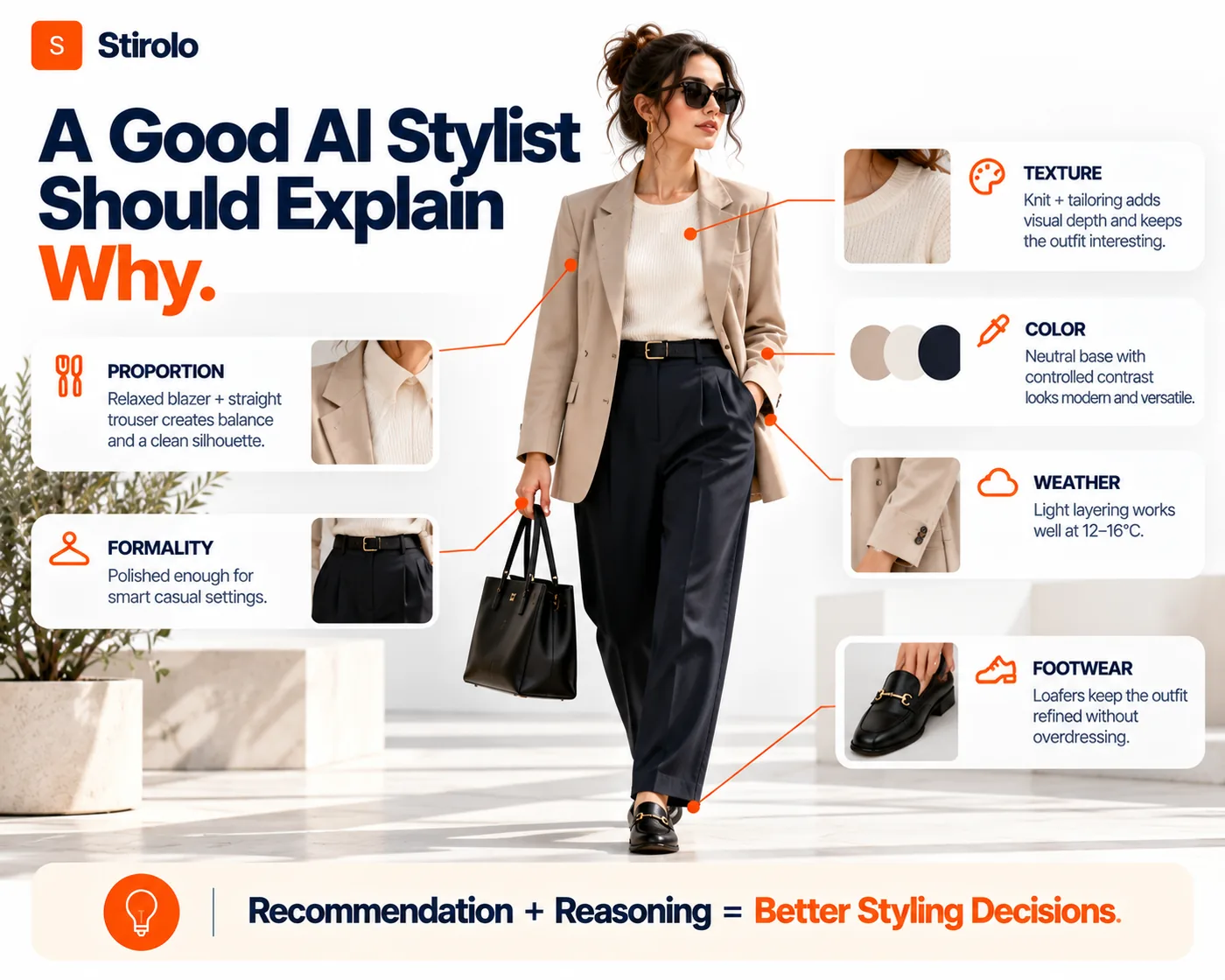
To judge a recommendation, ask why the pieces work together. A useful explanation should address proportion, color, formality, texture, weather and the role of each layer.
The explanation matters because attractive images can hide weak styling logic. If the reasoning is vague, ask the AI to compare 2 outfits and identify the stronger option for the specific occasion.
Step 7: Correct Weak Suggestions Instead of Starting Over
To refine a weak outfit, change one variable at a time. Ask for a different shoe, warmer layer, less formal trouser or more color rather than requesting a completely new look.
Small corrections reveal whether the system understands your preferences. A useful AI stylist should respond to your constraint instead of returning the same aesthetic in slightly different colors.
Step 8: Save Feedback So Future Outfits Improve
To improve future recommendations, record what you wore, skipped, changed and repeated. Feedback turns a one-off generator into a more useful styling system.
Save reasons when possible. “Too formal,” “jacket too boxy,” “good color balance,” and “would wear again with different shoes” teach more than a simple like or dislike.
How Can AI Help You Restyle Clothes You Already Own?

AI can help you restyle existing clothes by finding combinations you have not tried, changing the level of formality, rotating accessories and building outfits around neglected pieces.
Ask the system to identify 5 items with low wear counts, then build 2 outfits around each item. You can also ask for one piece to be styled for work, dinner and weekend use.
If you want stronger styling fundamentals behind those combinations, Stirolo’s personal style guides cover fit, color, capsules, travel and occasion dressing.
What Is the Difference Between an AI Stylist and Virtual Try-On?
An AI stylist decides what to combine. Virtual try-on shows how a garment or outfit could look on a body or uploaded photo. The 2 tools solve different problems.
Google’s virtual try-on systems generate visual previews using apparel images and body-aware image models. Google also states that virtual try-on is not a perfect representation of physical fit. Use the preview for visualization, then verify size, comfort and drape with real garment information or a physical try-on when possible.
How Do You Know Whether an AI Outfit Recommendation Is Good?
A good AI outfit recommendation should fit the occasion, use realistic wardrobe items, respect your preferences, make sense for the weather and explain its styling logic. The outfit should also feel like something you would actually wear.
Use 5 checks: wardrobe accuracy, fit logic, context match, styling coherence and personal relevance. Reject recommendations that fail 2 or more checks even if the image looks polished.
Why Do Some AI Stylists Feel Generic?
AI stylists feel generic when they lack personal data or rely on broad fashion patterns. A system cannot distinguish your taste from average taste if you never provide wardrobe, fit or preference signals.
Another problem is excessive validation. If the assistant says every outfit looks great, ask for comparative judgment: Which piece weakens the outfit? What would you remove first? Which option better fits the dress code? Specific questions force more useful analysis.
When Should You Use AI Styling?
Use AI styling when you need fast outfit options, want to wear more of your closet, need help with a specific dress code, plan travel outfits or want to compare combinations before trying everything on.
AI also helps when decision fatigue is the main problem. The system can narrow 50 possible combinations into 4 workable choices, while you keep the final decision.
When Should You Ignore AI Styling Advice?
Ignore AI styling advice when the recommendation depends on an incorrect item tag, unrealistic fit assumption, misleading visualization or a dress code the system misunderstood.
You should also override the system when comfort, cultural expectations, sensory needs, safety or personal identity matter more than visual coordination. AI provides recommendations; you remain the final judge.
How to Protect Your Privacy When Using AI Styling Tools
Before uploading wardrobe or body photos, check what the service stores, how long the service keeps images, whether you can delete data, and whether the provider uses uploads for model training.
Share only what the styling task needs. Full-body photos can improve visualization or proportion analysis, but a simple wardrobe-planning task may only need clothing images and preference data.
Quick Reference: AI Styling Workflow
| Task | Timing | Method | Difficulty |
|---|---|---|---|
| Catalog core wardrobe | 20–40 min | Photograph or import frequently worn items | Easy |
| Add style profile | 5–10 min | Record colors, silhouettes, formality and dislikes | Easy |
| Request outfits | 1–2 min | Add occasion, weather and anchor item | Easy |
| Review recommendations | 2–5 min | Check fit logic, context and coherence | Easy |
| Refine weak looks | 1–3 min | Change one variable at a time | Easy |
| Train future suggestions | Ongoing | Save, skip and explain edits | Easy |
Frequently Asked Questions
Use AI as a Styling Partner, Not a Final Authority
AI can make styling faster and more practical when the system understands your actual wardrobe and real constraints. The strongest workflow starts with accurate clothing data, adds personal and situational context, compares complete outfits, and improves through deliberate feedback.
Use AI to reduce decision fatigue and discover combinations you would otherwise miss. Keep the final decision human, especially for physical fit, comfort and personal identity.
Can AI style clothes I already own?
Yes. Wardrobe-aware AI tools can build outfits from items you upload or catalog, especially when item data is accurate.
Does AI know what clothes suit my body?
AI can use photos, measurements, fit feedback and silhouette preferences, but physical fit still needs real-world validation.
Can AI choose outfits for work or events?
Yes. Give the dress code, occasion, weather and practical constraints so the recommendation matches the setting.
Is virtual try-on the same as AI styling?
No. Virtual try-on visualizes clothing, while AI styling decides which pieces should be combined and why.
Will AI styling improve over time?
Yes, if the system stores useful feedback from saved outfits, skipped looks, edits and repeat wears.
Make AI Styling Work With Your Wardrobe
AI can make styling your clothes easier when it has enough context to work with. Start with the clothes you already own, add your preferences, fit needs, occasion, and weather, then refine the recommendations through feedback. The goal is not to let AI decide what you should wear. It is to use AI to find more combinations within your wardrobe, reduce daily outfit decisions, and understand which looks work for you. If you want to see how this approach works with an AI-powered wardrobe and personal styling system, explore how Stirolo works.