
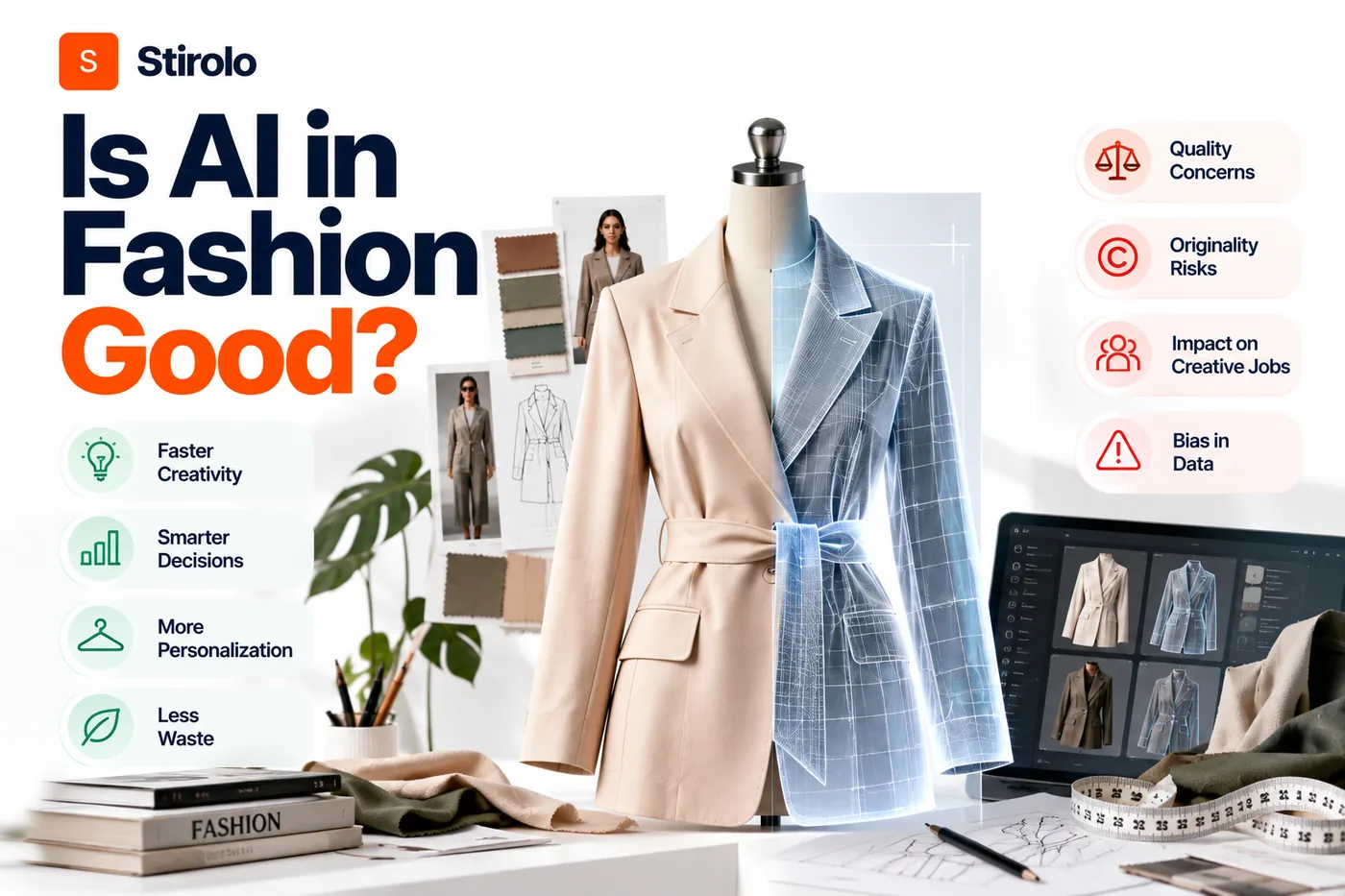
Yes, AI can be good for fashion when it improves creativity, personalization, forecasting, fit decisions, or operational efficiency while people remain responsible for the final result.
AI becomes less useful when a brand uses it to imitate creative work, publish misleading product imagery, skip garment testing, or produce more products simply because content and concepts are cheaper to generate. The technology itself does not decide whether the outcome is good. The workflow, data, disclosure, human review, and business goal do.
That distinction matters because “AI in fashion” covers very different systems. A demand model that helps a retailer order fewer unwanted sizes is not the same as a generative image used in an advertisement. An outfit recommendation based on your real wardrobe is not the same as an AI-generated garment concept that has never been sampled. Each use needs its own test.
Why Can AI Be Good for Fashion?
AI is useful when it reduces low-value work or improves a decision that already depends on large amounts of information.
Fashion teams work with images, text, sales histories, product attributes, customer behavior, inventory, weather, trend signals, fit feedback, and supplier information. Machine-learning systems can process some of that information faster than a person can. Generative systems can also produce draft text, images, variations, and concepts that people can evaluate.
McKinsey identifies potential fashion applications across product development, marketing, digital commerce, supply chains, store operations, and customer experience. The useful pattern is augmentation: AI speeds a task or expands the options, while people still set the brief and judge the output.
The practical benefits usually fall into 4 groups: faster experimentation, better prediction, more relevant personalization, and automation of repetitive work. None requires handing complete creative or commercial control to a model.
Is AI Good for Fashion Designers?
Yes, AI can help fashion designers explore more directions before committing time and money to development.
A designer can use generative tools to test silhouettes, print directions, color combinations, styling concepts, moodboard compositions, or campaign ideas. That can shorten early exploration. A team can reject weak directions quickly and spend more time developing the concepts with the strongest identity.
AI does not turn a rendered image into a manufacturable garment. Fabric weight, stretch, seam placement, closures, construction sequence, tolerances, grading, movement, comfort, and fit still need technical decisions and physical validation. A beautiful image can hide impossible construction.
Where Does Human Judgment Still Matter?
Human judgment matters most where fashion depends on taste, context, material behavior, responsibility, and brand meaning.
A model can generate 50 variations. A designer still decides which variation belongs in the collection, what should change, whether it resembles existing work too closely, and whether the garment communicates the intended point of view. Technical designers and patternmakers then determine whether the concept can work on a body and in production.
Recent legal scholarship also highlights copyright questions around AI-assisted fashion design. The exact legal position varies by jurisdiction and facts, so brands should treat provenance, training-data questions, and similarity review as real governance issues rather than assuming every generated output is safe to commercialize.
Does AI Make Fashion More Creative or More Generic?
AI can do either. The result depends heavily on the inputs, constraints, selection process, and amount of human development after generation.
Generic prompts tend to produce familiar visual patterns because the system is being asked for broad statistical associations. A specific creative brief gives the model less room to fall back on obvious conventions. Designers can constrain silhouette, proportion, fabrication, color, reference period, customer, price point, and brand rules before generating options.
The strongest workflow treats generated material as raw exploration. Designers edit, combine, redraw, reject, sample, and refine. The weakest workflow accepts the first polished render because it looks finished on a screen.
How Can Designers Protect Originality?
To protect originality, start with a designer-owned brief and finish with substantial human development.
Keep records of sketches, references, prompts, iterations, edits, and technical development. Avoid prompts that ask a system to copy a living designer or a recognizable protected work. Review suspiciously familiar outputs before publication or production. For commercially important work, use tools and contracts whose data and intellectual-property terms match the brand’s risk tolerance.
Is AI Good for Small Fashion Brands?
AI can be especially useful for small brands because it lowers the time cost of tasks that otherwise compete for a small team’s attention.
A founder may use AI to organize research, draft product-copy options, explore campaign concepts, classify customer feedback, prepare content variations, or create internal mockups. These uses can help a small team test ideas before paying for full production.
The danger is confusing lower content cost with lower business risk. A startup can generate 100 campaign images cheaply, but those images do not prove demand. AI can also make an undeveloped product look more finished than it really is. That gap can hurt trust if customers receive something materially different from the image that persuaded them to buy.
Small brands therefore benefit most when AI reduces preparation work rather than replacing product truth. Real samples, accurate product photography or clearly labeled visualizations, fit testing, quality control, and customer service remain important.
Are AI Fashion Ads Good for Customers?
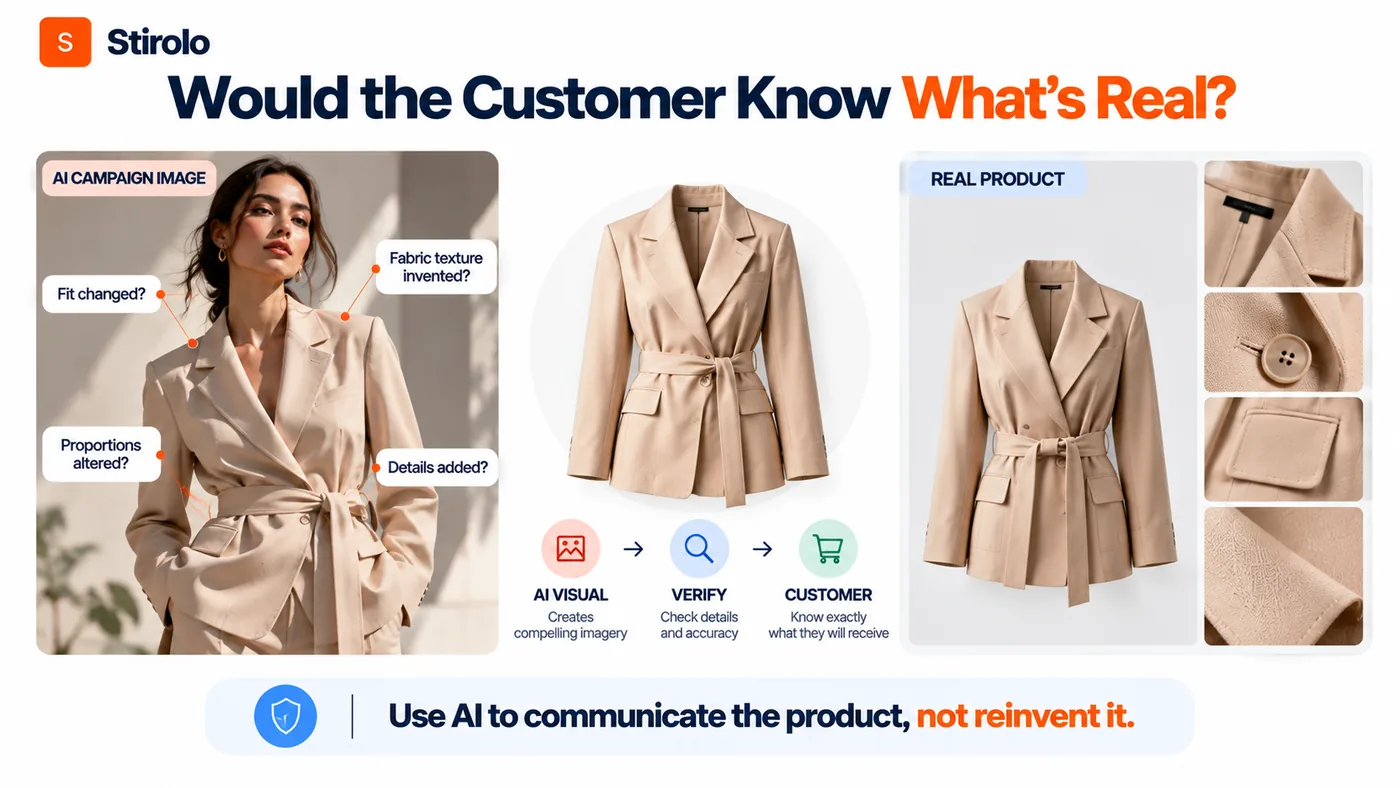
AI fashion ads can be useful when they communicate a real product accurately and do not create a false impression about fit, fabric, construction, or availability.
Generative imagery can help a brand prototype campaign directions, localize creative, or visualize styling combinations. Problems begin when an image invents garment details, changes proportions, smooths away fit issues, or presents a synthetic scene as evidence of how the physical product actually looks.
A simple customer-trust test helps: would a reasonable shopper understand what is real, what is simulated, and what they will receive? If the answer is unclear, the creative needs stronger disclosure, a more accurate image, or both.
Is AI Styling and Personalization Good for Shoppers?
Yes, personalization is one of the clearest consumer benefits when recommendations use relevant personal context instead of generic trend data.
A useful styling system needs to know more than what is fashionable. It should account for what a person owns, prefers, needs for the occasion, and can realistically wear. That is why wardrobe-grounded systems can be more practical than feeds that mainly encourage new purchases.
For example, Stirolo’s AI styling process weighs body, wardrobe, taste, occasion, and environment before ranking outfits. The value is not that AI “has taste” on its own. The value is that it can compare many combinations against the user’s context quickly.
Personalization still needs correction. People change their minds, dress differently across settings, and may reject technically compatible outfits for personal reasons. Feedback should change future recommendations rather than forcing the user to adapt to the model.
Can AI Help People Buy Less?
AI can support lower-consumption behavior when it starts with the wardrobe a person already owns.
Stirolo’s wardrobe intelligence features track wardrobe items and can support outfit recommendations, wear information, packing, and shopping guidance. A system designed around existing clothes can surface forgotten combinations or flag a potential duplicate before a purchase.
That outcome is not automatic across fashion AI. A recommendation engine optimized mainly for sales may encourage more transactions. The objective chosen by the business matters as much as the model.
Can AI Make Fashion More Sustainable?
AI can support sustainability, but using AI does not automatically make a fashion business sustainable.
Research reviews identify opportunities in demand forecasting, inventory management, production efficiency, design, ecommerce, and consumer engagement. Better forecasting can potentially reduce mismatches between supply and demand. Digital experimentation can also reduce some unnecessary physical iterations when teams use it before sampling.
There are 2 important limits. First, efficiency gains can be cancelled if a company simply uses faster design and content generation to produce more products. Second, AI systems have their own computing, electricity, water, and hardware footprint. Vogue has highlighted the difficulty of making broad sustainability claims without measuring both the fashion process and the infrastructure supporting AI.
The better question is whether a specific AI application reduces material waste, returns, excess inventory, unnecessary samples, or unnecessary purchases after its own costs are considered.
What Are the Main Risks of AI in Fashion?
The main risks are misleading outputs, creative sameness, intellectual-property disputes, biased recommendations, privacy problems, weak product validation, job redesign, and automation that increases low-value production.
These risks do not affect every application equally. A forecasting model can fail because historical data no longer represents demand. A styling model can perform poorly if body, climate, or wardrobe context is incomplete. A generative design can resemble existing work. A synthetic model image can create unrealistic expectations about fit or representation.
Privacy also matters when systems process body photos, measurements, purchase histories, location, calendars, or wardrobe data. Users should know what is collected, why it is needed, how long it is kept, and whether it is shared. Optional inputs should remain optional where possible.
Bias requires similar attention. Fashion data reflects past sizing systems, representation gaps, beauty standards, and commercial assumptions. A model trained on those patterns can reproduce them unless teams test outputs across different bodies, styles, cultures, and use cases.
How Can Fashion Brands Use AI Responsibly?
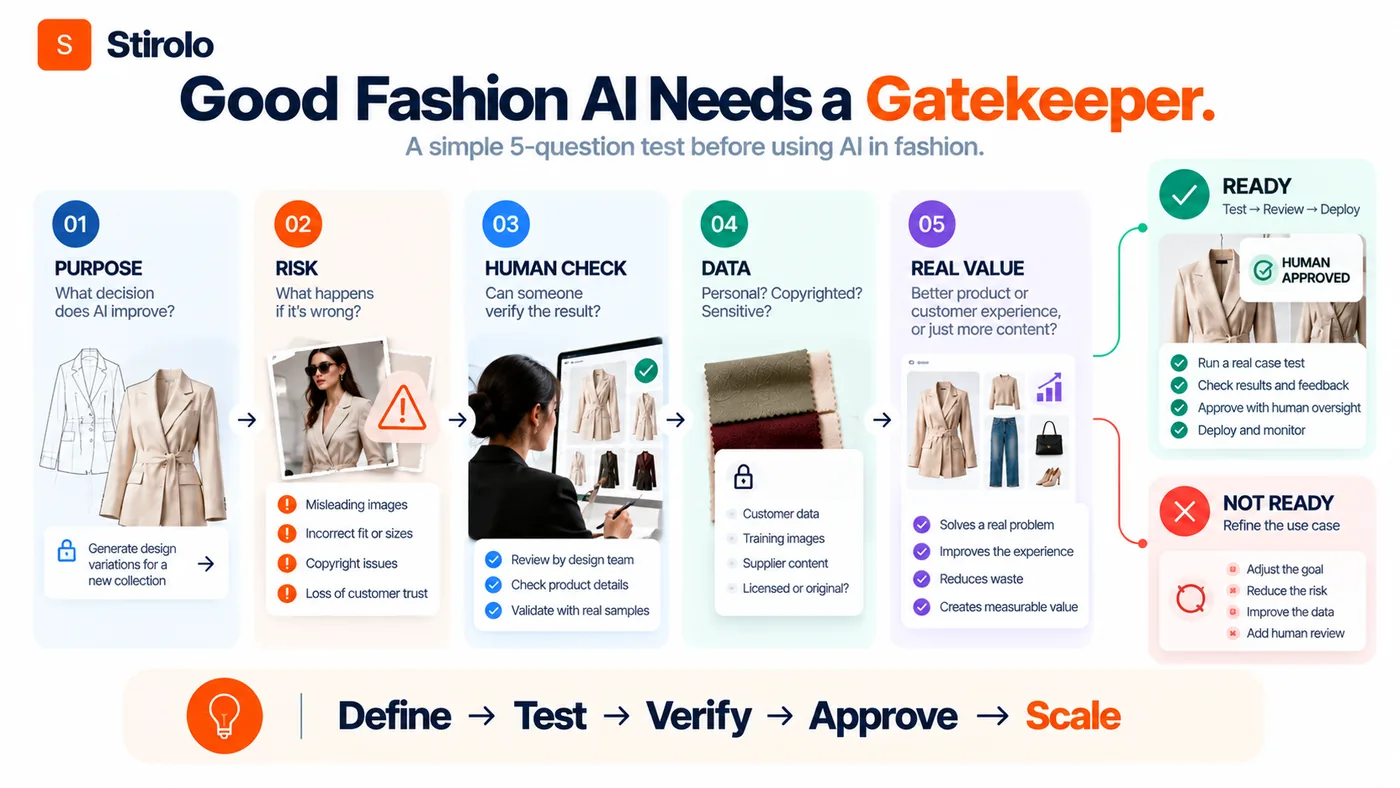
To use AI responsibly, give each system a defined job, a measurable success condition, and a human owner who can reject its output.
A practical workflow is to define the problem first, identify the data required, choose the narrowest suitable AI tool, test it on real cases, review failure modes, and only then expand its role. High-impact customer-facing uses need stronger review than low-risk internal brainstorming.
Brands should also separate visualization from verification. An AI image can communicate a direction. It cannot verify fabric hand, seam durability, colorfastness, sizing, movement, or comfort. Those claims require real product evidence.
Transparency should match the risk. Customers need more clarity when synthetic content could affect a purchase decision than when AI was used privately to summarize meeting notes. The goal is not to label every automated action. The goal is to prevent a person from being materially misled.
A 5-Question Test Before Using Fashion AI
- What decision or task will the AI improve?
- What happens if the output is wrong?
- Can a person verify the result before it affects a customer or product?
- Does the system use personal, copyrighted, or commercially sensitive data?
- Does success improve the product or customer experience, or merely increase the volume of content and products?
If a team cannot answer these questions clearly, the use case is not ready to scale.
Quick Reference: When Is AI in Fashion Good?
| Use | Potential value | Main risk | Good when... |
|---|---|---|---|
| Design ideation | More options, faster exploration | Generic or derivative concepts | Designer sets the brief and develops the final work |
| Demand forecasting | Better inventory decisions | Bad data or sudden market shifts | Predictions are tested and updated with current evidence |
| AI advertising | Faster creative testing | Misleading product representation | Synthetic elements do not distort what customers will receive |
| Virtual try-on | More confident exploration | False fit expectations | Limitations are clear and results are treated as guidance |
| AI styling | Personalized outfit decisions | Generic or biased advice | Recommendations use real wardrobe and personal context |
| Shopping guidance | Fewer duplicates and better pairing | Over-personalized selling | The system serves the user’s wardrobe goals, not only sales |
| Customer service | Faster routine support | Confident incorrect answers | Escalation and human review exist for uncertain cases |
FAQs About AI in Fashion
Is AI in fashion good for designers?
Yes, when designers use it to accelerate research, ideation, variations, and presentation while retaining control over creative and technical decisions.
Is AI-generated fashion bad for creativity?
No, not automatically. Generic use can produce repetitive work, while specific briefs and substantial human editing can make AI a useful exploration tool.
Are AI fashion models and ads ethical?
They can be, but brands should avoid misleading customers about the real garment, fit, model, or campaign context. Disclosure should increase when synthetic content could affect a purchase decision.
Can AI make fashion more sustainable?
Potentially. Forecasting, inventory planning, digital experimentation, and wardrobe tools may reduce waste, but AI also consumes computing resources and can accelerate overproduction.
Should people trust AI styling advice?
Treat it as decision support, not authority. Advice becomes more useful when it is grounded in your wardrobe, preferences, body context, occasion, and environment and can learn from corrections.
A Better Test for AI in Fashion
AI in fashion is good when it helps people make better creative, commercial, or personal decisions without hiding uncertainty or removing necessary human responsibility.
That standard works across the industry. Designers can use AI to explore without treating renders as finished garments. Brands can automate repetitive work without letting synthetic content misrepresent products. Retailers can forecast demand without assuming predictions are facts. Shoppers can use AI to make more relevant decisions without surrendering personal taste. Good systems also make their limits visible so people know when to question a recommendation.
For personal style, the most useful AI starts with your real context. The Stirolo style guides explain the human styling principles behind fit, color, capsules, seasons, travel, and dress codes, while AI can apply those kinds of principles to everyday wardrobe decisions at scale.
The goal is not more AI. The goal is better fashion decisions. When AI serves that goal and people remain accountable for what reaches the customer, it can be a valuable part of fashion rather than a substitute for the people who give fashion meaning.