
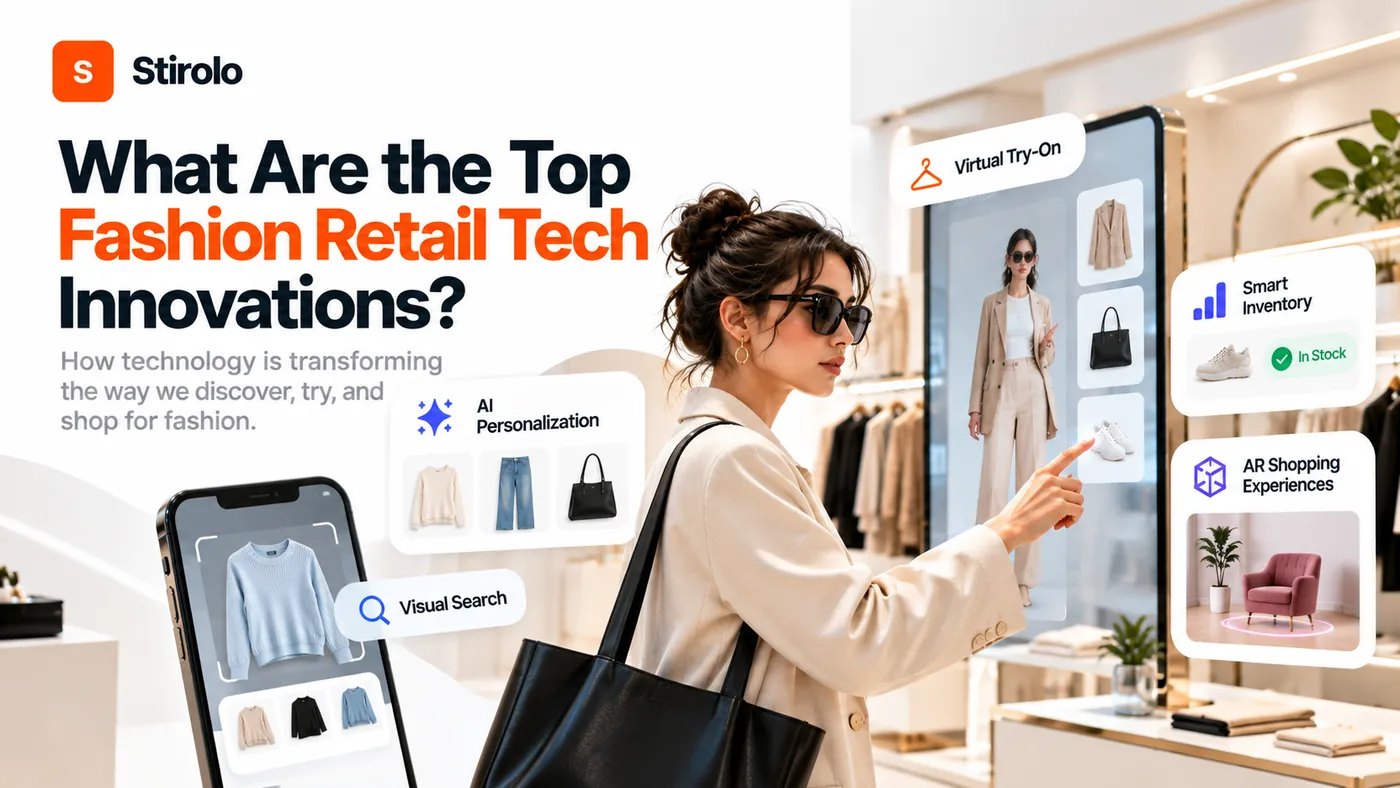
The top fashion retail tech innovations are AI personalization, conversational shopping, virtual try-on, smart fitting rooms, RFID inventory, demand forecasting, digital product passports, resale technology, and digital wardrobes. The strongest tools reduce uncertainty for shoppers or remove operational friction for retailers.
Fashion retail technology matters most when the technology solves a specific problem. A realistic product preview can reduce uncertainty before an online purchase. Accurate inventory data can stop a customer from traveling to a store for an unavailable size. A wardrobe-aware assistant can help someone judge whether a new piece works with clothes already owned.
The category therefore extends beyond flashy store displays. Modern retail technology now connects product discovery, evaluation, fulfillment, ownership, and resale. The result is a shopping journey that can become more personal without requiring more browsing.
What Are the Top Fashion Retail Tech Innovations Changing Shopping?
The most important innovations improve decisions before, during, and after a purchase. Fashion retailers now use AI for search and recommendations, computer vision for product understanding, augmented reality for previews, RFID for inventory accuracy, and automation for forecasting and fulfillment.
A useful way to judge each innovation is to ask what uncertainty disappears. AI can narrow an overwhelming catalog. Virtual try-on can show visual compatibility. RFID can reveal whether the right size exists nearby. Digital product data can explain origin, materials, or care. Wardrobe intelligence can show whether a purchase fills a real gap.
That standard also exposes weak retail technology. A feature can look impressive but add little value if the shopper still cannot answer basic questions about fit, availability, usefulness, or compatibility.
How Is AI Personalization Changing Fashion Discovery?
AI personalization is moving fashion discovery from broad filtering toward individual intent. Retailers can combine product attributes, browsing behavior, stated preferences, purchase history, and contextual signals to rank products more relevantly.
Conversational Search Understands Shopping Intent
Traditional site search works best when you already know the product name. Conversational systems can interpret requests such as “a lightweight jacket for a rainy business trip” or “shoes that work with wide-leg trousers.” Natural Language Processing (NLP) converts the request into attributes such as category, weather, formality, color, and use case.
Current fashion-industry research also points toward AI assistants becoming a discovery layer between shoppers and retailers. That change increases the importance of accurate product data because AI systems need structured information to compare options reliably.
Recommendation Systems Rank Products More Personally
Recommendation engines can move beyond “people also bought” suggestions. Better systems consider style affinity, size availability, price range, past returns, preferred silhouettes, and the current shopping task. Generative AI can also explain why a product may suit the request instead of showing an unexplained product grid.
Personalization still depends on data quality. A system trained mainly on clicks may confuse curiosity with preference. Explicit feedback, saved items, fit information, and repeated behavior provide stronger signals than a single browsing session.
How Does Virtual Try-On Improve Online Fashion Shopping?
Virtual try-on uses computer vision, image generation, augmented reality, or 3D modeling to preview a product on a person or body representation. The technology aims to reduce the gap between a product photo and the shopper’s expectation of wearing the item.
Visual confidence is the clearest benefit. Shoppers can test color, proportion, styling direction, and overall appearance before ordering. Research on virtual try-on also links the technology with improved product-selection confidence, while privacy concerns can reduce willingness to use systems that require personal images or body data.
Virtual try-on should not be treated as a perfect fit guarantee. Fabric stretch, garment construction, grading differences, and personal comfort remain difficult to infer from an image. Retailers should distinguish a visual preview from an exact sizing prediction.
The most useful implementations also connect the preview to product facts. A shopper may need size guidance, fabric composition, care details, delivery timing, and return information alongside the image. Combining visualization with reliable product data prevents the experience from becoming a novelty. Retailers can also let shoppers compare several colors or silhouettes without reopening multiple product pages, which makes the evaluation stage faster and more focused.
Stirolo takes a related wardrobe-first approach. Its outfit visualization system can preview combinations using the user’s own wardrobe and body context rather than treating visualization only as a sales feature.
What Do Smart Fitting Rooms and Smart Mirrors Add In Stores?
Smart fitting rooms connect physical shopping with digital product information. Common features include RFID item detection, touchscreens, smart mirrors, alternative-size requests, product recommendations, and digital wish lists.
The main advantage is continuity. A shopper does not need to leave the fitting room to search for another size or remember a product code. Store staff can also receive clearer requests. Academic research on smart fitting rooms has found that personalized recommendations, offers, and sustainability information can meaningfully influence the customer experience.
Smart mirrors can add virtual color changes or outfit previews, but retailers should keep the interaction optional. A faster physical fitting process may create more value than adding extra screens to a journey that already works.
Store technology can also help bridge channels. A shopper might save a fitting-room item to an account, order an unavailable size for home delivery, or retrieve an online wish list in store. That continuity matters because customers rarely think in separate e-commerce and physical-store journeys. They simply expect the retailer to remember the product, size, and decision already in progress.
Why Is RFID Still One of Fashion Retail’s Most Important Technologies?
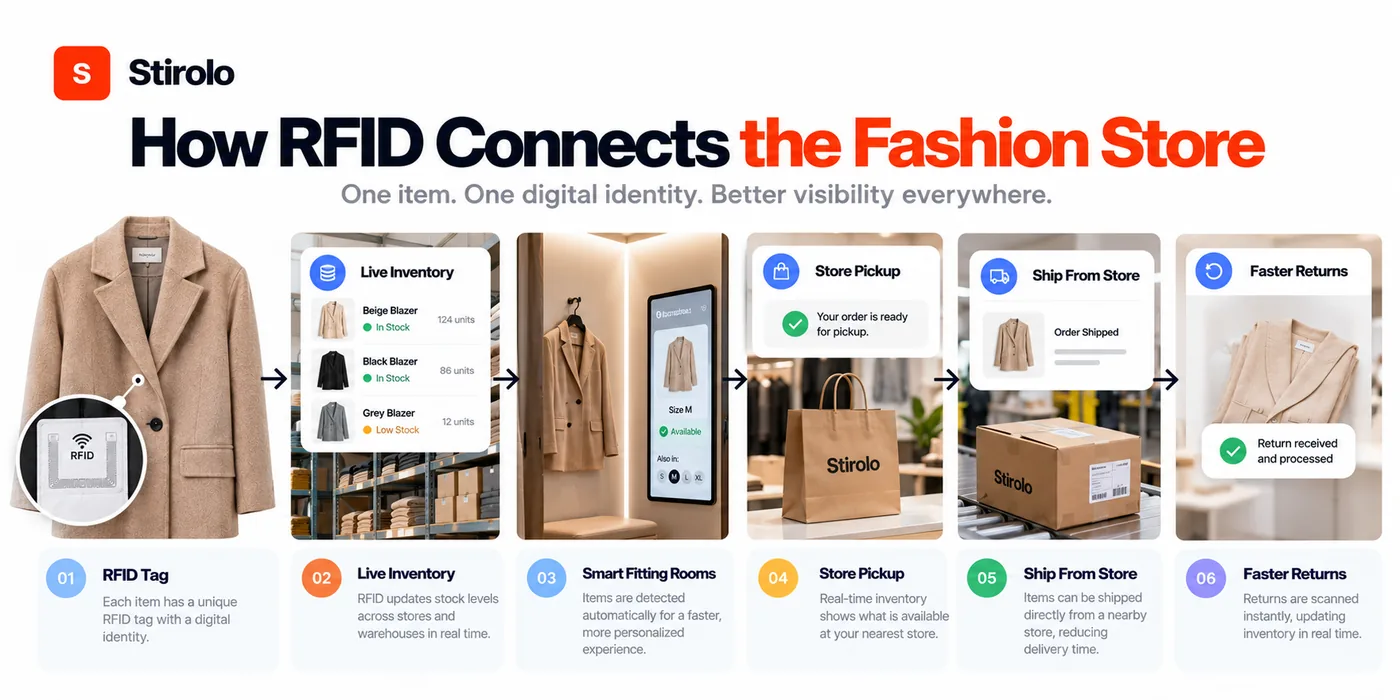
Radio-Frequency Identification (RFID) gives individual products a scannable identity that can be read without direct line of sight. Fashion retailers use RFID to improve stock counts, locate products, support omnichannel fulfillment, and connect physical items with digital systems.
RFID matters because personalization fails when inventory information is wrong. A recommendation has little value if the suggested size is unavailable. Accurate item-level visibility can support services such as buy online and pick up in store, ship from store, rapid stock checks, and smoother returns.
RFID can also support automated checkout and fitting-room interactions. The technology is less visible than generative AI, but reliable inventory data forms part of the infrastructure that makes customer-facing innovation possible.
How Are AI and Automation Improving Inventory and Demand Forecasting?
AI forecasting systems analyze sales, inventory, promotions, seasonality, location, and other demand signals to estimate what retailers may need. Better forecasting can help reduce stockouts, excessive markdowns, and unnecessary inventory.
Fashion creates a difficult forecasting problem because demand changes with weather, trends, social attention, local preferences, and short product cycles. Machine-learning models can process more signals than a static spreadsheet, but retailers still need human judgment for unusual events and genuinely new products.
Automation also supports merchandising. AI can help classify products, generate descriptions, enrich attributes, identify visually similar items, and surface anomalies in assortment data. These tasks are valuable because clean product information improves search, recommendations, and emerging AI shopping agents.
What Are Digital Product Passports and Why Do They Matter?
A digital product passport is a structured digital record linked to a physical product. Depending on the implementation, the record can contain materials, origin, care information, repair guidance, authenticity details, or other lifecycle data.
For fashion shoppers, the practical value is transparency. A scannable product identity can make care instructions easier to retrieve and can support authentication or resale. For retailers, consistent product records can connect compliance, supply-chain information, aftercare, and circular services.
Product passports become more useful when the information remains accessible after checkout. Retail technology should not stop once payment clears. Ownership creates new questions about care, repair, styling, resale, and replacement.
How Is Technology Changing Resale and Circular Fashion?
Resale technology is reducing the work required to identify, list, price, authenticate, and rediscover pre-owned products. Computer vision can recognize categories and visual attributes. AI can draft listing information. Product identifiers can preserve information that otherwise disappears after the first sale.
Retailers are also experimenting with trade-in programs and resale partnerships. The business opportunity is different from traditional retail because the same item can create value across multiple ownership cycles.
Technology cannot make every purchase sustainable by itself. The more practical contribution is better information: what an item is, how long it has been used, how to care for it, and whether another owner can use it next.
How Do Digital Wardrobes Extend Retail Technology Beyond Checkout?
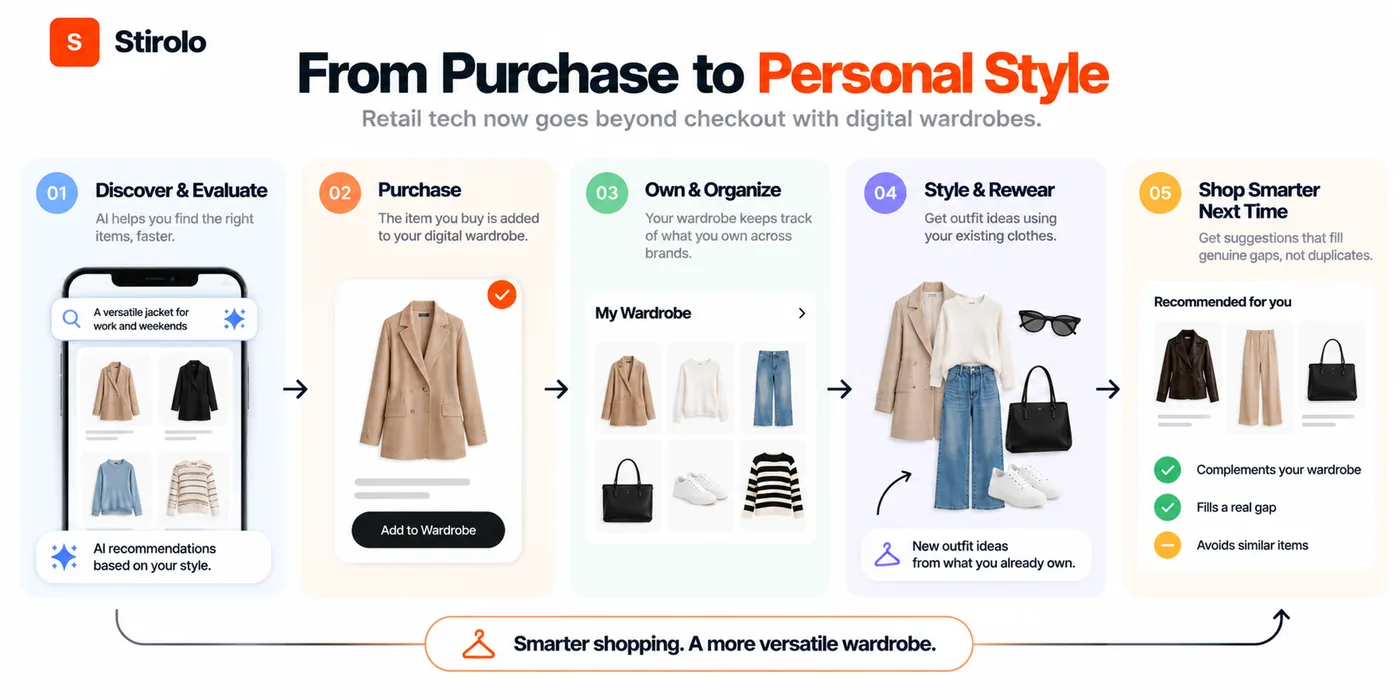
Digital wardrobes create a post-purchase layer that most retail systems historically ignored. A digital closet can record owned garments, categorize pieces, track wear, assemble outfits, and reveal gaps or duplicates.
The retail implication is significant. Traditional recommendations ask, “What might this shopper buy?” Wardrobe-aware systems can ask a more useful question: “What would add something genuinely useful to what this person already owns?”
Stirolo demonstrates that shift through its AI styling process, which weighs body context, wardrobe contents, taste, occasions, and environment before recommending outfits. Shopping guidance can then evaluate a potential purchase against the existing closet.
That model changes personalization from transaction history to ownership context. A retailer may know what you purchased from one store. A wardrobe system can understand how pieces from different brands work together in daily life.
Which Fashion Retail Innovations Create the Most Shopper Value?
The highest-value retail technologies usually save time, reduce uncertainty, or prevent a poor purchase. The right priority depends on the shopping problem rather than the novelty of the technology.
| Innovation | Main Job | Shopper Benefit | Difficulty |
|---|---|---|---|
| AI personalization | Rank relevant products | Less browsing | Medium |
| Virtual try-on | Preview appearance | More visual confidence | High |
| Smart fitting rooms | Connect store and digital tools | Faster fitting decisions | High |
| RFID | Track item-level inventory | Better availability data | Medium |
| Demand forecasting | Predict inventory needs | Fewer stockouts | High |
| Digital product passports | Preserve product information | More transparency | Medium |
| Digital wardrobes | Understand owned clothing | Smarter styling and buying | Medium |
A retailer does not need every technology at once. A strong implementation starts with the largest source of customer friction. Online retailers may prioritize search, fit, and virtual try-on. Store-heavy businesses may gain more from RFID and fitting-room improvements. Brands with long-lived products may benefit from product identity and aftercare systems.
What Are the Main Limits of Fashion Retail Technology?
Fashion technology still struggles with data quality, privacy, interoperability, and the difference between visual prediction and physical reality. AI can rank options, but incomplete product attributes produce weak recommendations. Virtual try-on can create a convincing image without perfectly predicting comfort or drape.
Privacy becomes especially important when systems use body photos, measurements, location, purchase history, or wardrobe data. Retailers should explain what data is collected, why the data is needed, how long the data is stored, and whether users can delete the information.
Technology can also create unnecessary friction. Requiring an account, a body scan, or a long setup process for a minor benefit may reduce adoption. The best experience asks for additional data only when the added personalization is clear.
Retailers should also avoid using AI only because competitors use AI. Current industry guidance increasingly emphasizes commercially meaningful use cases. A useful retail innovation should improve a measurable customer or operational outcome.
How Can Shoppers Use Fashion Technology Without Losing Personal Style?
Use fashion technology as a decision tool rather than an authority. Recommendations work best when you can correct them, reject them, and teach the system what you actually wear.
A product recommendation should still pass ordinary tests. Does the piece fit your life? Can you wear the item with multiple things you own? Does the material suit the climate? Does the purchase solve a wardrobe gap rather than duplicate an existing item?
For decisions that start with styling principles rather than products, Stirolo’s practical style guides cover fit, color, capsules, seasonal transitions, travel, and dress codes. Those frameworks remain useful even when technology changes.
The most promising direction for fashion retail technology is therefore not more automated consumption. The stronger direction is better context: helping people find what fits the need, understand what they are buying, and use what they own more effectively.
Frequently Asked Questions About Fashion Retail Tech Innovations
What Is the Biggest Technology Innovation in Fashion Retail?
AI-driven personalization is one of the broadest innovations because AI now affects search, recommendations, customer service, merchandising, content, and shopping assistants. RFID remains equally important as operational infrastructure for accurate inventory.
Is Virtual Try-On Accurate?
Virtual try-on can provide a useful visual preview, but accuracy varies by system. A generated image should not be treated as a guaranteed prediction of garment fit, fabric behavior, or comfort.
What Is RFID Used for in Fashion Retail?
RFID identifies individual items and helps retailers count, locate, and manage stock. RFID can also support omnichannel fulfillment, smart fitting rooms, returns, and automated checkout experiences.
How Is AI Used in Fashion Shopping?
AI can interpret conversational searches, rank products, recommend outfits, generate product content, analyze images, support virtual try-on, and help shoppers compare options. The quality depends on product data and personal context.
Are Digital Wardrobes Part of Retail Technology?
Yes. Digital wardrobes extend fashion technology into the ownership stage. They can organize clothes, track wear, plan outfits, and help shoppers judge whether a new purchase complements an existing wardrobe.
Fashion Retail Technology Is Moving From Selling More to Deciding Better
The top fashion retail tech innovations share one useful goal: they make a difficult decision easier. AI narrows choices, virtual try-on improves visualization, RFID improves availability, smart fitting rooms connect store experiences, and product passports preserve useful information.
Digital wardrobes push the same idea beyond the sale. The next useful recommendation may not be another product. The better answer may be an outfit already waiting in your closet, a duplicate you can skip, or one missing piece that works across several looks.
That is where fashion technology becomes more personal. The strongest systems do not simply know the catalog. They understand enough context to help you make a better decision.