
AI fashion is the use of artificial intelligence to create, analyze, sell, personalize, visualize, recommend, and manage fashion products and experiences. The term covers much more than AI-generated clothing. It includes technology used by designers, manufacturers, retailers, stylists, and people managing their own wardrobes.
An AI fashion system might turn a written brief into garment concepts, predict which products could sell, recommend a size, generate a virtual try-on image, rank outfits for an occasion, or organize a digital closet. The common feature is that software learns patterns from data and uses those patterns to produce a prediction, recommendation, classification, or new piece of content.
That broad definition matters because “AI fashion” is often used as shorthand for image generators. Generative images are only one part of the category. Machine learning, computer vision, recommendation engines, natural-language systems, and forecasting models also operate throughout the fashion lifecycle.
How Does AI Fashion Actually Work?
AI fashion works by taking fashion-related data as input, finding patterns in that data, and producing an output that supports a fashion decision or experience. The exact input and output depend on the task.
What data can an AI fashion system use?
Inputs can include garment photos, product attributes, sketches, text prompts, sales history, search behavior, returns, body measurements, weather, occasion data, wardrobe photos, style preferences, and feedback. A trend model needs different data from a virtual try-on system, while a personal stylist needs different context from a design generator.
What does the AI produce?
Outputs can be predictions, rankings, classifications, recommendations, text, images, or generated design variations. A forecasting model may estimate demand. A recommendation engine may rank products. A computer-vision model may identify garment color and category. A generative model may create a concept image from a prompt.
Why does human input still matter?
Fashion decisions involve fit, construction, identity, culture, brand meaning, budget, and context. AI can process signals quickly, but a plausible output is not automatically a correct physical garment, a commercially sound assortment, or a good personal style decision. Human review remains important wherever the cost of an error is meaningful.
What Are the Main Types of AI Fashion?
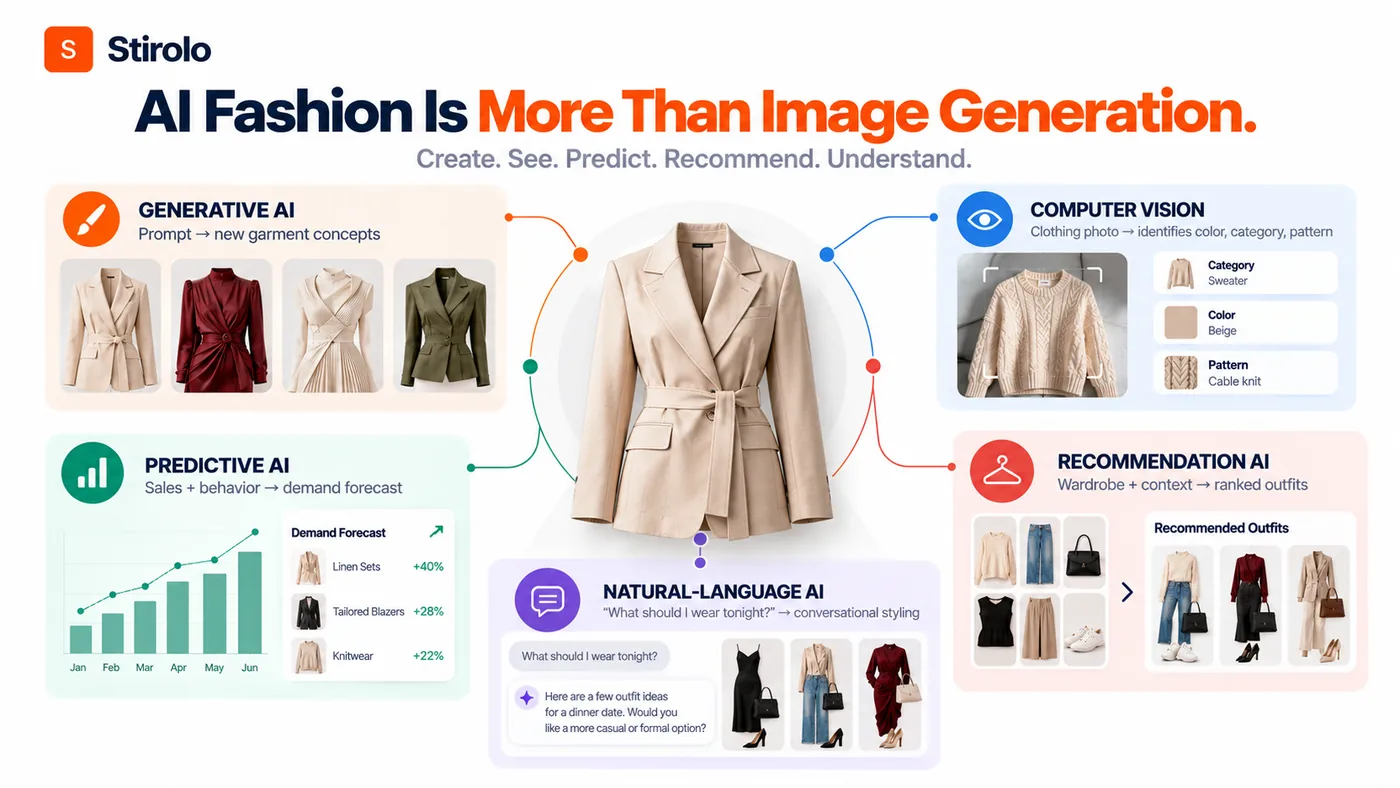
AI fashion can be grouped by the job the system performs rather than by the app that contains it. The categories often overlap inside the same product.
- Generative AI creates new text, images, videos, patterns, design concepts, product copy, or visual variations from prompts and references.
- Computer vision reads visual information. It can recognize garment categories, colors, patterns, body regions, poses, and product details from images.
- Recommendation systems rank products, outfits, or content using preferences, behavior, context, and item data.
- Predictive AI estimates future outcomes such as demand, inventory needs, trend movement, or likely customer response.
- Natural-language AI lets users interact through ordinary questions, briefs, product searches, and styling conversations.
A modern fashion platform may combine several of these. For example, a wardrobe app can use computer vision to catalog a shirt, recommendation models to pair it with trousers, natural-language AI to answer a styling question, and generative AI to visualize the final outfit.
How Is AI Fashion Used in Design?
Fashion designers use AI mainly to accelerate research, ideation, variation, visualization, and presentation. A designer can provide a written brief, sketch, silhouette, color palette, reference image, or print direction and generate alternatives for review.
The useful workflow is iterative. The designer defines constraints, generates options, rejects weak outputs, refines promising directions, and translates the chosen concept into technical information. AI can help explore more directions before expensive development begins.
AI visuals do not remove the need for garment engineering. A convincing image may hide impossible seams, inconsistent front and back views, unrealistic fabric behavior, or missing construction details. Patternmaking, measurements, grading, materials, fit testing, and sample approval still determine whether a concept can become a reliable physical product.
This distinction also protects originality. Designers can use AI as a controlled exploration tool while keeping the creative brief, selection criteria, brand codes, and final decisions human-led.
How Do Fashion Brands and Retailers Use AI?
Brands and retailers use AI to connect product decisions with demand, inventory, marketing, merchandising, and customer behavior. The goal is usually to make a better decision faster or personalize an experience at greater scale.
Trend and demand forecasting
Forecasting systems can analyze historical sales and current signals to estimate demand by product, category, market, or period. The value is not a magical prediction of the future. It is the ability to compare many signals consistently and update estimates as new data arrives.
Merchandising and inventory
AI can help teams decide what to stock, where to allocate it, how to group products, and when inventory may become excessive or scarce. These systems depend heavily on clean product and transaction data. Poor inputs can create precise-looking but weak recommendations.
Marketing and ecommerce content
Generative systems can support product descriptions, campaign concepts, image variations, localization, and customer-service drafts. Fashion teams still need review for product accuracy, brand voice, rights, representation, and disclosure where relevant.
How Does AI Fashion Change Shopping and Styling?
For consumers, AI fashion increasingly acts as a decision layer between a large set of clothing options and a smaller set that fits the person’s needs. That can happen before a purchase, during evaluation, or after clothes enter the wardrobe.
Recommendation engines personalize product discovery. Visual search can find visually similar items from an image. Size and fit systems can estimate a suitable option from product and customer data. Virtual try-on can generate a visual preview of a garment on a person or representative model. A preview should be treated as visualization, not a guaranteed measurement of physical fit.
AI styling goes further by combining clothing information with personal context. A useful system can consider your wardrobe, preferences, proportions, occasion, weather, and recent wear history instead of recommending isolated products. Stirolo’s AI styling process shows this consumer-side model: the system builds recommendations from clothes already owned and weighs multiple layers of context before ranking outfits.
This post-purchase use is an important part of AI fashion. Fashion technology does not have to end at checkout. AI can help people rewear existing pieces, discover combinations, plan travel capsules, and identify genuine wardrobe gaps before buying more.
What Is the Difference Between AI Fashion, Fashion Tech, Digital Fashion and AI Styling?
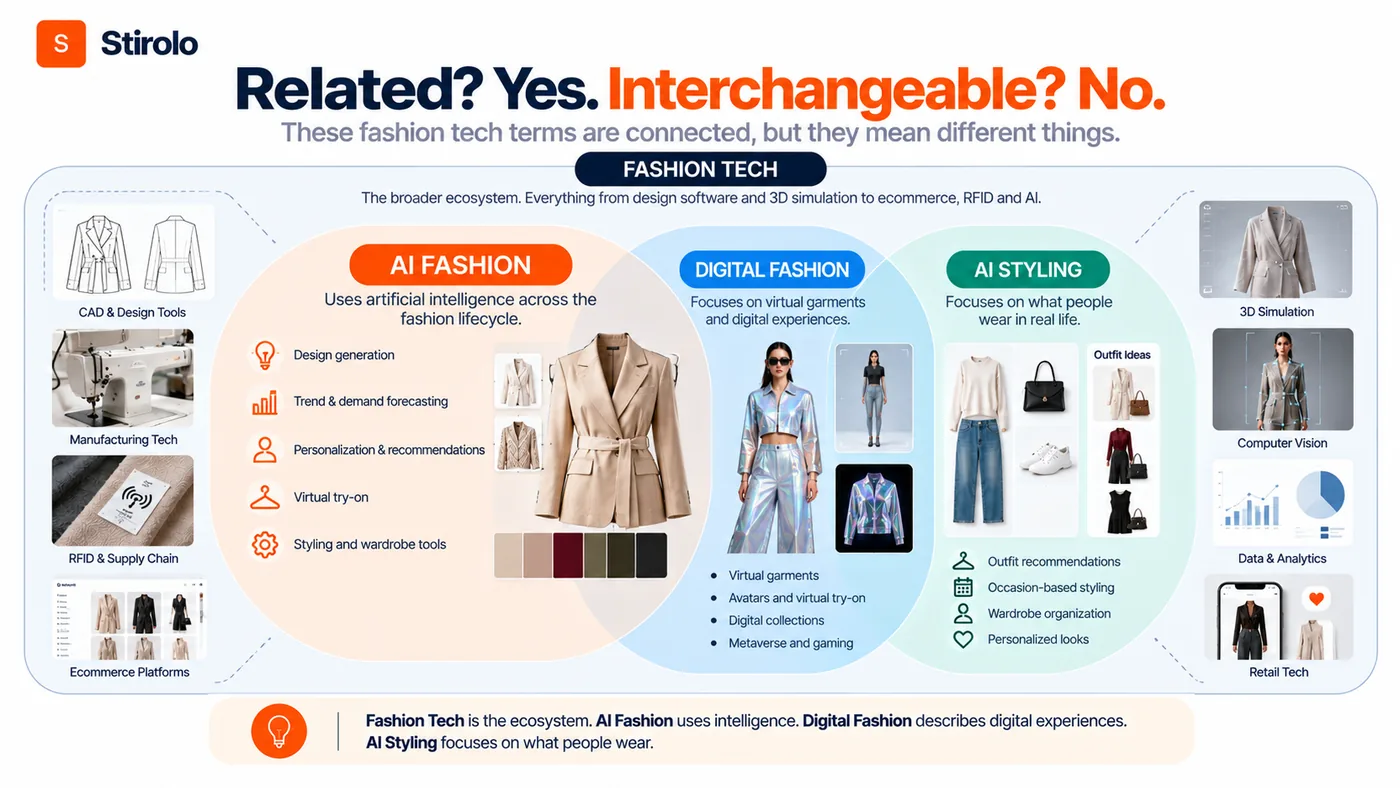
AI fashion is a subset of fashion technology, while digital fashion and AI styling describe narrower areas that can overlap with it. The terms are related, but they are not interchangeable.
| Term | What it means | Typical examples |
|---|---|---|
| AI fashion | Use of artificial intelligence across fashion. | Design generation, forecasting, recommendations, virtual try-on, styling. |
| Fashion tech | All technology applied to fashion, including AI and non-AI systems. | CAD, PLM, RFID, 3D simulation, ecommerce, AI. |
| Digital fashion | Fashion assets or experiences that exist primarily in digital form. | Virtual garments, avatars, digital collections, game wearables. |
| AI styling | AI focused on outfit and wardrobe decisions for a person. | Outfit ranking, occasion styling, closet-based recommendations. |
The distinction helps when evaluating a product. A 3D garment simulator is fashion tech even if it uses no AI. A virtual dress made for an avatar is digital fashion. A model that recommends an outfit from your closet is AI styling. All can exist inside the wider fashion technology ecosystem.
Is AI Fashion the Same as AI-Generated Clothing?
No. AI-generated clothing is one application within AI fashion. AI fashion also includes systems that analyze, predict, classify, recommend, search, personalize, and optimize.
A generated dress image is an example of generative AI. A model that forecasts demand for dresses is predictive AI. A system that identifies a dress from a photograph uses computer vision. A stylist that ranks the dress with items you already own uses recommendation logic. Calling all four “AI-generated fashion” would hide important differences in what the technology actually does.
The distinction also prevents a common misunderstanding: an AI-generated image is not necessarily a manufacturable garment. Visual generation can suggest an aesthetic direction, but physical production requires validated construction, materials, dimensions, and fit.
What Are the Benefits and Limits of AI Fashion?
The main benefit of AI fashion is faster, more personalized decision support; its main limitation is that outputs inherit the weaknesses of their data, models, and instructions. Good results depend on the task and the quality of the information available.
For creative teams, AI can expand the number of concepts explored before development. For retailers, it can help prioritize products and personalize discovery. For consumers, it can reduce search effort and turn personal context into more relevant recommendations. For wardrobe management, AI can organize large numbers of clothing combinations that would be tedious to compare manually.
The limits are equally practical. Generative images can invent details. Forecasts can fail when behavior changes abruptly. Recommendations can overfit past behavior and become repetitive. Virtual try-on can communicate appearance without guaranteeing size or drape. Personalization can become intrusive if a service collects more personal data than the experience requires.
The strongest systems make those limits visible. They separate visualization from fit guarantees, allow corrections, explain what data shapes a recommendation, and preserve a meaningful role for human judgment.
Does AI Fashion Replace Human Creativity?
AI can automate or accelerate parts of creative work, but fashion creativity still depends on human direction, selection, technical judgment, and cultural meaning. Generative systems are particularly useful for producing variations quickly. They do not decide which idea deserves to exist or why it matters to a specific audience.
Research on consumer responses also shows that perceived authenticity can affect reactions to AI-designed fashion. That makes authorship, human input, and brand meaning commercially relevant rather than purely philosophical concerns.
A practical division of labor is to let AI handle scale and iteration while people own the brief, taste, constraints, validation, and final decision. The same principle applies to personal styling. A model can rank possibilities, but the wearer remains the final authority on comfort, identity, and preference.
What Should Consumers Know About AI Fashion Apps?
Before using an AI fashion app, check what problem it solves, what data it needs, and what its output can genuinely tell you. Two apps labeled “AI fashion” may do completely different jobs.
A virtual try-on app may need a body photo and garment image. A wardrobe organizer may need clothing photos. A styling assistant may work better with preferences, occasion, climate, and feedback. More data is not automatically better; the data should have a clear relationship to the promised feature.
For wardrobe-based styling, look for systems that connect features instead of treating each recommendation as a fresh guess. Stirolo’s wardrobe intelligence features combine wardrobe cataloging, body analysis, outfit recommendations, conversational styling, visualization, packing, and shopping guidance around the same personal context.
Privacy also matters because fashion apps can process photos, measurements, location context, purchase history, and preferences. Read what is stored, whether optional features can be disabled, how deletion works, and whether personal data is used beyond the service you requested.
Where Is AI Fashion Going Next?
AI fashion is moving toward connected systems that carry context across design, retail, styling, and wardrobe use instead of solving one isolated task. The more useful direction is not simply better image generation. It is better continuity between decisions.
For brands, that can mean linking product data with design, merchandising, customer experience, and inventory. For consumers, it can mean an assistant that remembers what you own, what you wear, what fits your life, and what you deliberately reject. Better context can make recommendations more relevant without requiring endless browsing.
AI will also face stronger expectations around provenance, consent, accuracy, representation, and disclosure. Fashion is visual and identity-linked, so mistakes are highly visible. Systems that generate people, alter bodies, infer preferences, or recommend purchases need clear boundaries.
For readers who want the human styling principles behind those decisions, the Stirolo style guides cover fit, color, capsules, seasonal transitions, travel, and dress codes. AI becomes more useful when it applies sound styling logic to real personal context rather than treating novelty as the goal.
Frequently Asked Questions About AI Fashion
What does AI mean in fashion?
AI in fashion means using artificial intelligence to support fashion design, forecasting, production decisions, retail, personalization, styling, visualization, and wardrobe management.
Is AI fashion only for designers?
No. Designers use AI for creative work, brands use it for commercial decisions, retailers use it for personalization, and consumers use it for shopping, virtual try-on, styling, and wardrobe planning.
Is AI fashion the same as virtual fashion?
No. Virtual or digital fashion refers to digitally created garments and experiences. AI fashion refers to artificial intelligence used across fashion, including physical and digital products.
Can AI fashion tell me what to wear?
Yes, some AI styling systems can recommend outfits. The quality improves when the system knows your actual wardrobe, preferences, body context, occasion, and environment.
Can AI fashion replace a real designer or stylist?
Not completely. AI can generate and rank options quickly, while people still provide creative direction, technical validation, cultural judgment, comfort preferences, and final decisions.
AI Fashion Is a Category, Not a Single Tool
AI fashion describes a connected set of technologies used across the fashion lifecycle. It can help create a garment concept, forecast demand, organize inventory, personalize a store, visualize an outfit, or make an existing wardrobe easier to use. The value comes from matching the right type of AI to a clearly defined decision.
The most useful question is therefore not whether fashion uses AI. It is what information a system understands, what decision it supports, how its output is validated, and whether it improves the experience for the person using it. That framework separates practical AI fashion from impressive-looking technology with no clear job.