
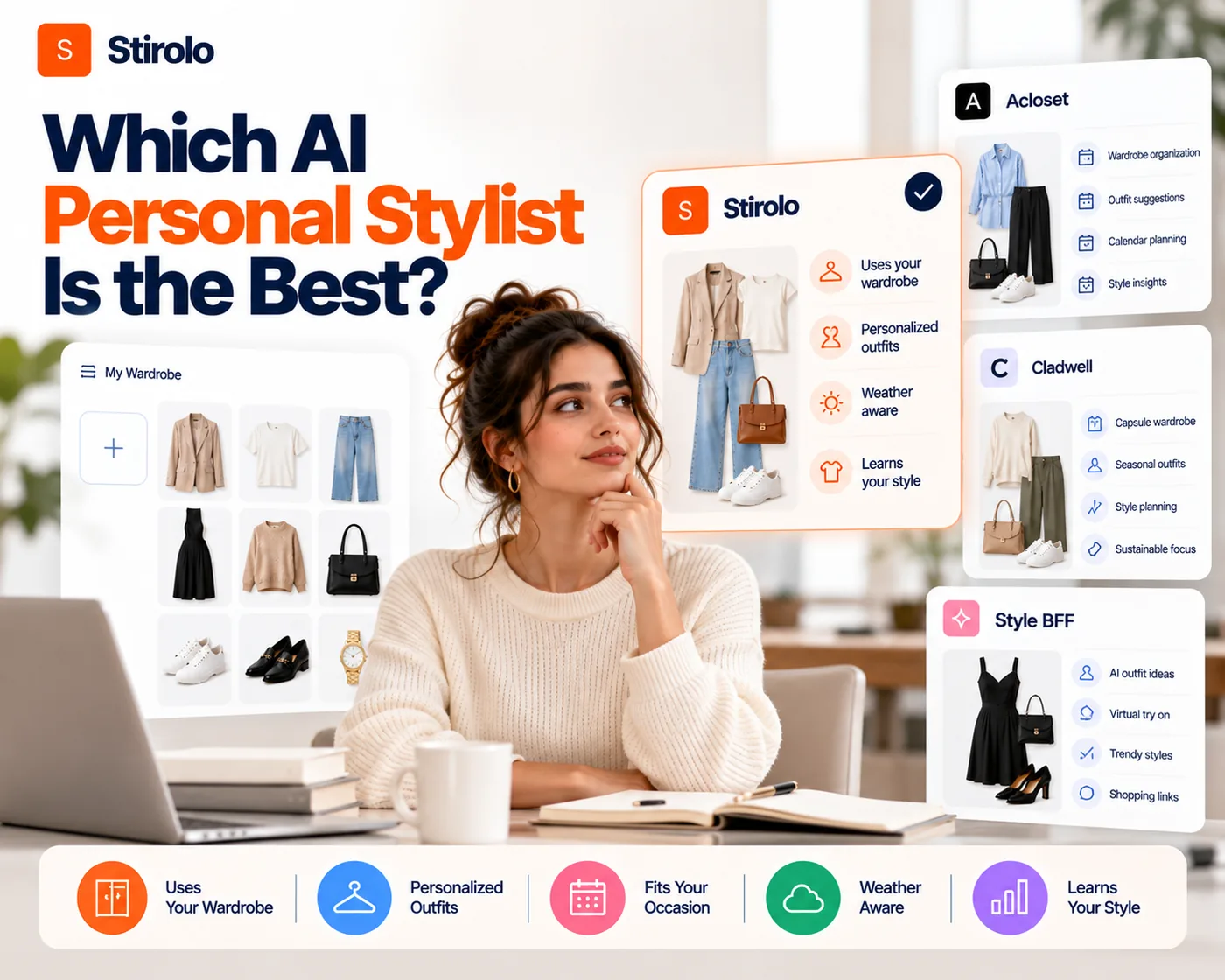
The best AI personal stylist is the one that understands your real wardrobe, preferences, dressing context and feedback well enough to make useful outfit decisions. There is no single app that is best for everyone because AI styling tools solve different problems: some organize a closet, some generate outfits, some visualize clothes, and some mainly help you shop.
A useful choice starts with the problem you want solved. If you stare at a full closet and still cannot decide what to wear, wardrobe-aware recommendations matter more than a large shopping catalog. If you want to preview a new garment, visualization matters more. If you want detailed critique, the system needs to explain why a look works and what should change.
That distinction matters because the label “AI personal stylist” now covers very different products. Comparing them only by marketing claims or a single “best” score can hide the feature that will determine whether you keep using the tool after the first week.
What Makes an AI Personal Stylist Worth Using?
A worthwhile AI personal stylist should reduce a real dressing decision, not simply produce attractive fashion images. The strongest systems connect information about you with information about the clothes available to you.
For everyday styling, useful inputs include your wardrobe, preferred colors, silhouettes, formality level, body or fit context, occasion, weather and previous reactions to suggested outfits. A tool does not need every signal to be useful, but each missing signal limits how personal its recommendations can become.
The output also matters. A complete outfit from clothes you own is more actionable than a mood board when your goal is deciding what to wear this morning. A specific explanation such as “swap the bulky overshirt because both layers add volume through the torso” is more useful than a generic score with no reasoning.
Which Type of AI Personal Stylist Do You Need?
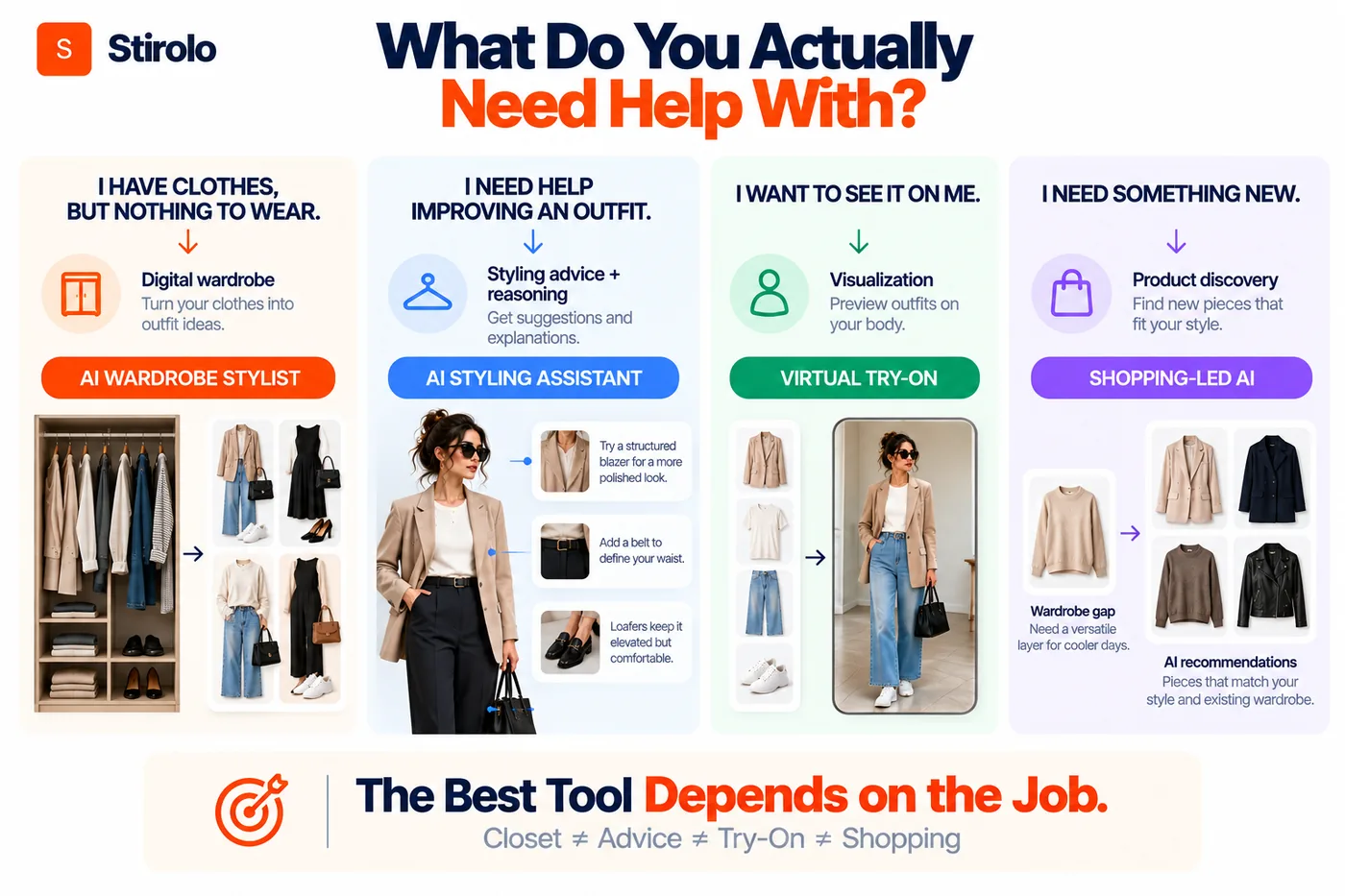
Choose the type of AI stylist by the decision you want help making. Four common categories overlap, but they are not interchangeable.
AI wardrobe stylists
AI wardrobe stylists digitize clothes you already own and build outfits from that inventory. They suit people who want more use from an existing closet, repeat fewer default outfits, plan travel capsules or reduce unnecessary purchases.
AI styling assistants
AI styling assistants answer questions about what to wear, how to combine pieces or how to adjust an outfit. Their usefulness depends on how much personal and wardrobe context they retain. A general chatbot can give fashion advice, but you may need to restate your closet and preferences repeatedly.
Virtual try-on and visualization tools
Virtual try-on tools generate an image of you wearing a garment or outfit. They are useful for visual comparison, but an image preview is not the same as verified physical fit. Fabric behavior, construction, sizing and comfort still need real-world checking.
Shopping-led AI stylists
Shopping-led tools recommend products based on taste, body information or browsing behavior. They can help when you need a missing piece, but they are less useful if your main goal is wearing more of what you already own.
Quick Reference: Match the Tool to the Job
| Your main need | Prioritize | Do not confuse it with |
|---|---|---|
| Wear your closet more | Digital wardrobe + outfit generation | A shopping recommender |
| Get daily outfit help | Weather + occasion + wardrobe context | Generic inspiration |
| Improve outfit choices | Specific critique + reasoning | A flattering score |
| Preview combinations | Body visualization or virtual try-on | Guaranteed fit |
| Buy fewer wrong items | Wardrobe-gap and duplicate checks | Trend discovery |
| Learn your style | Feedback memory + preference learning | One-time style quiz |
How Should You Compare AI Personal Stylist Apps?
Compare AI personal stylist apps by the information they use and the decisions they can make with it. Feature count alone is a weak comparison because several features may perform versions of the same task.
A practical comparison should ask whether the app can work with your clothes, remember your taste, account for the day’s context, explain recommendations, accept corrections and change future suggestions. Then check whether the setup effort, platform availability and privacy terms fit your routine.
Current tools illustrate the differences. WardrobeAI describes a digital wardrobe, AI outfit builder and style chat built around wardrobe and occasion context. SELION says its agent learns wardrobe, taste, sizes and lifestyle. Trendo focuses on clothes users already wear and lets them request outfits or checks for specific plans. These are useful capability examples, not proof that one product is universally better than another.
Does the Best AI Stylist Need Your Real Wardrobe?
Yes, if your goal is everyday outfit planning from clothes you already own. Without an inventory of your actual garments, an AI can recommend a type of outfit but cannot reliably tell you which specific pieces in your closet should form it.
A digital wardrobe also creates useful constraints. The stylist can avoid suggesting a navy blazer you do not own, notice that a pair of trousers has not been worn recently, or build several outfits around one difficult item. The quality of that process depends on accurate garment records.
Stirolo’s how Stirolo works page, for example, describes a setup that combines wardrobe items with body, taste, occasion and environment signals before ranking outfits. That is the kind of workflow to look for if your priority is styling your real closet rather than browsing hypothetical looks.
How Personal Should AI Styling Recommendations Be?
Personal styling should become more specific than “this looks good.” A useful AI stylist should be able to connect its recommendation to your stated preferences and the situation you are dressing for.
Suppose you prefer relaxed silhouettes, avoid dry-clean-only clothes, have a client meeting at 2 p.m., and expect warm weather. A personal recommendation should respect all four constraints. If the system repeatedly ignores one of them, its personalization is shallow even if the generated outfits look fashionable.
The same principle applies to criticism. An AI that validates every outfit may feel pleasant but gives you little decision support. Better feedback identifies a concrete issue such as proportion, color balance, formality or layering, then suggests a realistic adjustment using available clothes.
Can AI Personal Stylists Judge Fit and Body Proportions?
AI can use body measurements, photos or self-reported proportions to make styling suggestions, but it cannot guarantee how a physical garment will fit. Treat fit-aware recommendations as guidance, especially when the system has not seen the exact garment on your body.
Body context can still improve styling. A system may recommend different jacket lengths, trouser rises or silhouette balances based on the profile you provide. The recommendation becomes more useful when it explains the visual effect instead of declaring one body type “correct.”
For purchases, check the retailer’s garment measurements, size chart, fabric stretch and return policy. A generated image or AI size suggestion should not replace those details.
Should an AI Stylist Show Outfits on Your Body?
Body visualization is useful when you want to compare combinations before getting dressed, but it should be treated as a preview. Generative images can help you judge color relationships, layering ideas and broad proportions while still misrepresenting exact drape, length or texture.
The feature is therefore valuable as a decision aid, not as proof of fit. If visualization matters to you, check whether the app uses your photo, an avatar, a body model or a generic model. Those approaches provide different levels of personal resemblance.
You can review Stirolo features to see how wardrobe management, outfit recommendations, visualization and styling assistance can sit within one workflow. When comparing any app, look for whether those functions share the same profile data or operate as disconnected tools.
How Much Setup Is Worth It for Better Recommendations?
More setup can produce better recommendations when the information remains useful over time. Photographing garments, correcting automatic tags and completing a style profile takes effort, but those steps give a wardrobe-aware system a stronger base for future outfits.
The tradeoff is simple: low-friction apps can produce inspiration quickly, while deeper wardrobe systems may require more initial work before their recommendations become personal. Neither approach is automatically better. Choose based on how often you expect to use the stylist.
If you want one outfit idea for an event, a quick conversational tool may be enough. If you want daily recommendations, travel packing, wear tracking and shopping checks, spending time on a reliable wardrobe catalogue is easier to justify.
How Can You Tell Whether an AI Stylist Is Actually Learning?
A learning AI stylist should change its future recommendations after clear feedback. Saving, rejecting, editing or repeatedly wearing outfits should influence what appears next.
Test this deliberately. Reject a silhouette you dislike, save several outfits with a consistent characteristic, and correct a recommendation that feels too formal. Then watch whether later suggestions reflect those choices. If the same unwanted patterns keep returning, the product may be storing feedback without using it meaningfully.
What Privacy Questions Should You Ask?
Check privacy before uploading body photos, wardrobe images, measurements, purchase history or calendar information. These inputs can make styling more personal, but they also create a more detailed profile of you.
Read the product’s current privacy policy and settings. Look for what data is stored, why it is processed, whether information is shared with third parties, how long it is retained, and whether you can delete or export it. Do not rely only on a short marketing statement such as “privacy first.”
How Should You Test an AI Personal Stylist Before Paying?
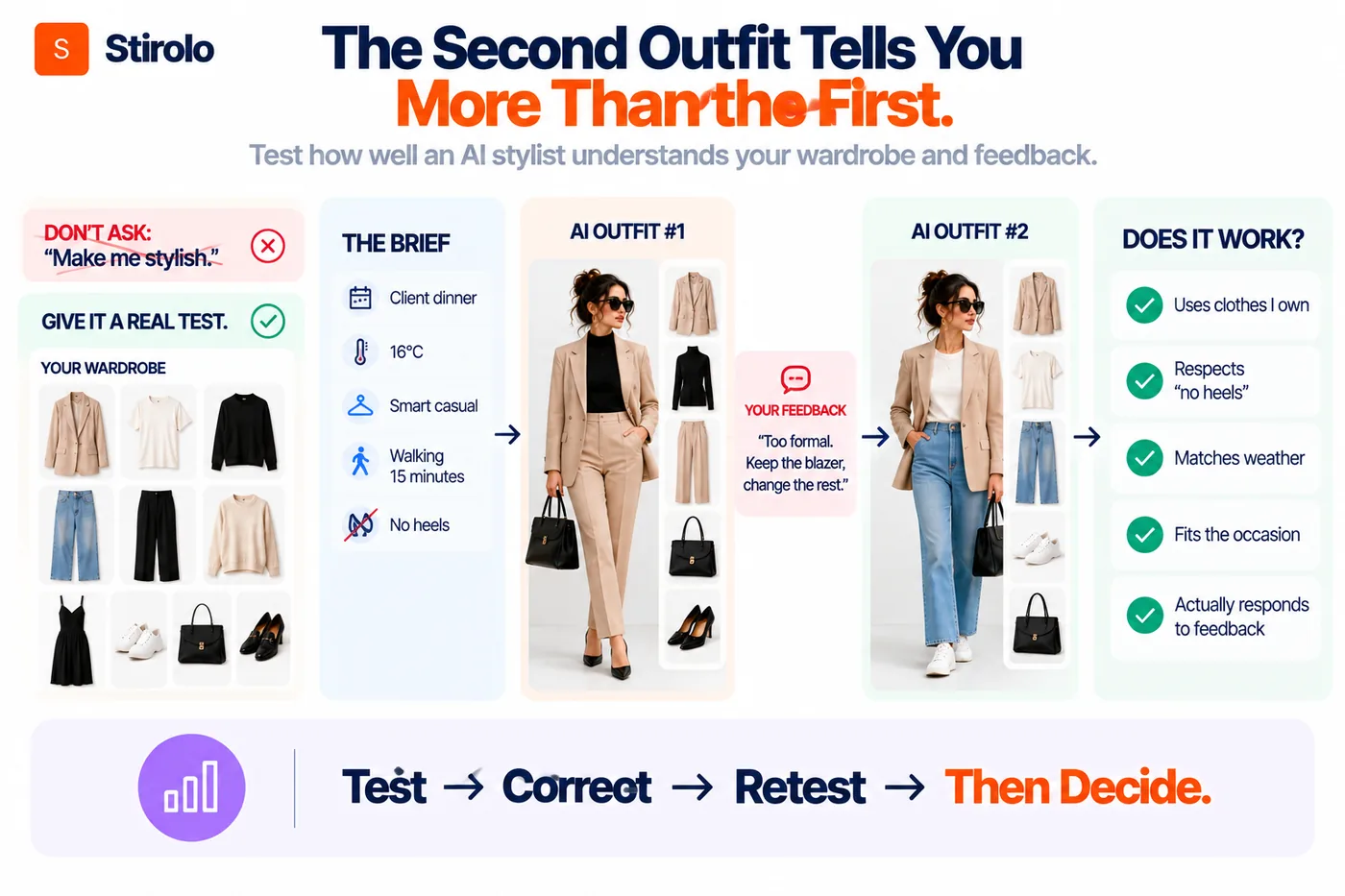
To test an AI personal stylist before paying, give it a small but realistic styling problem and judge the result against your actual life. Do not start with a vague request such as “make me stylish.”
Add enough clothes to create several complete outfits. Then ask for a look for a specific occasion, weather condition and comfort preference. Give one negative preference, such as no heels or no tucked shirts, so you can see whether the system respects constraints.
Next, correct one recommendation and request another. The second result is often more informative than the first because it shows whether the product can respond to feedback rather than merely regenerate a different outfit.
Finally, check whether you would actually wear the suggestion. A visually impressive render has little value if the outfit uses unavailable clothes, ignores the weather, conflicts with your comfort needs or pushes you toward purchases you did not request.
- Does it style clothes you actually own?
- Does it remember preferences and corrections?
- Does it account for occasion and weather?
- Does it explain why a recommendation works?
- Can you use it without unwanted shopping pressure?
- Are its privacy controls clear enough for the data you plan to upload?
Is Stirolo the Best AI Personal Stylist for Everyone?
No. No AI personal stylist is the best choice for every user because the category includes different goals, platforms and levels of setup. Stirolo is most relevant when you want recommendations grounded in clothes you already own and want multiple personal signals considered together.
Its published workflow centers on wardrobe items, body context, taste, occasions and environment, with feedback from saved, skipped and edited looks used to refine recommendations. That approach suits a wardrobe-first user more than someone who mainly wants a fast shopping discovery feed.
Someone who wants human styling may prefer a service that includes a person. Someone who wants only color analysis may not need a full digital closet. Someone who wants a one-off virtual try-on may prefer a dedicated visualization tool. The best choice follows the job, not the broadest feature list.
If your goal is building a smaller, more intentional closet, capsule wardrobe planning is another useful way to evaluate whether wardrobe-aware AI matches how you want to dress.
FAQs About Choosing an AI Personal Stylist
What is the best AI personal stylist for clothes I already own?
The strongest option for this goal is a wardrobe-aware stylist that catalogs your actual clothes and generates complete outfits from them. Check whether it also uses occasion, weather and your feedback.
Are AI personal stylists better than human stylists?
No, not in every situation. AI offers speed, availability and repeated wardrobe suggestions, while a skilled human can interpret nuance, fabric, fit and personal goals through direct observation and conversation.
Can a free AI stylist be good enough?
Yes. A free tier can be enough for basic outfit ideas or wardrobe organization. Compare feature limits, recommendation quality and privacy before paying for advanced styling or visualization.
Can AI tell me whether an outfit looks bad?
Yes, but the usefulness depends on the reasoning. Look for specific feedback about proportion, color, formality or coordination rather than a vague score or automatic approval.
Can an AI stylist replace trying clothes on?
No. AI can preview combinations and suggest fit directions, but physical try-on remains the reliable way to assess comfort, exact sizing, fabric behavior and movement.
Choose the AI Stylist That Understands Your Real Wardrobe
The best AI personal stylist is not the app with the longest feature list or the strongest claim to being number one. It is the tool that has the right information to solve your recurring dressing decisions and becomes more useful when you correct it. Start with your main need, test the system on clothes and situations you actually encounter, and pay attention to whether its advice becomes more specific over time. If you want styling centered on the wardrobe you already own, a wardrobe-first system such as Stirolo is worth evaluating against those same criteria rather than choosing it on branding alone.