

AI styling services work best when the technology solves a specific styling problem with personal data. The strongest services connect recommendations to your wardrobe, preferences, body context, occasion, or shopping needs instead of producing generic fashion advice.
No single styling service uses artificial intelligence (AI) “best” for every person. A digital closet user needs different technology from someone seeking color analysis, human feedback, or virtual try-on. The useful question is which service applies AI most effectively to the job you need done.
What Makes an AI Styling Service Actually Good?
A strong AI stylist uses relevant personal inputs, produces wearable recommendations, and improves when you correct it. A long feature list does not prove better styling.
The most useful systems start with concrete information. Examples include your actual garments, preferred silhouettes, dress codes, local weather, recent wear history, and fit preferences. Services that only ask for a short prompt have less context to work with.
Good AI styling also explains the recommendation clearly. You should understand why a blazer works for a meeting, why a color suits your palette, or why a purchase fills a real wardrobe gap.
A feedback loop matters because personal style contains subjective choices. Saving, rejecting, swapping, and rewearing outfits gives the system evidence about your taste.
Which Styling Services Use AI Technology Best for Different Needs?
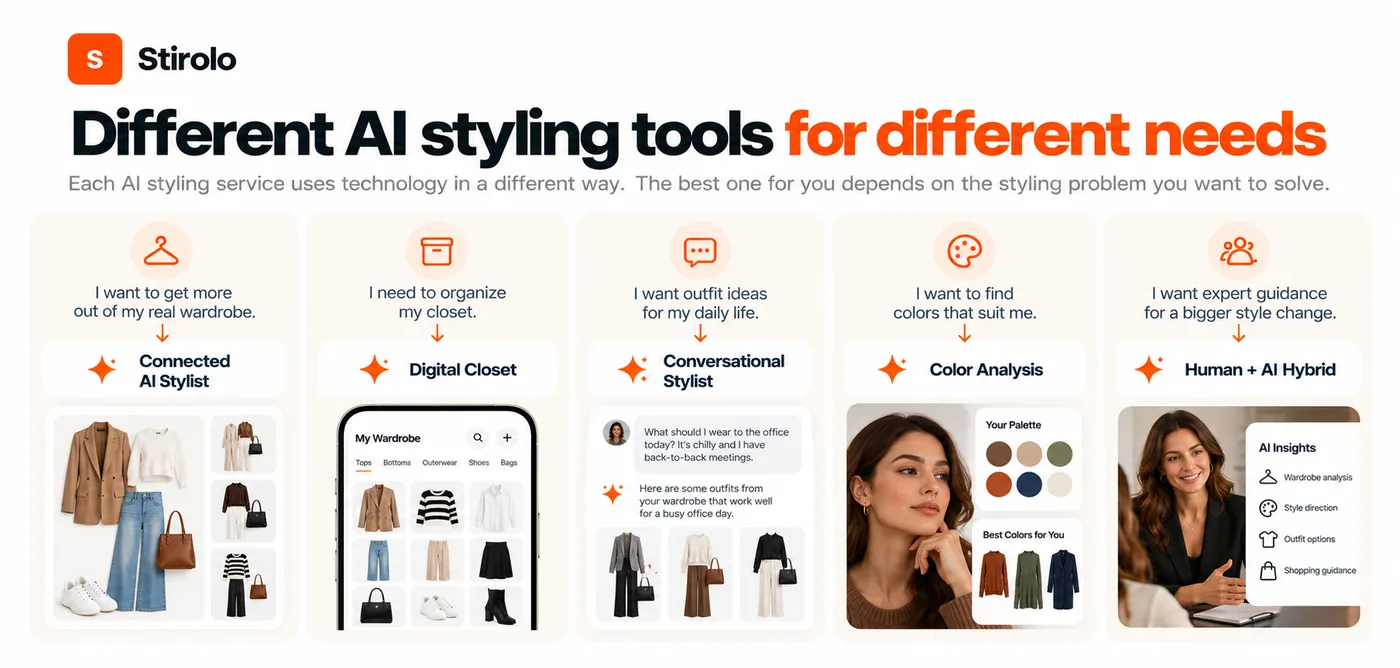
The best service depends on the styling task. Current products specialize in digital closets, daily recommendations, visual try-on, color analysis, shopping, or human-assisted styling.
Stirolo: Best Fit for Connected Wardrobe Intelligence
Stirolo combines wardrobe data, body analysis, conversational styling, outfit visualization, weather, occasions, and learning from corrections. The connected workflow gives the AI more context than a single-purpose outfit generator.
You can review the Stirolo feature set to see how wardrobe management, body analysis, recommendations, chat, travel packing, and shopping guidance connect.
Stirolo also grounds outfit recommendations in clothes you already own. That design reduces a common AI styling problem: attractive suggestions that require garments missing from your closet.
Stirolo suits users who want one system to support daily dressing, occasions, wardrobe use, packing, and considered shopping. Stirolo remains in early access, so availability and features can continue changing.
Whering and Acloset: Strong for Digital Closet Organization
Whering and Acloset focus strongly on digitizing and organizing existing clothes. Whering supports wardrobe tracking, outfit creation, lookbooks, packing, and wardrobe statistics. Acloset adds AI-assisted cataloging and outfit suggestions.
These services make sense when closet visibility creates your biggest problem. A searchable digital wardrobe can help you rediscover forgotten items and build combinations without physically pulling everything out.
Alta: Strong for Conversational Daily Styling
Alta centers AI around daily wardrobe decisions and conversational guidance. Current descriptions emphasize outfits based on your wardrobe, weather, lifestyle, and schedule, plus digital closet features and visual presentation.
A chat-first experience works well when you want quick answers such as what to wear for dinner, work, or changing weather. The value depends on how much personal context the service can access during the conversation.
Style DNA: Strong for Color-Led Personalization
Style DNA focuses heavily on color and personal style analysis. Color-led tools suit users whose main questions involve flattering palettes, coordinated purchases, and consistent visual direction.
Color analysis solves a narrower problem than full wardrobe intelligence. Choose a color-led service when palette decisions matter more than wear tracking, packing, or detailed closet planning.
Indyx and Stitch Fix: Strong Where Human Judgment Matters
Indyx combines wardrobe tools with access to human styling services. Stitch Fix combines algorithms with human stylists and a commerce model that sends selected clothing to customers.
Human-assisted services suit high-context decisions. Examples include wardrobe rebuilding, major events, professional image changes, and situations where conversation reveals preferences that software has not learned yet.
How Do AI Styling Services Compare at a Glance?
Compare services by the job you need completed, not by the number of AI labels on the website. The table below gives a practical starting point.
| Styling need | Useful service type | Method | Setup effort |
|---|---|---|---|
| Daily outfits | Wardrobe-aware AI stylist | Closet + weather + occasion | Medium |
| Closet organization | Digital wardrobe app | Photo catalog + auto-tagging | Medium |
| Color guidance | Color-analysis stylist | Selfie + palette analysis | Low |
| Visual confidence | Virtual try-on service | Generative image preview | Low-Medium |
| Major wardrobe reset | Human + AI hybrid | Data + stylist consultation | High |
| Smarter shopping | Wardrobe intelligence tool | Gap + duplicate analysis | Medium |
How Does the Best AI Styling Technology Work?
The strongest systems combine 4 stages: understand, rank, visualize, and learn. Each stage solves a different part of the styling decision.
1. Computer Vision Builds the Wardrobe Record
Computer vision identifies garment details from photos. Useful attributes include category, color, pattern, season, and formality. Automatic background removal also creates cleaner wardrobe images.
Accurate cataloging matters because an outfit engine cannot recommend your real clothes reliably when the wardrobe record contains missing or incorrect information.
2. Recommendation Models Rank Wearable Combinations
Recommendation systems score combinations against personal and situational signals. Strong inputs include weather, occasion, style preferences, fit information, recent wear, and available garments.
Stirolo describes its AI styling process as 5 input layers: body, wardrobe, taste, occasions, and environment.
3. Generative AI Adds Conversation and Visualization
Generative AI can explain outfit choices, answer follow-up questions, and create visual previews. A visual preview helps you judge proportion and coordination before changing clothes.
Generated images still require judgment. A rendered outfit can misrepresent drape, fabric behavior, exact fit, or garment details. Treat visualization as decision support rather than a fit guarantee.
4. Feedback Personalizes Future Recommendations
Feedback teaches the system which suggestions match your taste. Useful signals include saved looks, rejected outfits, item swaps, repeated wears, and explicit comments.
A service that learns from corrections can become more personal over time. A service that resets after every prompt often keeps producing generic answers.
Why Do Some AI Stylist Apps Feel Generic?
Generic results usually come from weak personal context, incomplete wardrobe data, or limited feedback. AI cannot infer every preference from one selfie or one sentence.
Users often want an AI stylist to understand unwritten rules. Examples include avoiding sleeveless tops at work, preferring loose trousers, repeating favorite shoes, or rejecting certain colors despite theoretical compatibility.
You improve recommendations by adding accurate garments, stating constraints, correcting poor suggestions, and recording what you actually wear. Specific feedback gives the system better evidence than passive browsing.
You should also distinguish inspiration from styling. An image generator can create attractive fashion pictures without understanding your closet. A wardrobe-aware stylist must connect the recommendation to garments you can actually wear.
What Should You Check Before Choosing an AI Styling Service?
Check the data inputs, recommendation source, feedback system, privacy terms, and business model before subscribing. Those 5 areas reveal more than promotional AI language.
- Check whether recommendations use your real wardrobe or a generic product catalog.
- Check whether the service considers weather, occasion, fit, color, or body context.
- Check whether you can reject, edit, and refine recommendations without starting again.
- Check how the company stores photos, wardrobe data, and body information.
- Check whether shopping commissions influence the recommendations you receive.
Pricing also deserves attention because feature limits vary. Some apps provide free closet organization but charge for advanced AI, virtual try-on, or human styling. Confirm current pricing on the provider before paying.
Are AI Styling Services Better Than Human Stylists?
AI services offer speed, repetition, and constant access; human stylists offer richer judgment and conversation. The stronger choice depends on the decision you need to make.
AI works well for repeated tasks. Examples include daily outfit selection, weather adjustments, closet search, packing lists, and tracking wear patterns. Software can repeat those tasks without booking another appointment.
Human stylists remain valuable for nuanced changes. Examples include executive image work, major life transitions, complex fit challenges, and wardrobe edits where emotional attachment affects decisions.
Hybrid services combine both approaches. You can use software for routine decisions and human expertise for occasional high-context reviews.
Which AI Styling Features Matter Most for Real Wardrobes?
Wardrobe grounding, context awareness, and useful feedback matter more than novelty. A flashy avatar adds little value when the service recommends clothes you do not own.
Wardrobe grounding means the system knows your available garments. Context awareness means the system understands why you need an outfit. Feedback means the system adapts when your preferences differ from its first recommendation.
Body analysis and virtual try-on add another layer for users who care about proportion and visualization. Wear analytics help users who want to understand wardrobe value and repetition.
For a direct feature-by-feature view, you can compare wardrobe apps across wardrobe management, recommendations, body analysis, visualization, and pricing approaches.
How to Choose the Right AI Styling Service for You
To choose the right AI styling service, define one styling problem first and test the service against that problem. Avoid choosing from a feature list alone.
Start with a concrete goal. You may want faster morning outfits, a searchable closet, better colors, fewer unnecessary purchases, event styling, or visual try-on.
Next, test the same real scenario across shortlisted services. Ask each service for an outfit using clothes you own for a specific event and weather condition. Judge whether the recommendation feels wearable, personal, and easy to adjust.
Then test correction. Reject one suggestion and explain why. A strong service should use the new information rather than returning a slightly rearranged version of the same idea.
Finally, decide whether the setup effort matches the benefit. A detailed digital closet takes time to build, but wardrobe-aware recommendations need accurate inventory. Choose a lighter tool when you only want occasional inspiration.
What Are the Biggest Limits of AI Styling Services?
AI styling still struggles with exact fit, fabric behavior, hidden preferences, and incomplete wardrobe data. Strong services reduce these problems, but no software sees clothing exactly as you do in person.
Fit creates the clearest limitation. A photo can show proportions and garment shape, but a photo cannot fully capture pressure points, stretch, movement, or comfort. Two trousers with the same labeled size can sit differently because fabric, rise, cut, and construction differ.
Fabric behavior also matters. Satin, denim, wool, linen, and jersey respond differently to light and movement. Generated outfit images can make a combination easier to imagine, but the image does not prove how the real garments will drape together.
Personal taste creates another challenge. You can dislike a theoretically flattering color or prefer an unusual silhouette because the choice feels like you. A useful AI stylist must let your repeated preferences outweigh generic fashion rules.
Wardrobe accuracy sets a practical ceiling. Missing shoes, outdated item photos, incorrect colors, or garments you no longer own can weaken recommendations. Keeping the digital closet current improves the quality of any wardrobe-based service.
How Can You Test an AI Stylist Before Paying?
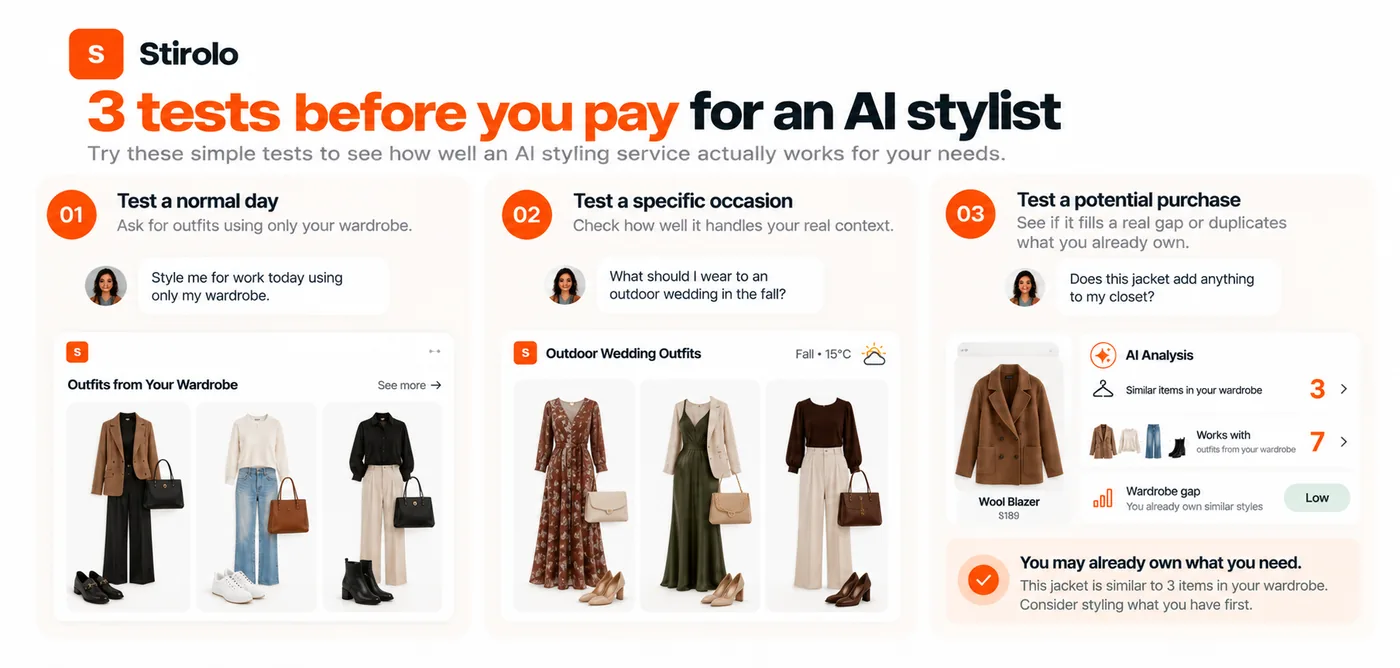
Test 3 real decisions before paying: a normal day, a specific event, and a potential purchase. Those tests reveal whether the service understands your wardrobe and responds to context.
Test 1: Ask for a Normal Daily Outfit
Ask the service to dress you for a normal workday or weekend plan using only items you own. Include the weather and one preference. A useful result should respect every constraint without inventing missing pieces.
Test 2: Ask for a Specific Occasion
Give the service a clear dress code, location, and activity. Examples include a client dinner, outdoor wedding, conference, or first date. Check whether the recommendation changes meaningfully with the occasion instead of repeating a generic formula.
Test 3: Check a Purchase Against Your Closet
Show the service one item you are considering buying. Ask how many existing outfits the item supports and whether you already own a substitute. A wardrobe-aware system should help you judge usefulness, not simply encourage another purchase.
Repeat one test after correcting the AI. Tell the service why you rejected the first answer. The second answer should reflect your correction clearly. That response tells you more about personalization than a polished first recommendation.
FAQs About AI Styling Services
Do AI styling services use clothes I already own?
Yes, many AI wardrobe services do. Stirolo, Whering, Acloset, Alta, and other digital closet tools can work with uploaded wardrobe items, although exact features differ.
Can AI tell what clothes suit my body?
Yes, some services analyze body context or proportions. Results depend on photo quality, model design, and available fit information. AI output does not replace physical garment fitting.
Is virtual try-on the same as an AI personal stylist?
No. Virtual try-on visualizes clothing, while an AI personal stylist recommends what to wear. Some services combine both functions in one workflow.
Can AI styling help me buy fewer clothes?
Yes, wardrobe-aware tools can support that goal. Gap analysis, duplicate checks, wear tracking, and outfit generation can help you evaluate purchases against clothes you own.
Should I choose AI styling or a human stylist?
Choose AI for frequent routine decisions and human styling for high-context personal guidance. A hybrid approach works well when you want both convenience and occasional expert input.
Choose AI Styling Based on the Problem You Want Solved
The most useful AI styling service is the one that understands enough about you to make a specific decision easier. Digital closets excel at organization. Color tools focus on palettes. Human hybrids add judgment. Connected AI stylists combine wardrobe data with daily context.
If you want recommendations grounded in your real closet, body context, occasions, and daily routine, explore the Stirolo feature set and decide whether that connected approach matches your styling needs.
Reviewed September | Target: People comparing AI personal styling services | Reading Level: Grade 8