
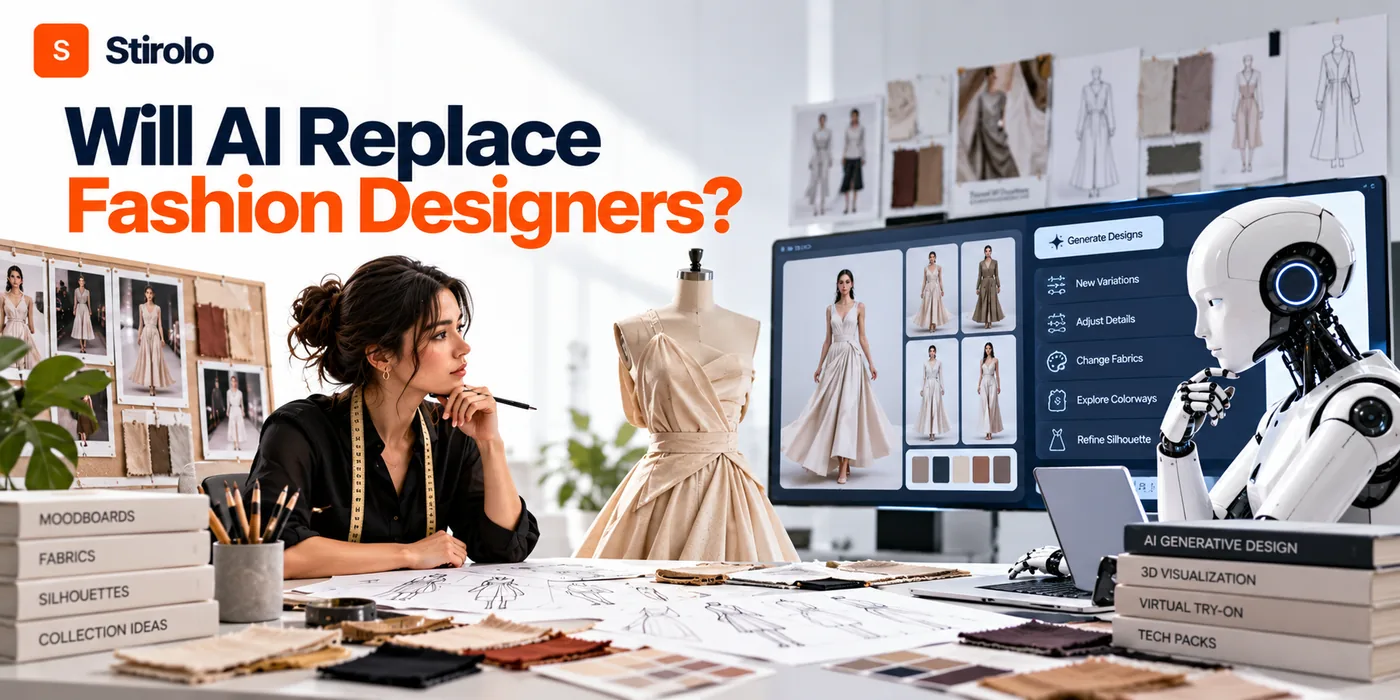
No, AI is unlikely to replace fashion designers as a profession. AI can automate parts of the design workflow, but designers still make the technical, material, cultural, brand, and commercial decisions that turn attractive concepts into clothing people can actually wear.
The bigger change is task replacement. Generative AI can produce mood boards, silhouettes, color variations, prints, campaign visuals, and early concepts quickly. That speed changes what employers need from designers. A designer who only produces basic visual options faces more automation pressure than a designer who understands construction, fit, materials, customers, and brand direction.
Fashion companies are already using AI across creation, marketing, product discovery, and customer experience. McKinsey describes AI as an increasingly important operating capability for fashion businesses, while current creative tools can generate and refine clothing visuals from text and image prompts. The evidence points toward redesigned workflows rather than the disappearance of human design teams.
Will AI Replace Fashion Designers Completely?
No. Fashion design contains too many different kinds of work for one AI system to replace the entire role. A finished garment requires creative direction, technical feasibility, fabric knowledge, fit decisions, costing awareness, supplier communication, sampling, and judgment about the customer.
AI performs best when a task can be expressed as patterns, examples, constraints, or visual instructions. Early concept generation fits that description. A designer can request 20 jacket directions, compare proportions, change a palette, or generate print ideas within minutes.
A generated image does not prove that a jacket can be cut efficiently, sewn at the target cost, graded across sizes, or worn comfortably. A human team must translate visual intent into construction decisions. That distinction separates an appealing fashion image from a manufacturable fashion product.
The most realistic outcome is a smaller amount of manual iteration around some tasks and greater expectations for each designer. Designers may produce more concepts, test more directions, and communicate ideas faster. Employers may then value judgment and technical range more heavily than raw output volume.
Which Fashion Design Tasks Can AI Already Automate?
AI can automate or accelerate many repetitive and exploratory tasks. Current image-generation systems can turn written descriptions into garment visuals and produce multiple versions of a concept. Vector tools can also generate editable pattern graphics for textile and surface-design work.
Concept and mood-board generation
To generate early concepts, designers can describe the garment category, silhouette, material, color, customer, season, and visual references. AI can return several directions quickly. Designers can reject weak ideas and develop the strongest options instead of manually rendering every possibility.
Color, print, and silhouette variations
To test variations, designers can hold the core garment idea constant while changing one variable at a time. AI can compare neutral and saturated palettes, short and long proportions, different surface patterns, or alternative trims. Controlled variation makes AI more useful than asking for random fashion inspiration.
Presentation and visualization work
To visualize a concept, designers can place garments on generated models, create styled looks, or produce contextual images before a physical sample exists. These visuals can support internal reviews and early merchandising discussions. Teams still need to label generated imagery clearly when the visual does not represent a finished product.
AI can also help summarize research, organize references, draft presentation copy, and prepare first-pass descriptions. These tasks consume time but do not necessarily require the designer’s highest-value judgment.
Which Parts of Fashion Design Still Need Human Designers?
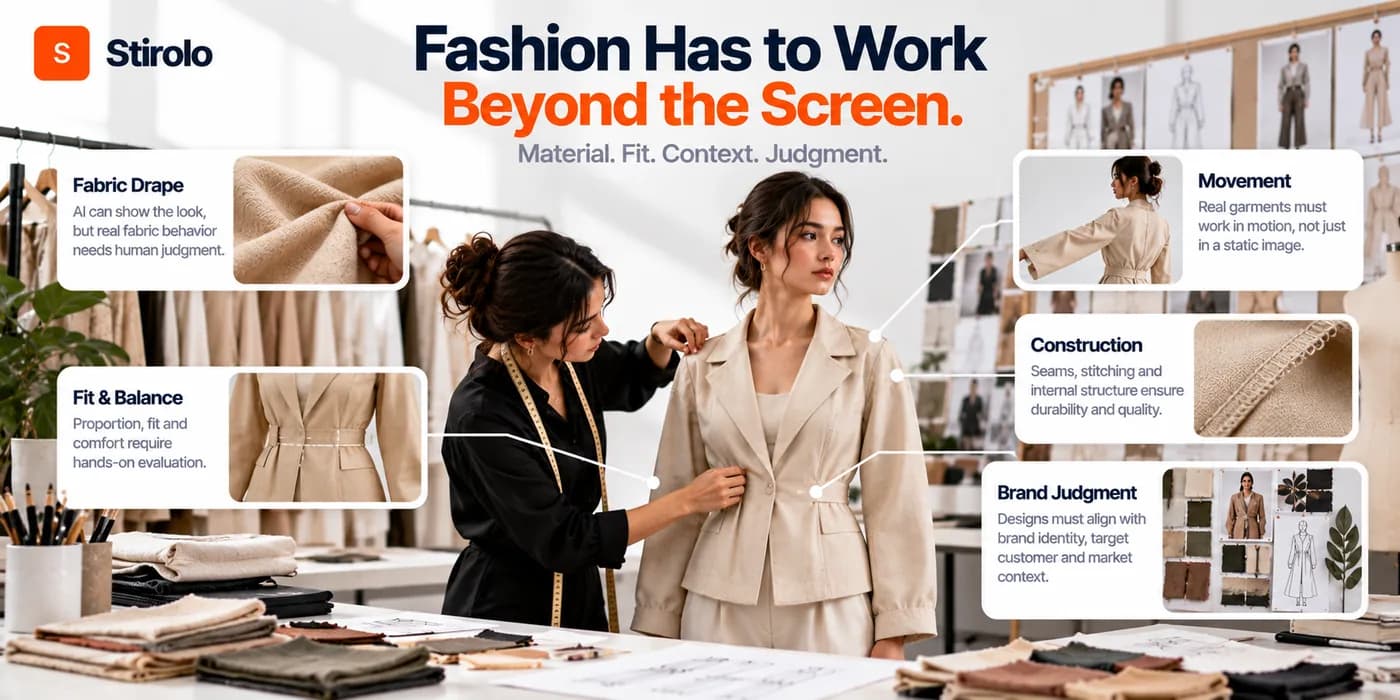
Human designers remain essential wherever a decision depends on physical reality, context, taste, accountability, or competing business constraints. Fashion is not only visual. Clothing touches a moving body, uses materials with specific behavior, and must survive manufacturing and use.
Material and construction judgment
A fabric has weight, stretch, recovery, drape, opacity, shrinkage, hand feel, and production limitations. A generated image can imitate the appearance of silk or denim without accurately predicting those properties. Designers and product teams must select materials that support the intended silhouette and performance.
Fit and proportion decisions
Fit requires observation on real bodies or validated digital systems. Designers evaluate balance, ease, mobility, seam placement, garment length, and how a product changes across sizes. AI can support visualization, but physical samples and qualified fit decisions remain important for production.
Taste, brand identity, and cultural judgment
A brand does not need unlimited ideas. A brand needs the right idea at the right moment. Designers decide which references feel relevant, which details belong to the brand, and which directions should be rejected. Cultural context also matters because an image model can reproduce visual patterns without understanding every social meaning behind them.
Creative leadership is partly an act of exclusion. The ability to say no to hundreds of plausible options becomes more valuable when AI makes those options cheap to generate.
Will AI Replace Entry-Level Fashion Design Jobs First?
Some entry-level tasks face higher automation pressure, but that does not mean every junior fashion job disappears. Junior designers often handle research decks, color variations, basic CAD updates, image cleanup, presentation work, and repeated visual iterations. AI can reduce the time required for several of those tasks.
The risk comes from how companies redesign roles. If one designer can complete work that previously required several people, a company may hire differently. The opposite effect can also occur when faster workflows let teams explore more products, personalize more content, or create new services.
Junior designers therefore need opportunities to learn the work that AI cannot teach through image generation alone. Garment construction, fittings, specification review, factory communication, textile knowledge, costing, and customer understanding build durable professional value.
Managers also face a training problem. If companies automate every basic task, new designers may lose the practice that once developed senior judgment. Strong teams will need deliberate apprenticeship, not only faster software.
Can AI Replace Patternmakers, Technical Designers, and Fit Experts?
AI can assist these specialists, but replacement is harder because their work connects design intent to physical production. Patternmakers translate shapes into pieces that must assemble correctly. Technical designers define measurements, construction details, tolerances, grading rules, and fit corrections.
Automation can speed pattern suggestions, measurement analysis, documentation, and repeated adjustments. Digital garment systems can also reduce some sampling by letting teams inspect simulated shapes before cutting fabric. Those gains are meaningful, but the output still needs validation against materials, machinery, factory capabilities, and real fit.
Technical specialists also diagnose problems. A twisting seam, collapsing neckline, restricted armhole, or unstable hem can have several causes. Fixing the issue requires knowledge of pattern geometry, fabric behavior, construction, and the intended aesthetic. A plausible AI suggestion is not enough when thousands of units may depend on the decision.
Fashion companies may therefore use AI to increase the reach of technical experts rather than remove them. One experienced specialist can review more options when software handles repetitive preparation.
How Will AI Change the Fashion Designer Role?
The designer role will move toward direction, editing, validation, and system thinking. Designers will spend less time creating every first draft manually and more time defining constraints, evaluating outputs, and connecting creative decisions to production and customer needs.
A useful AI workflow starts with a precise brief. The designer defines the customer, garment purpose, price position, silhouette, materials, brand codes, and manufacturing limits. AI then expands possibilities inside those boundaries. The designer selects, combines, corrects, and develops the viable direction.
This approach makes prompt writing useful, but prompting alone is not a fashion-design career. The valuable skill is knowing what information the system needs and recognizing why an output fails.
The same principle appears on the customer side. Stirolo’s AI styling process combines body, wardrobe, taste, occasion, and environment signals before ranking outfits. That model illustrates a broader point: useful fashion AI improves when human context and real constraints shape the output.
What Skills Should Fashion Designers Learn for an AI-Heavy Industry?
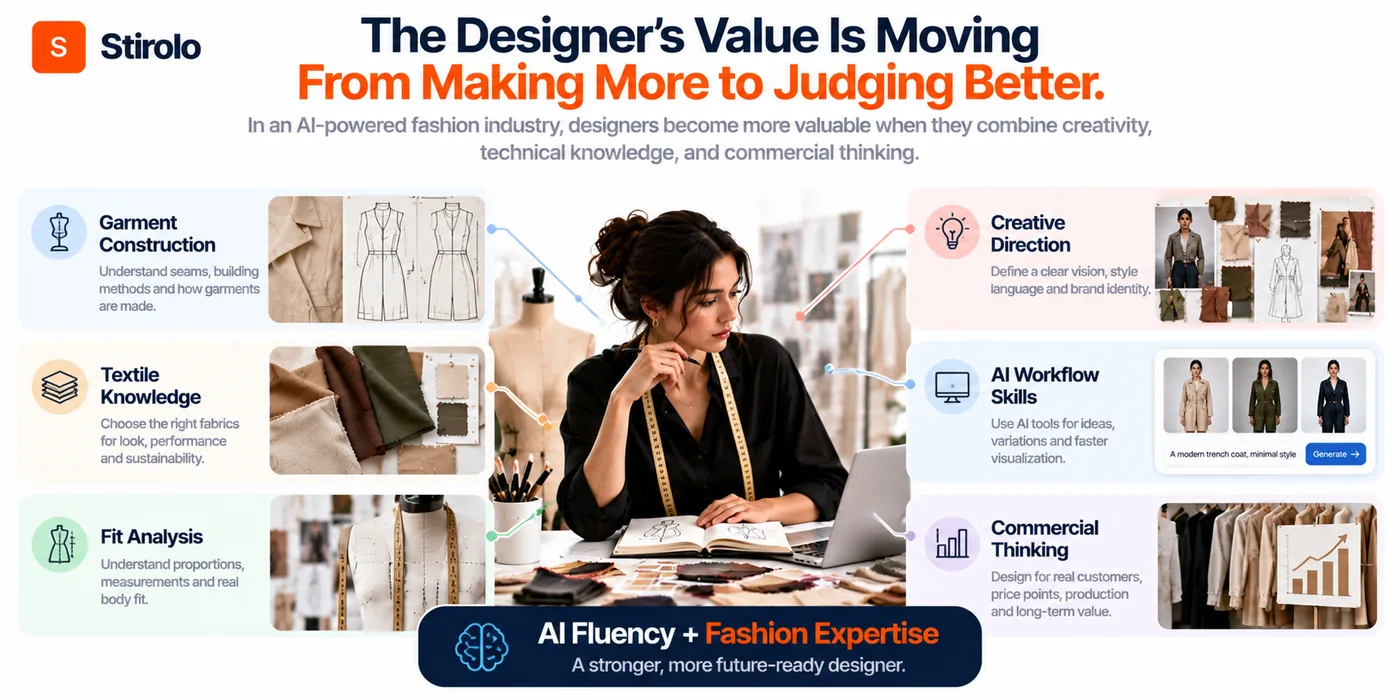
To stay valuable, fashion designers should strengthen the skills that help them direct AI and verify its output. Software familiarity matters, but technical and commercial knowledge creates stronger differentiation.
- Garment construction and pattern literacy: understand how visual ideas become pieces, seams, finishes, and workable products.
- Textile knowledge: know how fibers, structures, weights, stretch, drape, and finishes affect design decisions.
- Fit analysis: learn balance, ease, proportion, movement, grading, and common fit corrections.
- Creative direction: build a clear point of view and edit large numbers of plausible options consistently.
- AI workflow design: learn prompting, reference control, iteration, output evaluation, and responsible use of generated assets.
- Commercial thinking: connect design decisions to target customer, price, margin, assortment, returns, and repeat wear.
Designers should also understand how AI behaves after the product leaves the studio. Stirolo’s wardrobe intelligence features analyze owned garments, wear patterns, fit preferences, and outfit combinations. Customer-side systems can reveal a different design question: not only whether a garment looks appealing, but whether the garment earns a useful place in someone’s wardrobe.
How Should Designers Use AI Without Losing Originality?
To protect originality, designers should use AI as an exploration layer rather than a substitute for a design point of view. Start with original briefs, sketches, material references, customer observations, and brand rules. Use AI to test directions, not to decide what the brand should become.
Designers should also document sources and tool terms for commercial work. Generative systems differ in training approach, licensing, and permitted use. Teams need internal rules for reference images, confidential designs, trademarks, recognizable creators, and generated assets.
Repeated prompting can also create aesthetic convergence. If many designers ask similar models for the same trend language, outputs can begin to resemble one another. Physical experimentation helps break that loop. Draping, fabric manipulation, archive research, street observation, craft techniques, and conversations with customers can introduce information that does not begin inside a prompt box.
A strong designer can use AI and still make work that feels authored. The authorship comes from the brief, selection, development, construction, styling, and final decisions rather than from manually drawing every pixel.
Can AI Understand What Customers Actually Want to Wear?
AI can analyze customer signals, but customer desire is not fully captured by trend data or generated images. Purchase history, returns, searches, saved products, reviews, and wardrobe behavior can reveal useful patterns. Those signals still need interpretation because what attracts attention is not always what people wear repeatedly.
A design can perform well in a campaign and fail in daily life because of fit, care requirements, styling difficulty, climate, or limited versatility. Designers benefit from feedback that reaches beyond the point of sale.
Personal styling systems create another source of context. The Stirolo style guides emphasize fit, color, capsules, seasonal transitions, travel, and occasion dressing. Those everyday constraints are useful reminders for product teams. Clothing competes for wear time inside an existing wardrobe, not only for attention on a product page.
Future design teams may increasingly combine creative intuition with anonymized behavioral evidence. Human designers will still decide which customer problems deserve a design response and which data patterns should not dictate the collection.
What Does the Future of Fashion Design Work Look Like?
Fashion design work will likely become more AI-assisted, faster, and more multidisciplinary. Designers may move between concept generation, digital prototyping, customer insight, merchandising input, and creative review more fluidly than before.
Teams may also become leaner in areas dominated by repetitive visual production. At the same time, companies will need people who can govern AI output, protect brand identity, validate technical feasibility, and maintain quality. The balance will differ by business model. A fast-fashion marketplace, luxury house, independent label, and technical outdoor brand do not need the same human skills.
AI will also create new expectations. If concept generation takes minutes, stakeholders may request more options. If campaign variations become inexpensive, brands may produce more localized content. Faster tools can therefore increase workload unless teams define clear review gates and decision rights.
The safest career strategy is not competing with AI on speed. Designers should become better at framing problems, making difficult choices, understanding physical products, and connecting creative work to people. Those capabilities make AI output more useful and make the designer harder to replace.
Quick Reference: AI Replacement Risk by Fashion Design Task
| Task | AI capability | Human role | Replacement pressure |
|---|---|---|---|
| Mood boards and idea variations | High | Set brief and edit direction | Higher |
| Color and print exploration | High | Judge brand fit and production use | Higher |
| Fashion illustration and concept rendering | High | Control intent and accuracy | Higher |
| Technical specifications | Medium | Verify measurements and construction | Moderate |
| Patternmaking and grading | Medium | Validate geometry, fit, and production | Moderate |
| Fabric selection | Low to medium | Assess hand, drape, performance, sourcing | Lower |
| Fit approval | Medium support | Judge movement, balance, comfort, sizing | Lower |
| Creative direction | Supportive | Own taste, context, brand, final choices | Lower |
| Factory problem solving | Supportive | Resolve physical and commercial constraints | Lower |
FAQs About AI Replacing Fashion Designers
Will AI replace fashion designers in the next few years?
No clear evidence supports complete replacement. AI is already changing individual tasks, and some roles may shrink or change. Fashion companies still need human judgment across creative direction, fit, materials, technical development, production, and brand decisions.
Can AI design clothes by itself?
Yes, AI can generate clothing concepts and visuals from prompts. A generated concept is not automatically a production-ready garment. Human teams still need to validate construction, measurements, fabric, fit, cost, and manufacturing.
Which fashion design jobs are most at risk from AI?
Roles dominated by repetitive visual generation, basic variations, image cleanup, and routine presentation work face more automation pressure. Jobs combining technical expertise, physical product knowledge, customer understanding, and decision-making are harder to automate fully.
Should fashion designers learn AI tools?
Yes. Designers should learn enough AI to direct, evaluate, and integrate generated work. AI fluency becomes more valuable when paired with construction, textile, fit, creative-direction, and commercial skills.
Can AI replace creativity in fashion?
No. AI can generate novel-looking combinations and many alternatives, but fashion creativity also involves intention, cultural context, taste, material experimentation, and deciding what should exist. Human designers remain responsible for those choices.
Conclusion
AI will change fashion design more than it will erase fashion designers. The technology can compress ideation, visualization, variation, and routine production tasks, while human designers remain responsible for making concepts coherent, wearable, manufacturable, relevant, and worth choosing. Designers who combine AI fluency with technical knowledge, material judgment, customer understanding, and a distinct point of view will be positioned for the strongest roles as fashion workflows evolve.